
By the time most patients sit down for a facelift consultation, they’ve already had a quiet conversation with themselves about it. They’ve compared current photos to ones from five years ago, weighed their parents’ aging against their own, and run the math on birthdays more than once.
The question that follows is rarely “should I get a facelift?” It’s almost always “is it too soon?” or “have I waited too long?”
The honest answer has two sides. Many patients choose facelifts later in life, often between 55 and 69, when deeper signs of aging become harder to address with non-surgical options. At the same time, a growing share of patients are arriving in their 40s, opting for earlier, lighter intervention before those changes fully set in.
At Artisan Plastic Surgery in Atlanta, the city’s first woman-led plastic surgery practice, we walk patients through this question every week. This guide covers the signs that point toward surgery, how facial aging shifts decade by decade, and what affects how long your results last.
Key takeaways
A few honest takeaways before you read on. Use these as a starting point for the conversation you’ll eventually have with a surgeon.
- The right age for a facelift is less about a number and more about your anatomy, skin quality, and how your face is aging.
- Most patients consider surgery in their late 40s through 60s, though candidacy starts with overall health and tissue elasticity, not chronology.
- Different facelift techniques are matched to different stages of aging, with deeper-plane procedures suited to more advanced laxity.
- Result longevity varies by patient, technique, skin quality, and lifestyle, and there is no single number that predicts it.
- Lifestyle habits like sun protection, not smoking, and steady weight have a measurable effect on how long results hold.
- A consultation is the only reliable way to evaluate timing, because it accounts for things a number can’t, like skin elasticity and bone structure.
What signs show it’s time to consider a facelift?
The signs that point toward cosmetic surgery to lift and tighten the face are almost always structural, not surface-level. Fine lines and dull skin respond beautifully to good skincare and the right non-surgical treatment. What they cannot fix is descent, the slow drift of cheek fat downward, the softening of a once-defined jawline, or skin that has lost the spring it used to have.
The ASPS describes the classic indications as sagging facial skin, deepening nasolabial folds, jowls along the jawline, and loose neck skin or submental fat. If you’re seeing several of these together, that’s the strongest signal.
A few specific changes to look for in the mirror:
- Jowls or a softening jawline, especially when you tilt your chin down
- Nasolabial folds and marionette lines that no longer fully smooth out with filler
- Sagging or banding in the neck, sometimes with a developing “double chin”
- A tired or older-looking appearance in photos, even when you feel rested
- Loss of fullness in the midface and upper cheek that contributes to a flatter, more drawn look
- A positive “mirror lift” test, where gently lifting the skin in front of your ears gives you the look you actually want
That last one matters more than people realize. According to research using the FACE-Q satisfaction scales, patients reported high satisfaction across the lower face and jawline after surgery, with substantial improvement in how rested and confident they felt. The mirror test gives you a small preview of that change.
If those signs feel familiar, our board-certified plastic surgeons can walk through what’s structural, what’s still treatable with non-surgical care, and where you actually fall on that spectrum. Schedule a consultation to talk through what you’re noticing in plain language.
How does facial aging progress by decade, and what does that mean for timing?
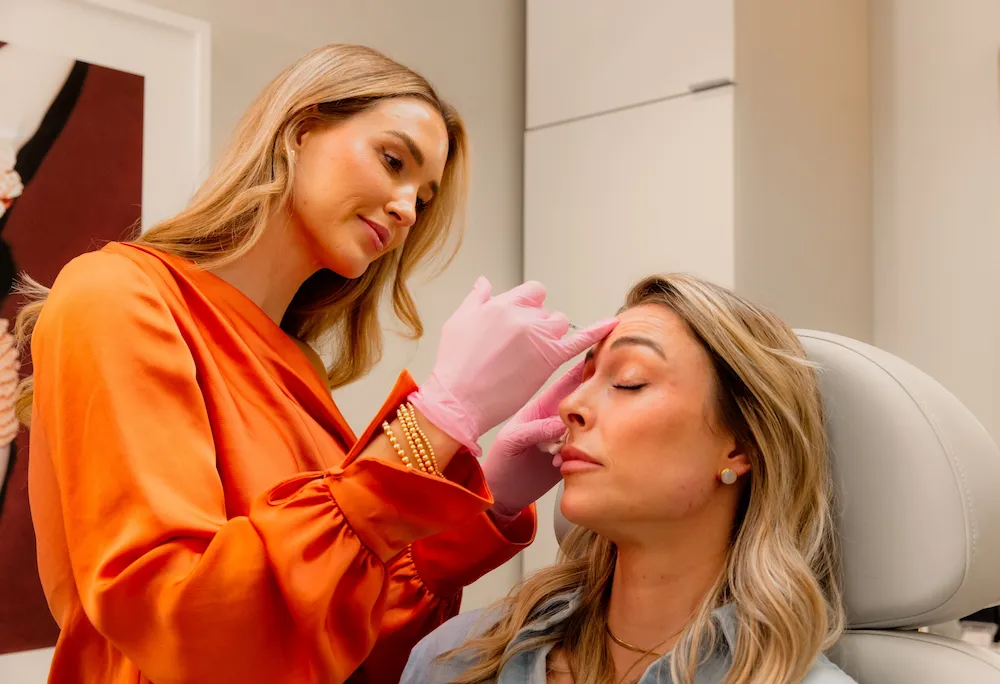
Facial aging is gradual, and it follows a fairly predictable arc, even though every face writes its own version of the story. Skin loses collagen and elastin starting in the late 20s, the deeper fat pads slowly slide downward, and bone subtly remodels around the cheeks and jaw. The decade you’re in tells you what is likely happening underneath, which in turn shapes whether surgery is the right tool yet.
In your 30s
For most people, the 30s are about prevention and maintenance. Fine lines around the eyes and mouth show up, and a small amount of midface volume loss begins, but laxity is usually too mild for surgery to be the right answer. Non-surgical care, including fine line smoothing solutions like BOTOX®, dermal fillers, fat transfer, microneedling, and good medical-grade skincare, addresses these earlier concerns well. According to ASPS, surgery in this decade is uncommon and usually only considered when genetics or significant sun damage have accelerated visible aging.
In your 40s
The 40s are often where the conversation starts to shift. Early jowling, a softening jawline, deeper nasolabial folds, and the first signs of skin laxity tend to appear. Patients in this window are increasingly choosing earlier, less extensive surgical options, sometimes called “mini” or limited-incision facelifts, that target the lower face and jawline before more advanced descent sets in. That makes choosing between a full facelift and more targeted procedures the central question at this stage. Research suggests that patients who have surgery before age 50 tend to maintain their results well, with very high one-year satisfaction.
In your 50s
The 50s are when many patients see the “classic” picture: deeper folds, a more pronounced jowl, midface descent, and noticeable neck laxity. This is where traditional SMAS and deep plane facelifts come into their own, because they reposition the deeper tissues, not just the skin. A 2025 meta-analysis comparing SMAS and deep plane techniques reported high satisfaction across both, with deeper-plane methods showing slightly higher overall satisfaction scores.
In your 60s and beyond
Age in your 60s, 70s, or even 80s is not a barrier on its own. According to ASPS, good results are very achievable in older patients, as long as overall health, healing capacity, and medical history support surgery. The gains in confidence at this stage can be significant.
A few outside forces speed up or slow down this timeline. Genetics account for a meaningful share of how your skin ages, while sun exposure, smoking, weight fluctuations, and chronic stress accelerate visible changes. That’s why some patients feel “ready” for surgery in their early 40s, while others sail comfortably into their late 50s with mostly non-surgical care.
This is where Artisan’s three-pillar approach matters. Plastic surgery, non-surgical face rejuvenation under Artisan Beaute, and wellness services live in one practice. That means we can match the intervention to the actual stage of aging, rather than reaching for surgery before it’s the right answer.
If you’re curious how earlier results compare to more advanced ones, browse our before-and-after gallery for a visual sense of what different techniques achieve at different stages.
Which facelift technique fits your age and aging pattern?
Once aging passes the threshold where non-surgical care starts to lose ground, the next decision becomes which technique fits your face. There isn’t one “right” facelift, and a good surgical plan looks different for someone in their early 40s than for someone in their early 60s. Non-surgical options like fillers and Morpheus8™, a skin tightening treatment, work well for early concerns, while surgical procedures address more advanced structural changes.
Below is a simple comparison of the three most common surgical approaches and how they’re typically chosen.
| Technique | Where it works | Who it tends to suit |
|---|---|---|
| Mini or limited-incision facelift | Lower face and jawline | Early-stage jowling, mild laxity, often patients in their late 30s to mid 40s |
| Traditional SMAS facelift | Cheeks, jawline, nasolabial folds | Moderate sagging, often patients in their 50s |
| Deep plane facelift | Midface, jawline, neck, deeper folds | More advanced descent, often patients in their late 50s and 60s |
Mini or limited-incision facelift
A mini facelift uses smaller incisions and addresses the lower face and jawline, without the more extensive dissection of a traditional procedure. According to ASPS, this approach is well suited to early-stage jowling and mild laxity, with shorter scars and faster recovery than a traditional facelift. It’s a common entry point for patients in their late 30s through mid 40s.
Traditional SMAS facelift
The SMAS facelift addresses the superficial musculoaponeurotic system, the fibromuscular layer beneath the skin. By repositioning that layer, your surgeon can correct moderate jowls, improve nasolabial folds, and refine the jawline. A 2025 meta-analysis reported about 87.8 percent satisfaction across nearly 2,900 SMAS patients.
Deep plane facelift
A deep plane facelift goes one layer deeper, releasing retaining ligaments beneath the SMAS so the entire midface, jawline, and neck can be repositioned together. The same 2025 meta-analysis reported 94.4 percent satisfaction with deep plane techniques, with comparable safety and a particularly natural appearance because the deeper tissues are mobilized as a unit.
Eugenia Yarovinski, a patient who had upper and lower eyelid surgery at our Northside office, described the experience this way:
“I just got Blepharoplasty upper and low eyelids with Dr. Sentosa. She has excellent skills and knowledge. She took her time to answer all my questions and reviewed all options. I am thankful to use her as my plastic surgeon. She made my surgery easy, pleasant and comfortable.”
Skin-only lifts simply pull the skin tighter without addressing deeper layers. They tend to give shorter-lived, less natural-looking results, which is why most modern surgeons no longer offer them in isolation. Many patients also benefit from combining a facelift with a neck lift, eyelid surgery, or fat transfer to restore lost volume in the midface. For a less-invasive option that still works beneath the skin, FaceTite® delivers radiofrequency skin tightening for the face to firm skin and reduce fat in the lower face and neck.
Recovery does vary by technique, with mini procedures generally allowing a faster return to social activities than a full SMAS or deep plane procedure. Your surgeon will walk you through what realistic downtime looks like for the technique that fits your face.
How long does a facelift last, and what affects its longevity?
This is one of the first questions almost every patient asks, and the honest answer is that it varies. There is no single number that predicts how long your facelift will last. The technique you choose, the quality of your skin, your age at surgery, and how you care for your skin afterward all play a role, sometimes more than the procedure itself.
The deeper-plane techniques generally produce longer-lasting results than skin-only or limited procedures, because they reposition the structural layers your face actually rests on. A long-running study of long-term facelift outcomes found that patients who had surgery before age 50 reported high satisfaction many years later. That suggests earlier intervention on more elastic skin tends to hold up better over time.
A few factors that meaningfully extend, or shorten, how long your results last:
- Daily sun protection, including a broad-spectrum SPF every morning
- Not smoking, which preserves skin elasticity and improves healing
- Stable weight, since significant fluctuations stretch and reshape facial tissue
- Consistent medical-grade skincare, including retinoids when tolerated
- Maintenance treatments like non-surgical face rejuvenation, lasers, or microneedling for facial rejuvenation to keep skin quality high
- Genetics and bone structure, which set the baseline you’re working with
Debra Webman, a longtime Northside patient, described her experience with ongoing facial care:
“I have seen Dr Alexander for years for ongoing injections both for Botox and fillers. I just had Sculptra done and it was the most natural looking enhancement for my face. I can already see my face becoming less hallow but very natural looking. I am very pleased with Dr Alexander’s expertise.”
Many patients eventually consider a touch-up or secondary procedure later in life, often pairing a smaller refinement with continued non-surgical care like laser resurfacing for fine lines and wrinkles to keep the skin’s surface in step with the deeper result. At Artisan, we focus on creating customized treatment plans, never one-size-fits-all approaches, so the goal isn’t a single dramatic moment but a thoughtfully sustained look across decades.
What other factors besides age determine the right timing for you?
Age is a starting point, not a verdict. Two patients who are exactly the same age can need very different recommendations, because the underlying tissue, history, and goals differ. Health, lifestyle, and skin quality almost always matter more than chronology.
The ASPS describes the strongest candidates as people who are in good general health, do not smoke, have realistic expectations, and have skin that retains some elasticity. Smoking constricts blood vessels and slows healing, so most surgeons require quitting well in advance. Significant weight fluctuations are usually a reason to wait, since changes in facial volume can shift how a healed result looks.
Skin elasticity is the quiet variable behind a lot of timing decisions. When non-surgical treatments stop giving you the lift you used to get, that’s often the signal that the structural layers, not just the surface, need to be addressed. According to Cleveland Clinic, patients with more elastic skin tend to see longer-lasting facelift results, which is part of why intervening earlier, when the tissue is healthier, can extend the value of surgery over time.
Here’s the part that surprises a lot of patients: a consultation is as much your evaluation of the surgeon as their evaluation of you. You’re allowed to ask hard questions about training, technique preference, recovery support, and how the team handles the unexpected. Think of it the way an artist might discuss a composition: balance, proportion, and how each element supports the whole.
A consultation at Artisan is in-person at one of our Atlanta-area offices, either Northside or Johns Creek, with our team. Your surgeon will examine your skin and underlying structure, listen carefully to what you actually want, and walk you through which approach fits your anatomy and your stage of aging. To help with the cost question, we offer flexible financing through Alphaeon Credit, Cherry, and CareCredit, so the financial side does not have to drive the timing of your decision.
Conclusion
The hotel bathroom mirror moment that started this article is one a lot of patients describe almost word for word. It tends to be quiet, private, and slightly disorienting, the gap between how you feel and what the lighting shows. The good news is that you don’t have to act on that moment alone, and you certainly don’t have to act in a hurry.
A useful next step is browsing real before-and-after photos that resemble your starting point, then having a personal in-person conversation that fills in the parts photos cannot. At Artisan in Atlanta, our philosophy is the art of personalized beauty, and as a board certified Atlanta plastic surgeon practice, we believe every face deserves a plan built around its own story, on its own timeline. When you’re ready to talk through yours, reach out to our team or call (404) 851-1998.
Frequently asked questions
Is 40 too young for a facelift?
Not necessarily. If you’re seeing early jowling or deepening nasolabial folds and non-surgical options are no longer giving you the result you want, a limited-incision or deep plane facelift can be reasonable in your 40s. Genetics, sun history, and weight changes can all shift this earlier.
What is the average age for facelift surgery?
Most patients have a facelift somewhere between their late 40s and early 60s. There has been a steady trend toward earlier surgery in the 40s, and a growing comfort with surgery in the 60s and 70s among healthy patients. Average is a starting point, not a target.
Is there a best age for a deep plane facelift?
The 40s, 50s, and early 60s are all common windows for deep plane procedures, depending on how aging is progressing. Skin elasticity and overall health matter more than the calendar. Earlier intervention on healthier tissue tends to hold up well, but later procedures can still produce excellent natural-looking results.
What if non-surgical treatments are not working anymore?
That is one of the clearest signals to consider surgery. When fillers feel heavy, no longer correct sagging, or start to require more product for less visible effect, the underlying structure has often shifted in ways injectables alone cannot fix. A facelift addresses the descent that non-surgical options were never designed to lift.
Can I get a facelift in my 60s or 70s?
Yes, as long as your overall health and healing capacity support surgery. Many patients in their 60s and 70s have facelifts and are very happy with the results. The conversation focuses on cardiovascular health, medications, and recovery support, more than your age.
Will I need a second facelift in 10 years?
Some patients pursue a touch-up or refinement later, while others maintain their results well with non-surgical care and never have a second procedure. Whether and when this happens depends on technique, lifestyle, and how your face continues to age.
How does Ozempic-related facial weight loss affect facelift timing?
Significant rapid weight loss often leaves behind extra skin and a deflated look, sometimes called “Ozempic face.” Most surgeons recommend waiting until your weight has been stable for several months before scheduling, and healthy weight management with professional support can help you reach that steady baseline first. That way the result reflects your final volume, not a moving target. A consultation can help you decide on the right window.
*Disclaimer: This content is for educational purposes only and does not constitute medical advice. A consultation with a qualified board-certified surgeon is required to determine the best treatment plan for your individual needs and any questions you may have about a medical condition or procedure.