


You’ve looked at photos, thought about size, and perhaps held up different shapes in the mirror to see how they fit. At some point, the result started to feel real. What stays hazy is the middle part: the surgery itself, and what actually happens once the operating room door closes behind you.
That uncertainty is where most of the nerves live. Getting familiar with the actual sequence, step by step, is one of the most grounding things you can do before you commit. It also helps to know how frequently the procedure is performed. According to ISAPS, more than 2 million breast augmentations were performed worldwide in 2023.
At Artisan Plastic Surgery, the city’s first woman-led practice and among the best cosmetic surgeons in the Atlanta area, we’ve found that a well-informed patient is a more confident one. That confidence starts with understanding. This article walks through three things: what happens before surgery, how the procedure itself is performed, and what recovery genuinely looks like.
Key takeaways
Before the step-by-step, here is the short version of what breast augmentation involves from your first conversation to your final result.
- The process starts well before surgery, with an in-person consultation where your surgeon assesses your anatomy and builds a plan around your goals.
- Most breast augmentations take place under general anesthesia as an outpatient procedure, lasting about one to two hours, so you go home the same day.
- Your incision location and implant placement, over or under the chest muscle, are decided with your surgeon based on your anatomy and goals.
- You notice a change in size right away, but the breasts sit high and firm at first. The final shape settles over the following weeks and months.
- Most people are back at a desk job within about a week. Strenuous exercise waits roughly six to eight weeks, guided by your surgeon’s clearance.
What happens before you reach the operating room?
Long before any incision, your journey to breast augmentation begins with a conversation. At Artisan, that first step is an in-person consultation, and it carries more weight than most people expect. Your surgeon evaluates your health, examines and measures your breasts, takes photographs, and talks through your goals.
Here is something worth holding onto: the consultation is not only a chance for your surgeon to evaluate you. It is equally your opportunity to evaluate them, their approach, and how carefully they listen.
From there, the team builds a treatment plan around your anatomy and goals rather than reaching for a one-size-fits-all template. This is also where you work through the details: implant type, size, incision placement, and whether the implant sits over or under the muscle. We encourage you to bring a friend to your implant sizing session, because a second set of eyes makes a personal decision feel a little less like you’re going it alone.
Once your plan is set, a few practical steps help your body show up ready:
- Stop eating after midnight the night before, since you will be under general anesthesia.
- Pause blood-thinning medications and supplements for at least two weeks beforehand, as your surgeon directs.
- Arrange for someone to drive you home, since you cannot drive yourself after anesthesia.
- Line up help for the first night, when reaching and lifting will be off limits.
If you’ve found yourself with more questions than answers, that is completely normal, and an in-person visit is exactly the right place to sort them out. You can schedule a consultation to talk through your options, where a hands-on assessment does what a screen simply cannot. There is no pressure to decide anything that day.
On the day of surgery, your surgeon marks the incision lines while you are standing upright, so the plan accounts for how your breasts naturally sit. You meet your nurse and your anesthesia provider, who review your history and answer any remaining questions. Then comes general anesthesia, and the surgery itself is usually complete within one to two hours.
Where will your surgeon make the incision?
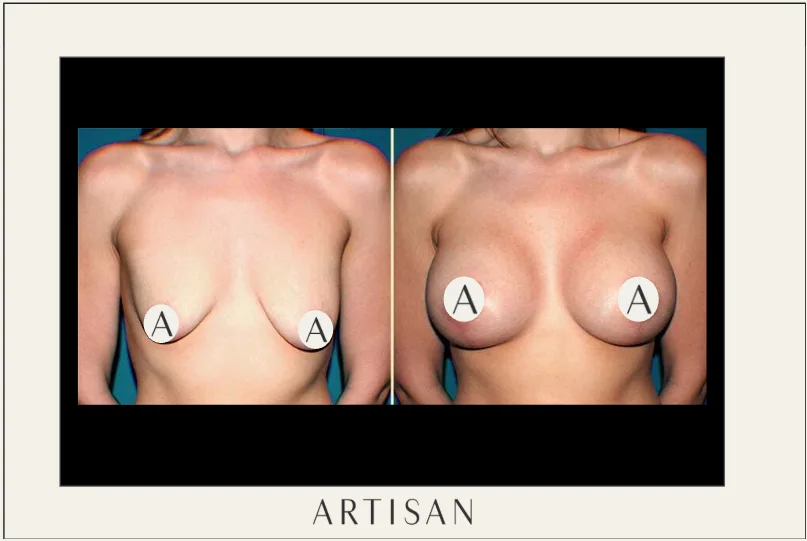
The incision is one of the first significant decisions in breast implant surgery, and there is no single right answer. Surgeons rely on four main approaches, each with its own trade-offs around access, scarring, and the type of implant being used.
| Incision | Where it is placed | Worth knowing |
|---|---|---|
| Inframammary fold | In the natural crease under the breast | The most common approach, with direct access and a scar hidden by a bra line |
| Periareolar | Along the lower edge of the areola | Scar blends into the areola border, but not suited to every anatomy |
| Transaxillary | In a fold of the armpit | No scar on the breast itself, with less direct access to the pocket |
| Transumbilical | Through the belly button | Rarely used today, and limited to saline implants only |
Why so much variation? The choice comes down to your implant type, your anatomy, and how you feel about scar placement. Silicone implants generally require a slightly longer incision, which tends to favor the fold or areola routes.
The inframammary fold has become the most common choice, used in roughly 80% of breast augmentations according to a 2023 analysis. At Artisan, your surgeon most often works through a small, discreet incision in that natural crease, chosen for precise access and scar placement that stays well hidden. The periareolar approach comes into the conversation when it suits your anatomy better. Either way, the decision is made with you and for your body.
How does your surgeon place and position the implants?

This is the heart of the operation, and it feels much more like careful sculpting than anything dramatic. The operating room is considerably calmer than the movies suggest. Once the incision is made, your surgeon creates a precise pocket for the implant by gently separating the breast tissue from the muscle and connective tissue of the chest wall.
That pocket can sit in one of two planes, and the implant placement techniques explained for each shape both the result and the early recovery. Submuscular placement tucks the implant partly under the pectoral muscle, which tends to create a smoother, more natural slope in patients with less breast tissue for coverage. Subglandular placement positions the implant over the muscle and behind the breast tissue, which can mean an easier early recovery and more fullness in the upper breast.
Neither option is universally better. Research suggests that under-the-muscle placement is associated with a lower chance of capsular contracture, the firm scar tissue that can form around an implant. The right choice depends on your tissue, your activity level, and your goals, all of which your surgeon works through with you during the consultation.
Alexandra, who had her breast augmentation at our Northside office, shared her experience:
“Had a breast augmentation done in October. It went perfectly, I am so happy with the results. All of the staff was kind and attentive, and I never felt any pressure during the consultation or payments process. They allowed me to split payments in increments that worked for me as well.”
With the pocket ready, the implant goes in. Many surgeons use a no-touch technique, often with a soft funnel, to slide the implant into place without direct handling. Pre-filled silicone implants are positioned first, while saline implants can be filled once they are inside.
Fat transfer is a different path altogether, using your own fat to create a more modest increase without an implant. Artisan primarily works with silicone implants filled with cohesive gel, and saline implants are also available, depending on your goals. Every implant used is FDA-approved.
Each plan is built around you rather than picked from a menu, which is what tends to produce natural-looking results. With the implants in position, the operation moves on to closing up.
How are the incisions closed and dressed?

Closing the incision is its own careful process, designed so the opening heals flat, clean, and as inconspicuously as possible. It happens in layers, working from the inside out.
Internally, your surgeon uses dissolvable sutures to bring the deeper tissue together. These reduce tension on the skin, which is one of the biggest factors in how a scar ultimately looks. Your body absorbs them on its own, so there is nothing to remove at a later appointment.
The outer skin is closed with fine sutures, surgical tape, or a skin adhesive, depending on the surgeon’s preference and the incision used. The method may vary, but the goal does not. A secure, low-tension closure gives the scar its best chance to fade over time.
A few things work together to keep scarring minimal:
- Choosing a discreet incision site, like the natural breast fold, so any scar stays hidden.
- Closing in careful layers so the skin edges meet without strain
- Supporting the healing scar with silicone sheets or tape once your surgeon clears it
- Protecting the incisions from stretching and heavy strain in the early weeks
Drains are rarely needed for a routine breast augmentation, so most patients do not have them at all. Before you leave the operating room, your breasts are dressed and supported in a surgical bra, which becomes a constant companion through the first stretch of recovery.
What happens in the first hours after surgery?
You wake up in a recovery area, a little groggy, with a nurse keeping an eye on your vital signs until you are steady. For most people, this stretch is brief, since breast augmentation is an outpatient procedure with no overnight hospital stay. Once you are stable, you head home the same day.
That is exactly why having a driver and a helper for the first night matters so much. You will already be in your surgical bra, and you will notice a change in size right away, though that first look is not the finish line. Your breasts sit high and firm to start, and the soft, settled shape you are working toward takes shape gradually over the coming weeks.
Discomfort is real but manageable, and your surgeon sends you home with prescribed medication to stay ahead of it. It is also worth thinking through the financial side in advance, so take some time to explore your financing options through Alphaeon Credit, Cherry, and CareCredit. Spreading the cost into monthly payments lets you focus your energy entirely on healing.
What does breast augmentation recovery look like week by week?

Recovery is gradual, and it follows a fairly predictable pattern. Knowing the shape of it ahead of time tends to make the slower days easier to sit with, and a full week-by-week recovery timeline lays out what to expect at each stage.
| Phase | Timeframe | What is normal | Activity |
|---|---|---|---|
| The first days | Days 1 to 3 | Soreness, swelling, tightness across the chest | Rest, short walks, surgical bra around the clock |
| Early healing | Week 1 | Discomfort eases, first follow-up visit | Many return to desk work, no reaching overhead |
| Settling in | Weeks 2 to 4 | Swelling and bruising fade noticeably | Light activity, nothing over five pounds |
| Dropping and fluffing | Months 1 to 3 | Implants soften and settle into position | Gradual return to exercise after clearance |
| Final shape | Month 6 and beyond | Shape fully settled, scars maturing | All activity, no restrictions |
What the chart cannot capture is how reassuring the check-ins feel. At Artisan, your recovery is supported through follow-up appointments at the one-week, three-week, and six-week marks, with the team reachable in between. Around three weeks in, many patients are guided through a gentle breast massage that helps the implants settle and discourages firm scar tissue from forming.
The drop and fluff phase is the one that tests patience the most. Your implants start high and firm, then gradually relax into a softer, more natural position over several months. Light movement is fine early on, but strenuous exercise and heavy lifting wait until roughly six to eight weeks out, once your surgeon gives the go-ahead.
Most of the recovery is uneventful, which is exactly the goal. A few signs still deserve a prompt phone call to your surgeon: a fever, pain that prescribed medication cannot manage, new swelling on one side, or an incision that looks red or feels warm. None of these are common, and catching them early is part of why those follow-up visits exist.
Taylor, a patient at our Northside location, shared her experience after breast implant surgery:
“My experience with Dr. Ashraf, Dr. Alexander, and Jordan Beasley has been nothing short of life-changing. I’m 45 years old, and I had 4 children via c-section (not the plan) and nursed all 4 for a combined total of 9 1/2 years. I wanted a mommy makeover (breast implants and tummy tuck). I couldn’t be happier with my results.”
By the time that last follow-up wraps up, the surgery you could not quite picture has become something you have fully lived through.
Conclusion
Remember that hazy middle part, the surgery you could not quite picture when you started reading? It is not a blank space anymore. You know the sequence now, from the consultation table to the operating room to the months of gradual settling that follow.
The most useful next step is not a leap. Browsing real patient photos that reflect your own starting point shows you what words simply cannot. When you feel ready, an in-person consultation will fill in the details that are specific to you.
At Artisan Plastic Surgery in Atlanta, we believe every patient deserves to feel heard, unhurried, and genuinely confident throughout the process. When you are ready to begin, book your consultation or call (404) 851-1998.
Frequently asked questions
How long does breast augmentation surgery take?
Most breast augmentations take about one to two hours, depending on the implant type and the specifics of your plan. It is performed under general anesthesia, so the time passes without you being aware of it.
How painful is breast augmentation recovery?
The first three to five days are the most uncomfortable, typically described as soreness and tightness rather than sharp pain. Prescribed medication keeps it manageable, and most people shift to over-the-counter relief within about a week. Tightness across the chest is normal early on and gradually eases as the muscle relaxes around the implant.
Will the scars from breast implant surgery be visible?
Scars fade significantly over time, but they do not disappear completely. Surgeons place incisions in discreet spots, like the natural breast fold, so any scar stays hidden under a bra or swimsuit. Careful, layered closure and attentive scar care afterward make a real difference in the final result.
How often should breast implants be checked?
For silicone implants, imaging to check for a silent rupture is generally recommended a few years after surgery and periodically after that, and if one is ever found, removing silicone implants safely or exchanging them is a straightforward next step. Beyond imaging, staying aware of any changes and keeping up with annual visits to your surgeon are the simplest ways to stay ahead of anything unexpected. Your surgeon will give you a monitoring schedule suited to your implant type.
Will breast augmentation affect breastfeeding?
Many people are able to breastfeed after breast augmentation, though it depends partly on which incision was used. Incisions in the breast fold or armpit are less likely to affect milk ducts than those placed around the areola. If breastfeeding is in your plans, let your surgeon know early.
*Disclaimer: This content is for educational purposes only and does not constitute medical advice. A consultation with a qualified board-certified surgeon is required to determine the best treatment plan for your individual needs and any questions you may have about a medical condition or procedure.