


Here’s something people rarely say out loud before breast augmentation: the surgery itself isn’t usually what keeps them up at night. It’s the recovery, the part that happens at home, in a body that suddenly feels unfamiliar. Is this swelling normal? Why does my chest feel so tight? When will I actually feel like myself again?
The reassuring part is that this path is well-mapped. Breast augmentation ranked as the third most common surgical procedure worldwide in 2024, with over 1.6 million procedures performed, according to the ISAPS. Millions of women might have moved through this exact recovery, so the milestones and the strange-but-normal sensations are predictable enough to plan around.
At Artisan Plastic Surgery in Atlanta, we believe in understanding the plastic surgery process from start to finish, so we walk patients through what recovery actually looks and feels like long before the surgery date. Knowing what’s coming is what turns anxious guessing into a steady plan, shaped around each patient rather than a template, an art of personalized beauty. This article maps recovery week by week, sorts what’s normal from what requires attention, and covers the habits that protect your results.
Key takeaways
Here’s the short version of what breast augmentation recovery tends to look like.
- Recovery moves in phases, not on one clock. The first 72 hours are the most intense. From there, most people return to a desk job within about a week.
- Pain peaks in the first 48 to 72 hours, then eases. Prescription medication usually covers the first few days, and short walks start right away.
- The “drop and fluff” phase is when implants settle from high and firm into a softer position. It becomes noticeable around weeks 3 to 6 and continues for months.
- Light lower-body exercise often opens up around weeks 4 to 6. Strenuous exercise and heavy lifting usually wait until 6 to 8 weeks, and final results sharpen around the six-month mark.
- A smooth recovery comes down to a few habits: wear your support bra as directed, protect your incisions, ease back in gradually, and call your surgeon early with any concern.
What happens in the first 72 hours after breast augmentation surgery?
The first three days are the most intense stretch of the recovery timeline after cosmetic chest surgery, and also the most predictable. Most patients having a breast augmentation go home the same day, a little groggy from anesthesia. The soreness feels less like a sharp pain and more like the deep ache of an intense chest workout.
Swelling builds over the first couple of days and peaks around day three, making the breasts look fuller, higher, and firmer than the final result will be. Some bruising near the incisions is normal too, and it fades over a week or two. First-time patients also notice a distinct tightness across the chest, surprising until you know to expect it.
| Timeframe | What’s normal | What to focus on |
|---|---|---|
| Day of surgery | Grogginess from anesthesia, soreness, chest tightness | Rest, fluids, and someone staying with you overnight |
| Days 1 to 2 | Swelling and bruising build, soreness near its peak | Prescription pain medication, short walks, sleeping propped up |
| Day 3 | Swelling around its peak, breasts sitting high and firm | Surgical bra around the clock, light walking, no lifting |
Plan to have help at home for the first 24 to 72 hours, since driving is off the table while you’re on prescription pain medication. If you care for small children, our team recommends arranging extra hands in advance. Sleep on your back, propped up with pillows or a recliner, this keeps swelling down and protects the incisions.
Two things do quiet but important work in these early days. Your surgical bra, worn around the clock, gives gentle compression that supports the implants while everything calms down, according to The Aesthetic Society. Your first follow-up, usually within the first week at our Northside or Johns Creek office, is when your surgeon checks the incisions and confirms you’re on track.
The clearer this picture feels before your surgery date, the calmer the first days tend to be. You can schedule a consultation with Artisan to talk through what your own first 72 hours would look like.
What is recovery like during the first week after breast augmentation?
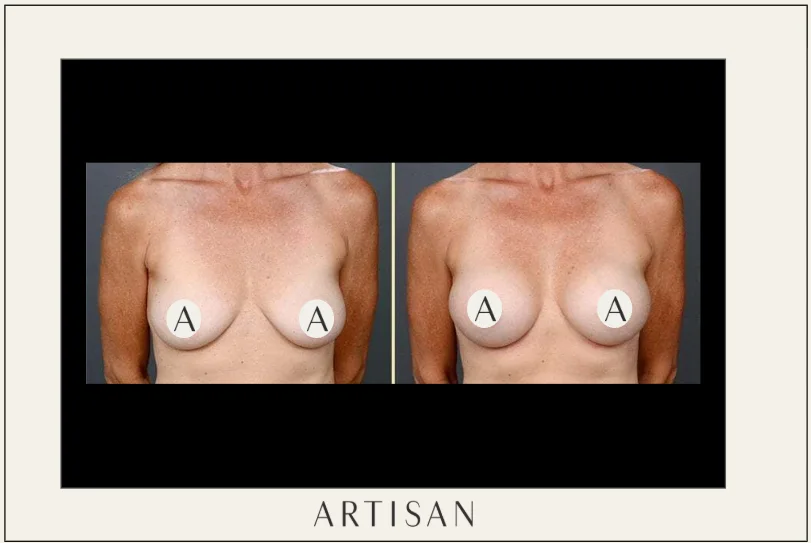
By the end of week one, most people feel meaningfully better than they did on day three. The pain that peaked at 48 to 72 hours starts a steady decline, and many patients move from prescription medication to over-the-counter options within several days.
The chest tightness is often the most talked-about sensation right now. It can feel like a firm band across your chest, especially with implants under the muscle, and it eases as the muscle relaxes. Showering is usually fine after the first day or two, as long as you keep the incisions clean and dry.
Short walks remain your best friend this week, a few minutes every couple of hours keeps circulation moving. Most people sail through week one without trouble. Still, it helps to know the signposts that mean you should call your surgeon rather than wait:
- A fever, especially above the level your surgeon flags for you
- Pain that climbs instead of easing as the days pass
- Redness that spreads outward from an incision
- Unusual drainage, or a bad smell, from an incision
- Sudden, noticeable swelling on just one side
None of that is meant to alarm you. When something feels off, you don’t have to guess because the team at Artisan is reachable, and a quick call beats a worried night. Knowing the difference between normal healing and a real concern is what lets you relax into the rest of your recovery.
When can I return to work and daily activities after breast augmentation?
Most people return to a desk job within about a week, but “back to your life” happens in stages rather than all at once. Patients generally return to normal routines after 5 to 7 days, then ease back into exercise over the following weeks, with strenuous workouts waiting longest.
A practical scheduling tip helps here: book your surgery before a weekend and take the following week off. That way you can ease back early if you feel great, or give yourself more time without scrambling.
Driving comes back once you’re fully off prescription pain medication and can turn the wheel comfortably, usually within one to two weeks. Light household chores are reasonable after the first week, as long as nothing strains the chest. Reaching overhead loosens up over the first few weeks.
| Activity | Typical timing | What to keep in mind |
|---|---|---|
| Desk job | About 5 to 7 days | Many take the full week to be safe |
| Driving | 1 to 2 weeks | Only once off prescription pain medication |
| Light household chores | After the first week | Nothing that strains the chest |
| Reaching overhead | Eases over the first few weeks | Limit it early to stay comfortable |
| Light lower-body exercise | Around weeks 4 to 6 | With your surgeon’s okay |
| Strenuous exercise and heavy lifting | Around 6 to 8 weeks | Cleared individually by your surgeon |
If your job involves heavy lifting or physical labor, plan for at least three weeks off. Arrange extra help at home if your daily routine usually includes lifting. Every timeline shifts a little by person, which is why our board-certified surgeons build a return-to-activity plan around your job and your body, not a generic calendar.
When the early restrictions feel slow, it helps to see where they lead. Artisan’s before-and-after gallery shows real, settled results from real patients.
Kitty., a patient at our Northside office who valued close follow-up as she returned to her routine, shared her experience:
“She has a strong supporting staff who are very knowledgeable and follow up closely. Dr. Alexander was always available to discuss any of my concerns (very few) after my procedure and guide me through the healing process. I would highly recommend her and her practice.”
What breast changes happen during weeks 4-6 of recovery?
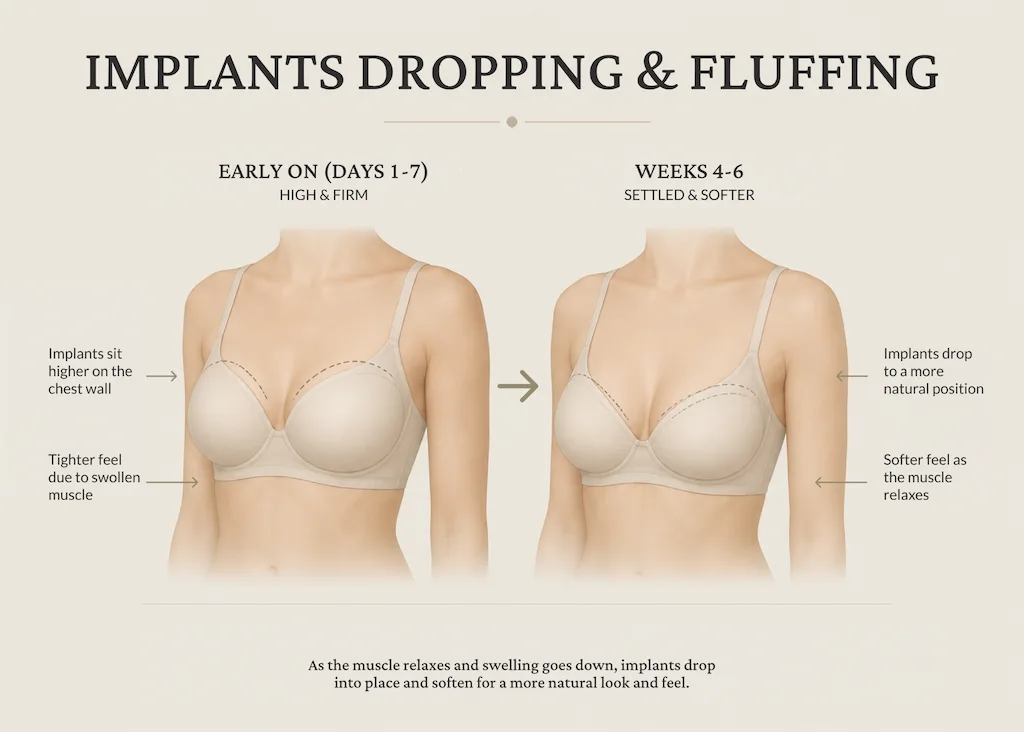
Weeks four through six are when the breasts start to look and feel like themselves. Early on, implants tend to sit high and firm, partly from swelling and partly because the chest muscle is still tight around the new volume. As that muscle relaxes and swelling fades, the implants begin to settle.
This is the “drop and fluff” phase: the implant drops into the natural breast pocket while the lower breast fills out and softens. It becomes noticeable around weeks 3 to 6 and keeps going for months.
So what does that actually feel like? Mostly, it feels like relief. The tightness keeps easing, the breasts grow softer day by day, and the high, rounded look settles into a more natural contour. Here’s what tends to unfold during this window:
- Most of the swelling has resolved, and your breasts feel softer with each passing week.
- The implants begin to drop into a more natural position on the chest.
- Upper fullness eases as the lower breast fills out.
- Light walking and lower-body workouts are often cleared, with your surgeon’s okay.
- Many people move from the surgical bra to a supportive, wire-free sports bra.
It’s worth being patient with this phase. The shape you see at six weeks is a good preview, but it isn’t the finished picture, and chest-straining exercise still needs to wait. Think of it like a composition coming into focus, the proportions settling a little more each week.
What happens in the months after breast augmentation as final results settle in?
By a few months out, the daily work of recovery quietly fades and the focus shifts to the finished result. Full recovery to normal activity averages around six weeks, with strenuous exercise and heavy lifting typically cleared around 6 to 8 weeks once your surgeon signs off.
The implants themselves keep settling. For most patients, they finish dropping and fluffing over 3 to 6 months, though under-the-muscle placement or larger implants can take up to a year, which is one reason choosing the right implant size and shape matters as much for recovery as for the final look. Patients with tight chest muscles, such as athletes, may notice a longer wait.
Scars follow their own slow timeline. They start as fine red lines, then gradually fade and flatten over 6 to 12 months, helped along by silicone sheets, gentle massage, and sun protection.
| Timeframe | What’s happening | What you can do |
|---|---|---|
| Around 6 weeks | Most swelling gone, breasts softening | Resume most normal activity and light workouts |
| Months 2 to 3 | Implants settling, shape refining | Return to strenuous exercise once cleared |
| Months 3 to 6 | Implants mostly settled, scars fading | Full activity, with a focus on scar care |
| 6 to 12 months | Final results settled, scars continuing to lighten | Routine follow-ups, enjoy the result |
Here’s the good news on sensation: changes are common and usually temporary. Some areas of the breast or nipple may feel numb or extra sensitive in the early weeks as nerves settle. For most people, that drifts back toward normal over the following months. Follow-up visits continue through the first year so your surgeon can track healing and how the implants have settled.
Final results generally come into clear focus around six months, sometimes up to a year. Artisan’s board-certified surgeons plan each breast enhancement around your frame and the result you described, so the settled shape reads as a refined version of you, not a standard outcome.
What tips help ensure a smooth breast augmentation recovery?

Most smooth recoveries come down to a handful of steady habits, plus a plan you trusted from the start. None of these is complicated, but together they do real work:
- Wear your surgical support bra exactly as directed, usually around the clock for the first few weeks.
- Eat well and stay hydrated, leaning on protein, fruits, and vegetables to give your body what it needs to repair.
- Skip nicotine and alcohol while you heal, since both slow the body’s repair work.
- Care for your incisions as instructed: keep them dry early, cleanse gently once cleared, and avoid soaking for several weeks.
- Manage swelling with rest, propped-up sleep, and short, gentle walks
- Hold off on heavy lifting and chest-straining exercise until your surgeon clears you.
It also helps to know when a question is worth a phone call. A fever, sudden one-sided swelling or pain, spreading redness, or unusual discharge all warrant reaching out promptly. Early questions are easy to answer, so it’s always better to call than to wonder.
Della., a patient at our Johns Creek location who came through a multi-procedure surgery with an easy recovery, shared her experience:
“66 years old, had a Blepharoplasty, face lift, breast augmentation, and tummy tuck all at one time. Priced fairly, surgeons excellent, after care superb. Not one problem after surgery, results are amazing.”
The smoothest recoveries, though, tend to start before surgery, with a plan built specifically for you. A consultation is as much your chance to evaluate the practice and the people as it is theirs to evaluate you. As Atlanta’s first woman-led plastic surgery practice, Artisan brings a perspective shaped by women who understand how this decision, and this recovery, actually feel.
Your surgeon walks through your anatomy, your goals, and a customized treatment plan, never a cookie-cutter recommendation. Cost shouldn’t be what derails your focus on healing, which is why flexible financing through Alphaeon Credit, Cherry, and CareCredit can spread it into manageable payments. That keeps the attention where it belongs, on your recovery and your result.
All of this is easier to picture in person. When you’re ready, you can schedule a consultation at our Northside or Johns Creek office to talk it through.
Conclusion
Recovery stops being the scary unknown once it has a shape. The swelling, the tightness, the strange in-between weeks all turn out to have names and reasons and a timeline. The first 72 hours ask the most of you, the first weeks reward your patience, and the months that follow hand you the result you planned for.
When you’re picturing what’s ahead, browsing real patient photos that match your starting point is one of the most grounding things you can do. A personal consultation then fills in the parts a photo can’t show, like what your specific recovery would involve.
At Artisan Plastic Surgery in Atlanta, we believe the goal isn’t only a beautiful result. It’s a patient who felt heard at every step, from the first conversation through the last follow-up. When you’re ready to talk it through in person, reach out to our team or call (404) 851-1998.
Frequently Asked Questions
What is normal pain after breast implants?
Most people describe it as soreness and tightness, closer to the day after an intense chest workout than to a sharp or stabbing pain. It tends to peak in the first 48 to 72 hours, then eases steadily from there. Prescription medication usually covers the first few days, and many people move to over-the-counter options within about a week.
When can I return to work after breast augmentation?
If you have a desk job, you can usually return about 5 to 7 days after surgery, once you are off prescription pain medication and feel alert. Jobs that involve heavy lifting or physical labor typically need at least three weeks off.
Can I shower after breast augmentation surgery?
In most cases, showering is allowed within the first day or two, as long as you keep your incisions dry or follow your surgeon’s specific instructions. Baths, pools, and hot tubs are off-limits longer, often for several weeks, because soaking incisions raises the risk of infection. Your surgeon will give you the exact timeline for your situation.
When can I drive after breast augmentation?
Driving is usually safe again one to two weeks after surgery, but two conditions matter more than the calendar. You need to be completely off prescription pain medication, and you need to move your arms and turn the wheel comfortably without pain. If either still feels off, give it a few more days.
How long do I wear the surgical bra after breast augmentation?
Most patients wear a surgical support or compression bra around the clock for the first few weeks, removing it only to shower once that is allowed. From there, many transition to a supportive, wire-free sports bra, with underwire saved for later in recovery. The goal is steady support while the implants settle into place.
*Disclaimer: This content is for educational purposes only and does not constitute medical advice. A consultation with a qualified board-certified surgeon is required to determine the best treatment plan for your individual needs and any questions you may have about a medical condition or procedure.