


A facelift does not lift the whole face. The operation most people picture works on the lower face and neck, generally the tissue sitting below the tops of the ears. The forehead and brow fall outside that reach entirely, and the upper cheek needs a different set of vectors to lift it.
That distinction shows up in the data. ISAPS counted 524,386 brow lifts worldwide in 2024, recorded as a category entirely separate from facelift surgery. Surgeons track the upper face separately because, anatomically, it is a separate problem with separate solutions.
At Artisan Plastic Surgery in Atlanta, our co-founders read a face the way an artist reads a composition, looking for which zone is actually driving the change you see. This article maps what each zone treats, how to tell which one fits your concerns, and what recovery looks like when you target one area instead of all three.
Key takeaways
- A standard facelift works on the lower face and neck, mainly the lower cheek, jowls, and jawline. The forehead and brow need a separate upper-face procedure, and the upper cheek needs a midface lift.
- Your symptoms name the zone. Brow droop and heavy lids point up, cheek descent and tear-trough shadowing point to the middle, and jowls point down.
- Combining two zones makes sense when the aging is genuinely spread across both. Treating one and leaving its neighbor untouched can create a visible step at the transition.
- Recovery scales with how much tissue the surgeon moves. Smaller, zone-specific lifts generally return you to normal activity sooner than a broad operation does.
- Surgical lifting and non-surgical treatments address different severity levels, not the same problem two ways. Lifting repositions descended tissue, while fillers and fat transfer restore lost volume.
What does an upper face lift, midface lift, or lower facelift actually treat?

Each term names a region, not a brand of surgery. Surgeons divide the face into three horizontal bands, and the procedure follows whichever band shows the dominant change. Getting the zone right is most of the work.
| Zone | What it covers | What a lift there addresses |
|---|---|---|
| Upper face | Forehead, brow, temples | Brow descent, forehead creases, hooding from a low brow |
| Midface | Lower eyelids, upper cheeks, nose to upper lip | Malar cheek descent, tear-trough shadowing, some nasolabial fullness |
| Lower face | Lower cheek, lips, chin, jaws, neck | Jowls, marionette folds, loss of jawline definition |
Upper face: forehead, brow, and the eyelid connection
An upper face lift is usually a brow or forehead lift. It elevates a descended brow, softens forehead and frown-line creases depending on technique, and can improve hooding at the outer upper eyelid when a low brow is causing it.
Here is the part that surprises people. A brow lift does not replace eyelid surgery when the real issue is redundant skin on the lid itself. Brow position and eyelid skin are two different findings, and they are sometimes both present.
Midface: cheeks and the under-eye transition
The midface runs from the lower eyelid across the upper cheeks and nose to just above the upper lip. A midface lift elevates malar cheek tissue that has drifted downward, and it can soften the lid-to-cheek junction and tear-trough hollowing.
What it will not do is fix jowls or neck laxity. That is a different band of the face, and no amount of cheek elevation reaches it.
Lower face: jowls, jawline, and the neck below
A lower facelift treats lax lower-cheek tissue, jowls, marionette folds, and a jawline that has lost its edge. When laxity continues past the jaw, a neck lift can address loose skin, fullness under the chin, and the vertical bands that show when you tense.
This is why traditional facelift surgery concentrates below the tops of the ears. Its incisions and tissue vectors are built to move lower-cheek and neck descent. The forehead sits outside that reach, and the malar cheek higher up needs the separate upward vector a midface lift provides.
Treating only the zone that has changed also protects the zones that have not. Elevating a brow that never dropped, or filling a cheek that never hollowed, is how a face starts to look worked on rather than rested.
Which targeted lift or combination is right for your concerns?
The right lift follows the location and the cause of the change, not your age. Two people the same age can need entirely different operations, and one of them may need nothing surgical at all.
Read your own face by what bothers you most:
- Lateral brow droop, heaviness across the upper lids, or an expression that reads tired or stern when you feel neither points toward the upper face.
- Flattening or hollowing across the cheekbones, a deepening shadow under the eye, or a nasolabial fold that has become a groove points toward the midface.
- Jowls forming at the jawline, marionette lines, loose lower-face skin, or vertical neck bands point toward the lower face.
A mini cheek lift sits inside that middle category, though the label deserves a caution. “Mini cheek lift” and “mini mid face lift” are marketing shorthand rather than standardized operations, so the only meaningful definition is the one your surgeon writes into your plan.
Sometimes two zones genuinely belong together. Brow descent alongside eyelid aging, or lower-face laxity alongside neck laxity, tend to travel as a pair. Treating one while ignoring its neighbor can leave an obvious step where they meet.
A 2025 study of 380 patients who had a limited-incision lift found ancillary procedures in 98.9 percent of cases, with a brow lift added in 72.6 percent.
That figure describes a selected surgical population, not a rule that everyone needs combination surgery. Plenty of patients do beautifully with one zone treated well.
Skin laxity, volume loss, muscle change, and bone structure each pull the recommendation in a different direction. Lifting repositions descended tissue and removes excess skin, while volume loss responds to dermal fillers or fat transfer, which cannot substitute for genuine skin laxity. Non-surgical options work on earlier, milder changes, and surgery reaches the structural descent that those treatments cannot.
At Artisan, every plan is curated around one face rather than pulled off a menu. That is why the same three zones produce a different recommendation for nearly every patient. Minimally invasive surgical options such as FaceTite® can also tighten skin and reduce fat beneath the surface when a full lift is more than the anatomy calls for.
If you cannot tell which zone is doing the most work, that is precisely what a hands-on assessment settles. Schedule a consultation and let a board-certified surgeon map it with you rather than guessing from photographs.
How are upper, midface, and lower lifts actually performed?
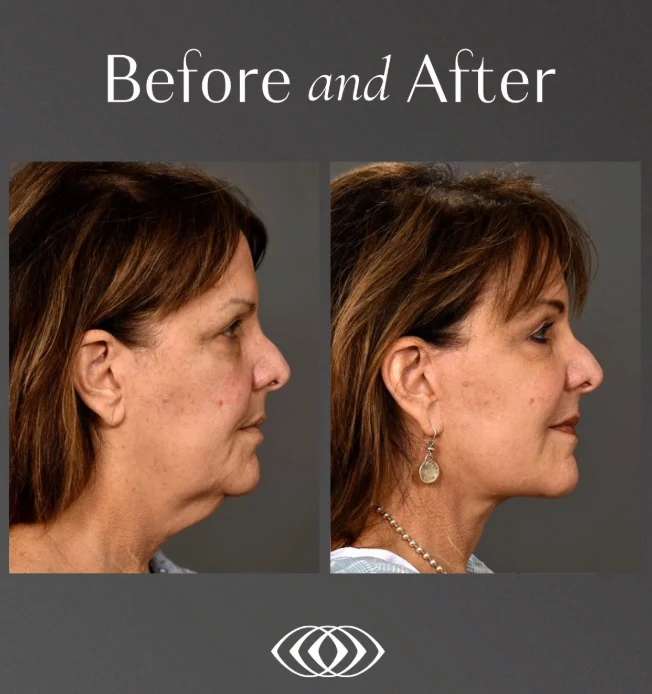
Technique differs by zone, but the underlying logic is shared. The surgeon releases tissue that has settled in the wrong position and moves it back where it belongs. Support then comes from underneath, so the skin is never carrying the load.
Incision placement by zone
An endoscopic brow lift uses three to five roughly one-inch incisions hidden behind the hairline, with a camera guiding the release and elevation of forehead tissue. No forehead skin is removed. A coronal approach instead uses a single incision running ear to ear within hair-bearing scalp.
Midface access varies more. Surgeons reach the cheek through temporal endoscopic access, a lower-eyelid incision, or a deep-plane dissection. From there they reposition the malar fat pad upward and inward, securing it with sutures or fixation devices.
A lower facelift typically runs from the temple hairline, around the ear, and into the posterior scalp, sometimes joined by a small incision under the chin. Concealment depends on placing those lines inside the hairline and the natural folds of the ear.
Surgical depth and the SMAS layer
This is the difference that matters most for how a result ages. A skin-only lift pulls and redrapes skin without repositioning anything beneath it, which is where the over-tightened look comes from. SMAS techniques tighten the deeper fascial layer, and a deep-plane lift dissects beneath that layer to move skin and fascia together as one composite.
A 2025 meta-analysis of 21 studies covering 2,896 patients reported satisfaction of 94.4 percent for deep-plane techniques versus 87.8 percent for SMAS. Reported overall complications ran 17.2 percent and 10.3 percent respectively. Neither number makes one approach universally correct. Deeper is not automatically better, and the right depth is the one your anatomy actually needs.
Susan, a patient at our Northside office who had more than one facial zone addressed in a single operation, shared their experience:
“I had a facelift with upper and lower eye surgery with Dr. Diane Alexander at Artisan, and I’m so pleased with my experience so far. Dr. Alexander and her entire medical staff have been wonderful, attentive, caring, and professional every step of the way. The level of care and communication has been excellent.”
Anesthesia and time in the operating room
Targeted lifts are usually outpatient. A brow lift may be done under local anesthesia, intravenous sedation, or general anesthesia, while facelift surgery most often uses general anesthesia or sedation. In one published series, a limited-incision lift averaged two hours and five minutes compared with roughly four hours for a conventional lift.
What are recovery and results like after a targeted lift?
Recovery scales with how much tissue was moved. A single-zone lift asks less of your body than a broad operation, and the timeline reflects that. Swelling, bruising, tightness, and a brow that initially sits a touch high or uneven are all normal parts of settling, not signs that something went wrong.
| Phase | Timeframe | What to expect |
|---|---|---|
| Early healing | Days 1 to 7 | Swelling and bruising peak; rest with short walks |
| Back in public | Days 7 to 14 | Most patients return to work and social plans |
| Building strength | Weeks 3 to 6 | Strenuous exercise resumes with surgeon clearance |
| Settling | Months 3 to 4 | Contours refine and scars continue to soften |
The zone changes the pace. ISAPS reports that most brow lift patients are back to work or social activity in seven to 10 days, and midface lift patients in five to 10 days. A full facelift more often needs seven to 14 days before light work, with swelling easing across two to three weeks.
So what does that mean for planning? Build in a buffer. Book the operation with a quiet fortnight after it, not a wedding.
Results are long-lasting rather than permanent, because aging does not pause after surgery. Sun protection and consistent skincare protect a result more than any single follow-up treatment does. Resurfacing or injectables can refresh skin quality later without repeating the lift.
Seeing that arc on real faces helps more than reading about it. Artisan‘s before-and-after gallery includes a facelift category worth spending time in before your consultation. Look for patients whose starting point resembles yours rather than the most dramatic result on the page.
How do you choose a surgeon and prepare for a confident decision?
Start with credentials you can verify and a facility that is accredited, then work outward to judgment and fit. A consultation is not an audition. It is equally your chance to evaluate the surgeon, their space, and how they think about your face.
Questions worth bringing with you:
- How many of this specific procedure do you perform, and why this approach for my anatomy?
- Where exactly will the incisions sit, and how will the scars be concealed?
- Can I see long-term photographs of patients with a brow position, hairline, and skin type like mine?
- What happens if the result is asymmetric, and how is a revision handled?
Be candid about your health history, because it genuinely changes the plan. Blood pressure, clotting disorders, prior facial surgery, and every medication and supplement you take belong on the table. ASPS reports that active smokers carry a 12-fold higher risk of wound-healing problems and recommends stopping at least four weeks before surgery.
The honest risk picture is reassuring without being empty. A 2024 review of 27 studies covering 6,086 facelift patients found more than 85 percent satisfaction. Temporary facial-nerve effects occurred in 0.85 percent and skin healing problems in 0.41 percent.
Swelling, bruising, numbness, and mild asymmetry are normal parts of settling rather than signs of trouble. An experienced surgeon plans around every one of them.
Cost belongs in the same conversation, openly. What shapes it is the specific operation, how much dissection it requires, anesthesia, facility time, and whether zones are combined into one session. Your consultation includes a personalized breakdown, and flexible financing through Alphaeon Credit, Cherry, and CareCredit lets you choose a payment plan that fits.
As Atlanta’s first woman-led plastic surgery practice, Artisan brings a perspective to that conversation that patients tell us they feel immediately. Consultations happen in person at our Northside and Johns Creek offices, because reading brow position, skin quality, and tissue mobility takes hands, not a screen.
Carol, a patient at our Northside office who had a lower face and neck lift, described how the team handled the process around her surgery:
“Dr Alexander performed a lower face and neck lift on me 5 weeks ago. The results are amazing already. The staff and Dr Alexander were so helpful prep and post op and answered all my questions and concerns promptly.”
Researching this carefully before committing is exactly the right instinct. When you are ready to put a plan to it, book your consultation or call (404) 851-1998 to reach our team.
Conclusion
The word facelift promised more than it delivers, and that turns out to be good news. A facelift addresses the lower face and neck, the brow and forehead answer to their own procedure, and the upper cheek answers to a third. Once you know that, you can stop shopping for an operation and start identifying a zone.
Browsing real patient photographs that start where you start is one of the most clarifying next steps. A personal consultation then fills in what photographs cannot show about your own tissue.
Every face arrives as its own composition, and at Artisan in Atlanta we would rather refine yours than redraw it. Reach our team when the timing feels right, or call (404) 851-1998.
Frequently asked questions
What areas does an upper face lift treat?
An upper face lift treats the region above the eyes, mainly the forehead and brow. It can raise a descended brow, soften forehead and frown-line creases, and reduce hooding at the outer upper eyelid caused by brow position. It does not treat the cheeks, jawline, or neck.
Is an upper face lift the same as a brow lift?
In practice, yes. Most surgeons use “upper face lift” and “brow lift” or “forehead lift” to describe the same operation, though terminology varies between practices. What matters more than the label is which structures the surgeon plans to release and elevate.
What does a midface lift improve?
A midface lift improves the central third of the face. It lifts descended cheek tissue, restores contour over the cheekbone, improves the transition from lower eyelid to cheek, and can soften nasolabial fold prominence. It is not a treatment for jowls or the neck.
Can a midface lift help under-eye hollows?
It can. Repositioning and re-supporting cheek and lower-eyelid tissue restores the lid-to-cheek contour, which is often what makes a hollow read as a shadow. How much improvement you see depends on your anatomy and the technique chosen.
What is a mini cheek lift, and how does it differ from a full midface lift?
“Mini cheek lift” is not a standardized operation name. It generally describes a limited procedure using shorter incisions that addresses fewer areas, while a full midface lift centers specifically on the cheeks and lower-eyelid region with broader tissue repositioning. Ask your surgeon to define exactly what a mini version includes for you.
What does a lower facelift include?
A lower facelift treats changes below the corners of the mouth. That means jowls, loose lower-face skin, marionette folds, and a softened jawline. Treatment under the chin and along the neck is often included when laxity extends that far.
Does a lower facelift also lift the neck?
Often, but not automatically. A neck lift is added when loose neck skin, fullness under the chin, or visible vertical bands need treatment alongside the jawline. The two are usually performed in the same session when both are indicated.
Can I combine upper, mid, and lower face procedures in one surgery?
Yes, selected combinations can be done in a single operation, including a brow lift with a facelift and eyelid surgery. Whether that is appropriate depends on your goals, your anatomy, your general health, and the safety of the total operative plan. Our surgeons weigh operating time and recovery burden alongside the aesthetic benefit.
How long does recovery take after a targeted facelift?
Recovery depends on how much tissue was moved. Brow lift patients commonly return to work in seven to 10 days and midface lift patients in five to 10 days. Full facelift patients generally need seven to 14 days, and strenuous exercise waits at least three weeks.
How long do results from a midface lift last?
Results are long-lasting but not permanent, because aging continues after surgery. Visible settling finishes at roughly three to four months, and the repositioned tissue holds its improved position well beyond that. Skin quality, sun exposure, and weight stability all influence how the result carries forward.
What are the risks of a midface lift?
Swelling, bruising, temporary numbness, and mild asymmetry are expected parts of healing rather than complications, and they settle as tissues recover. The less common risks are scarring, bleeding under the skin, infection, and, because the procedure works near the lower eyelid, dry eye or a change in lower-lid position. The vast majority of patients move through recovery without any of those, and your surgeon plans specifically to minimize them.
What determines the cost of a midface or lower facelift?
Cost is shaped by the exact operation, how much dissection it requires, anesthesia, facility time, and whether zones are combined into one session. Combining procedures can reduce duplicated anesthesia and facility charges, but the final figure is always individual. Your consultation includes a personalized breakdown, and our practice offers flexible financing through three providers.
*Disclaimer: This content is for educational purposes only and does not constitute medical advice. A consultation with a qualified board-certified surgeon is required to determine the best treatment plan for your individual needs and any questions you may have about a medical condition or procedure.