




Facelift techniques get their names from all sorts of places. An incision shape, a trademark, a promise about speed. What actually separates one from another is depth, meaning how far beneath the skin your surgeon goes to reposition tissue.
That single distinction explains almost everything else: how long the operation takes, how much of the neck can be corrected, and how the result holds up as you keep aging.
The published evidence is worth reading before you shop by name. A 2025 review of 21 studies and 2,896 patients found satisfaction of 94.4 percent for deep-plane surgery and 87.8 percent for SMAS techniques, according to the meta-analysis. Two approaches sold as worlds apart landed within seven points of each other.
At Artisan Plastic Surgery in Atlanta, our surgeons pick the technique after examining your face, never before. This article explains what each named technique actually does, how the main approaches compare in results and recovery, and which pattern of aging each one tends to suit.
Key takeaways
- Facelift techniques are best understood by the tissue layer they reach. Skin-only lifts work at the surface, SMAS and deep-plane techniques reposition the supporting layer underneath, and that difference drives nearly every other trade-off.
- “Quick Lift” and “mini facelift” are marketing labels with no standardized definition, while the S-lift, SMAS and deep-plane approaches have published, defined methods. The operative details, not the brand, decide how much laxity can be corrected.
- Deeper is not automatically better. Research puts satisfaction slightly higher for deep-plane surgery than for SMAS, but complications run higher too. The choice has to be individual.
- Short-scar lifts have a real ceiling at the neck. Loose neck skin, fullness under the chin, or visible vertical bands usually call for a neck lift alongside the facial work.
- No facelift is permanent. Surgery resets where your tissues sit, but it does not pause aging, so results are best described as long-lasting rather than fixed.
How do the main facelift techniques work at each tissue layer?
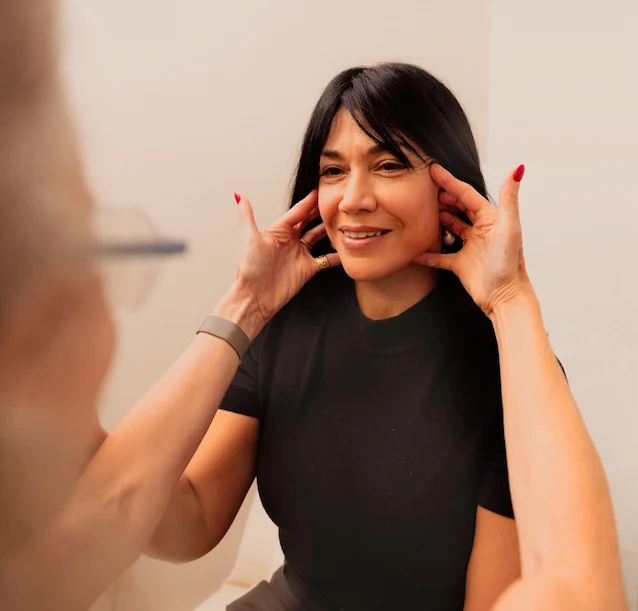
A facelift is not one operation. It is a family of procedures, all technically called rhytidectomy, that differ by the deepest layer the surgeon repositions.
Surgeons generally describe the face in five layers, stacked from the surface down:
- Skin
- Subcutaneous fat, the soft padding just beneath it
- The SMAS and facial-muscle layer, a sheet of fibrous tissue that acts as the face’s internal support
- Deep fat and loose areolar tissue
- Periosteum and deep fascia, sitting against the bone
Aging touches several of these at once. Skin loses elasticity, fat descends or thins, and the SMAS, retaining ligaments and platysma all stretch. A technique is essentially a decision about which of those layers to address.
Skin-only lift
The oldest approach lifts the skin, trims the excess, and closes it. Nothing underneath is tightened, so the skin itself carries all the lifting tension.
That is the problem with it. ASPS teaching material links the skin tension of that approach to a higher risk of wound-healing trouble, abnormal scarring, a flattened look, and earlier return of aging changes. It has largely been replaced by techniques that support the deeper layer.
Quick Lift and other short-scar suspension lifts
“Quick Lift” is a proprietary label, not a defined operation. The same goes for “mini facelift,” a term with no standardized definition that can describe several quite different procedures. What decides how much laxity can be corrected is the operative detail, not the name on the brochure.
The closest technique with a real evidence base is MACS, short for minimal access cranial suspension.
MACS uses a short incision in front of the ear and up into the temple, then lifts a limited amount of skin. Vertical purse-string sutures suspend the midface, jowls and outer platysma upward. Published reviews report high satisfaction and few serious problems, along with one consistent limitation: it does relatively little for the neck.
The S-lift
An S-lift takes its name from the shape of the incision, which curves in front of and around the ear. It is a short-flap procedure, meaning the surgeon lifts a small skin flap and then folds or stitches the SMAS beneath it, often catching the platysma as well.
Published descriptions position it for early jowls and mild anterior neck laxity, and the technique specifically is not intended for platysmal bands that are visible at rest. Extended versions push further into the midface and moderate neck laxity.
SMAS techniques and the traditional facelift
A SMAS facelift is defined by deliberate work on the superficial musculoaponeurotic system. Your surgeon might fold it (plication), overlap it (imbrication), remove a strip of it (SMASectomy), or lift it as its own flap.
The point of all four is the same. The deep layer carries the lift, so the skin can be laid back down with far less tension. That is what keeps a result from looking pulled.
A traditional or complete facelift usually pairs one of these SMAS maneuvers with broad skin elevation and platysma tightening across the lower face and neck.
Deep-plane surgery
Deep-plane surgery goes one layer further. Rather than separating skin from SMAS, the surgeon releases the retaining ligaments that tether the face to deeper structures. Skin and SMAS then move together as a single composite unit.
Because the cheek and malar tissues travel as one piece, this approach can reposition the midface more directly than techniques working above it.
How do Quick Lift, S-lift, SMAS and deep-plane methods compare?
Here is the honest comparison, which is less dramatic than the marketing around it. Every approach lifts. What changes is how much, how far into the neck, and at what cost in recovery and risk.
| Approach | Best suited to | What it involves |
|---|---|---|
| Quick Lift and short-scar lifts | Early jowling, mild to moderate lower-face laxity | Short pre-ear incision, limited undermining, suspension sutures |
| S-lift | Early jowls, mild anterior neck laxity | S-shaped incision, SMAS folded or stitched, often with platysma |
| SMAS facelift | Jowling plus neck aging across the lower face | SMAS folded, trimmed or lifted so the deep layer holds the tension |
| Deep-plane facelift | Descended cheeks, deep folds, heavier tissue | Retaining ligaments released, skin and SMAS moved as one unit |
| Traditional or complete facelift | Moderate to advanced lower-face and neck aging | Broad skin elevation with SMAS and platysma tightening |
Short-scar approaches use the least dissection and generally allow the quickest return to normal life. Their ceiling shows up at the neck. Reviews of short-scar suspension lifts consistently note limited neck rejuvenation, and the S-lift literature is explicit that resting platysmal bands need something more.
Deep-plane and extended SMAS techniques are where surgeons turn when laxity is substantial or the midface has genuinely descended. A review of 47 studies covering 10,766 patients found that the one direct comparison available reported better midface rejuvenation with the deeper technique.
But deeper does not automatically mean better or more natural. Alongside that satisfaction edge, the same 2025 meta-analysis found overall complications of 17.2 percent for deep plane against 10.3 percent for SMAS. Both were described as producing robust, long-lasting outcomes.
So what does that mean for you? The comparison is a trade, not a ranking. A slightly higher satisfaction ceiling comes with a slightly higher chance of something needing attention during healing, and a good surgeon weighs both against your anatomy.
It is also worth knowing how thin the direct evidence is. Most studies compare a technique against itself over time rather than head to head. At Artisan, our team treats these approaches as tools within one operation rather than competing products.
Which facelift technique fits your facial aging and goals?

The technique follows the anatomy. A surgeon assessing your face is reading skin quality, where the fat sits, how far the deep layer has descended, and how much of the change is happening below the jawline.
Short-scar options tend to suit early aging: good residual elasticity, early jowls, mild to moderate lower-face laxity, and a neck that has not changed much yet. A traditional facelift becomes the better answer once jowling is pronounced, there is real excess skin along the jaw, or the neck has visible banding. Deep-plane surgery earns its place when nasolabial folds are deep, the cheek tissues have descended, or heavier soft tissue needs genuine mobilization.
Age by itself is a poor guide. These factors do more of the work:
- Skin elasticity and thickness, which determine how tissue will redrape
- The weight and distribution of your soft tissue
- Underlying bone structure and facial proportions
- Whether laxity sits mainly in the lower face, the neck, or both
- General health, including anything that affects healing
- Any previous facial surgery, which changes the tissue planes a surgeon will find
Prior surgery deserves particular attention. Scarring and altered planes mean the second operation is rarely a repeat of the first, and it often calls for a deeper or more conservative approach rather than the same limited lift again.
Susan, a patient at our Northside office whose plan combined a facelift with eyelid surgery, described the experience:
“I had a facelift with upper and lower eye surgery with Dr. Diane Alexander at Artisan, and I’m so pleased with my experience so far. Dr. Alexander and her entire medical staff have been wonderful — attentive, caring, and professional every step of the way. The level of care and communication has been excellent. I still have two more follow-up appointments and will post photos once I’m fully healed, but I’m already thrilled with my results and the overall experience. Highly recommend Dr. Alexander and the Artisan team!”
Very few faces age in one place only, which is why a plan often combines procedures. A neck lift joins the plan for platysmal bands, loose neck skin or fullness under the chin. Fat transfer restores volume where the face has hollowed, eyelid surgery addresses eyelid-specific changes, and resurfacing handles the things a lift genuinely cannot touch: fine lines, texture and sun damage.
Non-surgical options work on a different problem, not the same problem more gently. Treatments like Morpheus8™ suit earlier, milder changes in skin quality. Minimally invasive surgical options such as FaceTite® tighten and reduce fat beneath the skin through openings a couple of millimeters wide, and surgery is what reaches true structural descent.
Researching this carefully before deciding is exactly the right instinct. Every plan our practice builds starts from your face rather than a menu, which is what “The Art of Personalized Beauty” means in a consultation room.
What does recovery look like, and what results can you expect?
Recovery is more predictable than most people expect, and the milestones are similar across techniques. What changes is the scale.
Incisions generally run through the temple and hairline, then around the front and back of the ear, with a small opening under the chin when the neck is being treated. Those borders are chosen because they hide well. Short-scar techniques often skip the extension behind the ear, which is part of why they correct less neck.
Most facelifts are outpatient procedures performed under general anesthesia or intravenous sedation with local anesthetic. A compression dressing usually stays on for the first day or two.
| Phase | Timeframe | What to expect |
|---|---|---|
| Right after surgery | First 24 to 48 hours | Compression dressing, rest, no driving or showering |
| Early recovery | Days 3 to 7 | Swelling peaks then eases, stitches usually out around a week |
| Back to light activity | Weeks 1 to 3 | Short-scar lifts often 5 to 7 days, fuller lifts closer to 2 to 3 weeks |
| Settling | Weeks 3 to 6 | Bruising resolves, no strenuous exercise for at least three weeks |
| Final contour | Months 3 to 6 | Swelling gone, scars softening, the result reads as itself |
Swelling, bruising, tightness, itching and patches of numbness are all expected, and they are signs of healing rather than signs of trouble. Bruising and swelling improve substantially over two to three weeks, though your face may not feel entirely like your own for two to three months while sensation returns. ISAPS puts return to light work or activity at seven to 14 days for most patients.
Here is the part worth sitting with. The final result is usually judged at three to six months, not at three weeks. The early weeks look tighter and puffier than the outcome you will actually keep.
Which brings us to the word “permanent.” A facelift produces long-lasting improvement in laxity, jowls, jawline and neck contour, and it genuinely resets where your tissues sit. What it does not do is stop time.
Skin continues to change, volume shifts, and gravity keeps working, so results are honestly described as durable rather than fixed. Short-scar lifts tend to give more moderate correction at the neck and folds, and that shows over time.
Recovery is also where a practice earns its keep. Artisan has spent years refining a detailed post-op protocol so each facelift patient heals faster and more comfortably. That protocol is built around your technique, not a generic handout. To judge which recovery profile fits your calendar, request an appointment and talk it through in person.
What are the real risks and trade-offs of facelift surgery?
The vast majority of facelift patients heal without any significant problem, and modern technique has made that more true than it used to be. Being clear-eyed about the exceptions is still part of choosing well.
Potential issues include bleeding beneath the skin, infection, temporary numbness, prolonged swelling, slow wound healing, hair thinning near the incisions, unfavorable scars, asymmetry, and temporary weakness in a facial nerve. A collection of blood under the skin flap, called a hematoma, is the most common early one, and it is usually managed by draining it promptly.
The numbers are reassuring in context. A 2024 systematic review of 27 SMAS studies covering 6,086 patients found more than 85 percent satisfaction, with temporary facial-nerve weakness in 0.85 percent and skin healing problems in 0.41 percent. Only one permanent nerve injury appeared across the entire group.
A smaller incision does not remove risk, only some of the dissection. A 2023 systematic review of 20 studies and 4,451 limited-incision patients reported 3.2 percent overall complications, including 2 percent hematoma. That is a good record, and it is not zero, which is the honest way to read any short-scar marketing that implies otherwise.
Several factors raise the odds of a bleeding or healing problem, and most of them are manageable in advance:
- Blood pressure that is not well controlled
- Smoking, which meaningfully reduces blood flow to the healing skin
- Anti-inflammatory medications and supplements that thin the blood
- Diabetes or poor blood sugar control
- Combining several procedures in one session
Surgeons ask smokers to stop at least four weeks before surgery for exactly this reason, and that single change does more for your result than almost anything else you can control.
The over-tightened look and the tethered earlobe sometimes called a pixie ear come from the same root cause: too much tension on the skin. The safeguard is technical rather than cosmetic. Flaps are kept adequately thick, the deeper SMAS or platysma carries the lifting force, and the skin is closed with as little pull as possible.
Call your surgical team promptly for rapidly increasing swelling on one side, bleeding, severe or escalating pain, fever, spreading redness, drainage, wound separation, skin that looks dusky, or new facial weakness. Knowing the list is not a reason to worry. It is what lets you relax through the ordinary parts of healing, because you know what actually warrants a phone call.
Choosing well is the largest single variable in all of this. Verify board certification with the American Board of Plastic Surgery, confirm the facility is accredited, and ask how often your surgeon performs the specific technique being recommended. Then look at before-and-after photos of patients whose starting point resembles yours, not the most dramatic case in the gallery.
Kitty, a patient at our Northside office who valued being advised rather than sold to, put it this way:
“Dr Alexander is an amazing surgeon and person. She’s takes her time to figure out what your goals are and advises accordingly. She has a strong supporting staff who are very knowledgeable and follow up closely. Dr. Alexander was always available to discuss any of my concerns (very few) after my procedure and guide me through the healing process. I would highly recommend her and her practice.”
What should you expect at a facelift consultation?
A consultation is not an audition. It is equally your chance to evaluate the surgeon, the space and the philosophy behind the recommendation, and you should leave knowing whether the fit feels right.
The visit itself is hands-on. Your surgeon examines your skin quality, tissue weight and the specific distribution of your laxity, then talks through your goals before naming a technique. As Atlanta’s first woman-led plastic surgery practice, Artisan brings a particular sensitivity to that conversation.
Consultations happen in person at our Northside and Johns Creek offices, with facelift surgery performed at Northside. There is a reason we do not shortcut this. A screen cannot show a surgeon how your tissue moves under their hands, and that assessment is what separates a curated plan from a guess.
Expect a real conversation about cost as well. Pricing depends on the technique, the complexity of your anatomy, anesthesia, facility time and any procedures performed alongside the lift. Your consultation includes a personalized breakdown rather than a number pulled from a chart, and we offer flexible financing through Alphaeon Credit, Cherry, and CareCredit.
Nothing has to be decided in the room. When you are ready to start, schedule a consultation or call (404) 851-1998, and bring every question you have written down.
Conclusion
The names will keep multiplying, because names are easy to trademark and surgical judgment is not. What holds still underneath all of them is the question this article started with: which layer of your face needs to move, and how far. Once you can hear a facelift recommendation in those terms, the marketing stops being confusing and starts being easy to see through.
The most useful next step is visual. Look through real patient results and find faces that started where yours is now, because that comparison tells you more than any technique chart can. A personal evaluation fills in what photographs leave out.
Every face is its own composition, and the work is refinement rather than redrawing. That is the standard Artisan holds itself to in Atlanta, where patients deserve to feel heard, respected and genuinely confident in what they choose. Call (404) 851-1998 when you would like to talk it through.
Frequently asked questions
What is a Quick Lift facelift?
Quick Lift is a proprietary name for a limited, short-scar facelift rather than a standardized operation. These procedures generally use shorter incisions and suspend or tighten the SMAS to improve the cheeks and jawline. Because the label is trademarked rather than defined, the incision, tissue plane, anesthesia and neck effect vary between surgeons.
Is a Quick Lift the same as a mini facelift?
Not necessarily. A Quick Lift can function as a type of mini facelift, but “mini facelift” itself has no standardized definition and can describe a limited SMAS plication or even a limited deep-plane procedure. Ask what the operation actually involves rather than what it is called.
What is an S-lift and what does it treat?
An S-lift is a short-scar, limited-dissection facelift named for its S-shaped incision around the ear. It typically uses SMAS plication or suspension sutures to treat sagging jowls and the front of the neck. Modified versions extend into the midface and moderate neck laxity.
How does an S-lift differ from a SMAS facelift?
An S-lift is one specific limited-incision technique that happens to use SMAS work. A SMAS facelift is the broader category, defined by deliberate treatment of the SMAS layer through plication, SMASectomy or flap elevation. Every S-lift involves SMAS, but not every SMAS facelift is an S-lift.
What does SMAS mean in facelift surgery?
SMAS stands for superficial musculoaponeurotic system, a fibrous, muscular sheet sitting beneath the skin and its fat layer. It functions as the internal scaffolding of the face. Surgeons can fold, trim, or lift this layer to reposition the tissue underneath and take the strain off the skin.
Is a SMAS facelift better than a deep-plane facelift?
Neither is categorically better. A 2025 meta-analysis of 21 studies found satisfaction of 94.4 percent for deep plane against 87.8 percent for SMAS, but overall complications of 17.2 percent against 10.3 percent. Both produce robust, long-lasting results, and the right choice depends on your anatomy rather than on a ranking.
Who is a good candidate for a mini or short-scar facelift?
Good candidates usually have early facial aging, mild to moderate lower-face laxity, early jowling, adequate general health and realistic expectations. Skin that still has useful elasticity matters more than a particular age. More advanced descent, heavy jowls or substantial neck laxity generally point toward a more extensive operation.
Can a short-scar facelift correct a loose neck?
Only partially. A short-scar lift can improve early or limited neck laxity, but it cannot reliably correct excess neck skin, platysmal bands or deeper fullness under the chin. Those changes usually call for a neck lift performed alongside the facial work.
Is a facelift permanent?
No, and any surgeon promising otherwise is overselling. A facelift creates long-lasting improvement by repositioning tissue that has descended, but it does not stop aging. Skin quality, volume and gravity keep changing, so results are best described as durable rather than permanent.
Does a facelift remove wrinkles and sun damage?
Not on its own. A facelift addresses sagging, jowls, laxity and contour along the face and neck, which is structural work. Fine lines, uneven tone, texture and sun damage are skin-quality problems that respond to resurfacing treatments such as lasers, peels or microneedling, often planned alongside surgery.
*Disclaimer: This content is for educational purposes only and does not constitute medical advice. A consultation with a qualified board-certified surgeon is required to determine the best treatment plan for your individual needs and any questions you may have about a medical condition or procedure.

