



Are you considering a tummy tuck but feel unsure about what recovery will be like? You’re not alone. The period between surgery and your final results can feel mysterious. But knowing what to expect after your procedure is key to feeling prepared and confident every step of the way.
If you’ve already set your appointment and chosen your surgeon, you’re ready for the next step: preparing for the recovery that follows. The real transformation unfolds during the days and weeks after surgery, as your body heals and adjusts to the changes.
Recovery has predictable patterns. In 2024 alone, 172,826 tummy tuck procedures were performed in the United States, according to ISAPS. Thus, understanding these stages in advance turns anxious planning into a workable plan.
At Artisan Plastic Surgery in Atlanta, the city’s first woman-led plastic surgery practice, we know finding a tummy tuck surgeon is just the first step, and we guide patients through recovery before surgery even begins. This article breaks down the week-by-week timeline, the aftercare habits that protect your results, and signs your healing is on track.
Key takeaways
Here is the short version of what to expect during tummy tuck recovery.
- Recovery unfolds in phases, not on a single timeline. The first two weeks focus on rest, drain care, and drain removal once output drops. Weeks 2 to 4 bring easier movement and a return to light desk work.
- Pain peaks in the first few days and then eases quickly. Scheduled medication, short indoor walks, and keeping drains empty are the early anchors.
- Most patients can drive about two weeks after surgery, once they are off prescription pain medication. Light walking and cycling can resume around weeks 4 to 6. Full exercise is typically cleared around weeks 6-8.
- At three months, most of your contour is visible, and swelling has largely subsided. Scars continue to mature for 12 to 18 months, softening from pink to pale.
- Compression garments, short daily walks, protein-forward meals, and keeping follow-up visits on the calendar are the aftercare habits that do the most work.
How do I prepare my home and body for tummy tuck recovery before surgery?

Preparation is key to a smooth and comfortable recovery after a tummy tuck. By taking steps before your surgery, both in your home and in your daily routine, you can minimize stress, reduce risks, and give yourself the best possible start on your healing journey.
Your surgeon’s office will give you a written pre-op packet, but a handful of universal setup decisions are worth making early. Two weeks before surgery, most practices ask you to stop blood thinners, NSAIDs, and certain supplements to lower the odds of bleeding and seromas. If you smoke or vape, this is also the window to stop, because nicotine reduces blood flow to healing skin.
If you are still deciding whether the timing works for your family, schedule a consultation to walk through the specifics with our team.
A few practical items to have ready at home:
- A designated recovery spot with pillows for a flexed, semi-reclined position
- A driver for the trip home and a responsible adult to stay for the first 24 hours
- Protein-forward, bland foods for days one through five, plus stool softeners and electrolyte drinks
- Loose, easy-on clothing and slip-on shoes you can manage without bending
- Filled prescriptions, a thermometer, gauze, and a small notebook for tracking drains
If you have young children at home, arrange help with everything that involves lifting or quick, reactive movements for the first two weeks. Nothing about recovery mixes well with a toddler who wants to be up.
Jin K. shared how glad she was with the results of her procedure:
“I had a tummy tuck and diastasis recti repair surgery with Dr. Val. The surgery was very satisfactory and professional. I’m beyond happy with my results and I’m very glad I went with Dr. Val for this procedure. On top of the stellar surgery, the entire staff has been very sweet and delightful to interact with. I recommend this clinic for anyone looking for not just a professional service, but one that makes you feel pampered and cared for.”
What happens during the first week of tummy tuck recovery?
The first week is the most intense and also the shortest part of recovery. Your body is adapting simultaneously to a newly reconstructed abdominal wall, drains, and a compression garment. Additionally, each day during this week visibly feels slightly better than the last.
Before diving into the week-by-week details, it helps to see the whole arc in one place. Here is the full shape of a typical tummy tuck recovery timeline.
| Phase | Timeframe | What’s normal | Activity level |
|---|---|---|---|
| Immediate | Days 1 to 3 | Peak swelling, tightness, and drains in place | Rest, short indoor walks every few hours |
| Early | Days 4 to 7 | Swelling plateaus, first post-op visit | Showers once cleared, light indoor activity |
| Late first week | Week 1 to 2 | Drains are usually removed as output drops | Gentle indoor activity, taper pain meds |
| Mid | Weeks 2 to 4 | Bruising resolves, posture softens | Desk work restart, often driving by week 2 |
| Progress | Weeks 5 to 8 | Upright posture returns, scars pink | Light cardio cleared, errands resume |
| Settling | Month 3 | Most swelling gone, contours visible | Full exercise typically cleared |
| Maturing | Months 6 to 12+ | Scars soften, and a pale, final contour settles | Routine life, focus on weight stability |
Pain, swelling, and the feeling of “tight”
During the first 72 hours, the abdomen is firm, stretched, and sore, with swelling typically peaking between days 3 and 5. Most patients report a deep, aching sensation from muscle repair rather than sharp pain. Standing fully upright may be difficult initially, but this is normal.
Medications, drains, and what to track
Expect a planned combination of prescription pain medication and acetaminophen during the first few days. At Artisan, a four-day Exparel nerve block significantly reduces post-op pain, and patients frequently mention it as the most helpful part of their recovery. Drains are usually emptied two to three times daily, with output recorded in a small notebook for your post-op team.
Walking, showering, and the first post-op visit
Begin short indoor walks the day after surgery, every few hours, even if just to the kitchen and back. Walking helps reduce swelling and lowers the risk of blood clots in the legs. Your first post-op appointment usually occurs within 3 to 7 days. During this visit, your surgeon will examine your incisions, review drain output, and generally authorize showering with drains still in place. The compression garment must remain on continuously during this period.
What progress do I make in weeks 2 to 4 of tummy tuck recovery?
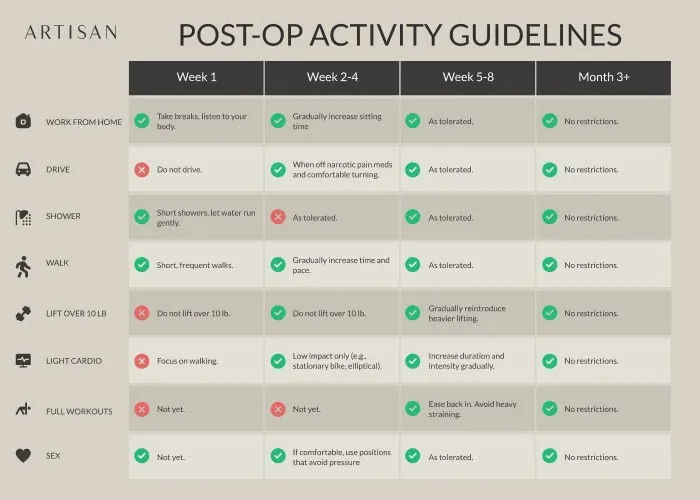
Weeks 2 to 4 mark when the recovery timeline visibly loosens its grip. Swelling remains, but it is softer and fluctuates throughout the day. Most patients describe this window as the moment when the surgery stops being the loudest thing in the room.
By week 2, bruising transitions from purple to yellow-green and largely resolves by weeks 4-5. Prescription pain medication is usually tapered to over-the-counter options. Walks can be extended to 20-30 minutes daily by the two-week mark. Drains are generally removed around week 1 or 2, when output is consistently low, marking a significant milestone that many patients recall as a key turning point.
Desk work often resumes between weeks 2 and 3 for jobs that do not require lifting. Driving becomes realistic around 2 weeks after surgery, once you are fully off prescription pain medication. No lifting more than five to ten pounds, no vacuuming, and no gym work yet.
Mya W., a patient whose recovery care she described as attentive from the first check-in, shared her experience:
“I recently had a breast reduction and tummy tuck performed by Dr. Sybile Val, and I couldn’t be happier with my results. Dr. Val is not only an exceptionally skilled surgeon but also a genuinely kind and compassionate person. She went above and beyond to make sure I was comfortable and informed every step of the way.”
During this phase, nutrition plays a quiet but important role. Protein aids in tissue repair, water helps reduce lingering swelling, and fiber, along with stool softeners, manages a slower digestion caused by pain medication.
What can I do during weeks 5-8 as my tummy tuck recovery progresses?
Weeks 5 to 8 mark the transition from day-to-day management to a sense of regular life again. Posture returns, energy comes back, and the abdomen stops announcing itself with every motion. Most patients describe this phase as “almost back to normal, except for the gym.”
Standing fully upright becomes comfortable for most patients around weeks 5-6. Light cardio, such as walking and stationary cycling, is typically cleared at 4-6 weeks, and full exercise, including core work, at 6-8 weeks, after your surgeon reviews your incisions in person. Scar care usually begins around week four, once all incisions have fully closed.
Our team at Artisan sees this phase as the moment patients start imagining their normal life again. You might resume errands, pick up non-physical routines, and even plan a short trip once cleared. End-of-day swelling and a slight abdominal tightness are still completely normal for months. Your aftercare arc at this stage is calibrated to your anatomy, your job, and the way your body has actually healed so far.
What happens in month 3 and beyond for full tummy tuck results?
By 3 months, the shape you aimed for begins to show, and seeing real tummy tuck before-and-after results can help you picture your own. Progress becomes more gradual and quieter, relying mostly on time and consistent habits. No major changes are expected anymore, which indicates that everything is going well.
During this period, most patients experience a 60% to 90% reduction in swelling, with preliminary contours becoming visible. This milestone is often referred to as “Golden Milestone” or “Final Reveal Phase.” By 6-12 months, swelling is effectively resolved in most patients. According to the American Society of Plastic Surgeons, the compression garment plays a quiet role during these months, helping minimize swelling and supporting the abdomen as it heals.
Scars mature on a longer schedule than the rest of the recovery. They remain pink and slightly firm for several months, then gradually fade and soften over 12 to 18 months. Keeping the scar out of direct sun, using silicone products, and letting time do its work are the most effective interventions.
In the long run, the best outcomes occur when your weight remains steady, and you stay active regularly. Pregnancy, significant weight fluctuations, or major abdominal injuries can stretch the muscle wall that was repaired. Beyond the physical, many patients describe an emotional shift somewhere in the three-to-six-month window.
What aftercare tips speed up my tummy tuck recovery?
Post-tummy tuck care focuses on simple, consistent habits that support natural healing rather than major interventions. Key steps include staying hydrated, wearing compression garments, walking gradually, and monitoring for issues. At Artisan, we tailor each aftercare plan during your consultation, taking into account your unique anatomy, occupation, and home environment to determine the appropriate recovery pace.
A handful of habits do most of the work:
- Wear your compression garment as directed, usually around the clock for 4-6 weeks. They tend to reduce seroma formation and subcutaneous edema after waistline reshaping procedures like a tummy tuck.
- Walk every day, starting with short indoor laps and gradually building to 20 to 30 minutes. Movement discourages blood clots and keeps swelling from pooling.
- Eat protein at every meal, drink plenty of water, and limit sodium to keep swelling down.
- Sleep in a semi-reclined position with pillows under the knees for the first two to three weeks.
- Attend every follow-up visit, even the ones that feel redundant.
Nicotine and alcohol should be avoided during early recovery. Surgeons typically advise patients to refrain from smoking for at least 14 days after surgery and to avoid alcohol while on prescription pain medications, as both can slow the healing process.
Taylea B., a patient who returned years after her original tummy tuck for an additional procedure, described the long-term experience:
“Dr. Diane Alexander is my go to physician for plastic surgery. She performed my tummy tuck in 2020 and a breast lift with implant exchange in 2025. I trust her implicitly, and my outcomes have always exceeded my expectations.”
Knowing when to call is important. Contact our office at (404) 851-1998 if you experience a fever of 100.4 degrees Fahrenheit or higher, red or hot incisions, excessive bleeding, or calf pain or swelling in one leg, which could indicate a blood clot.
However, if you are still in the planning phase, a personal consultation at our Northside or Johns Creek location is the best next step. Our team will guide you through the entire process, from pre-op preparations to scar care in six months.
Conclusion
The uncertainty at the start of your tummy tuck journey is not just about the procedure itself. It’s also about the unknowns of recovery. What will you feel like in two weeks? Will you recognize yourself at the end of it? Real healing happens gradually, with each milestone: your first pain-free stretch, standing a little straighter, or finally sleeping comfortably on your side. If you’re seeking reassurance, looking at real patient stories and seeing others who started just like you can be empowering.
When you’re ready, a personal consultation will answer your unique questions and help tailor a recovery plan just for you. Our team is here to support you from your first step through every stage of healing. At Artisan Plastic Surgery, we believe your recovery should be as individual as your transformation.
Take control of your tummy tuck journey. Reach out today to schedule your consultation or call us at (404) 851-1998. Let’s design a recovery plan that fits your life and helps you achieve the results you deserve.
Frequently asked questions
How long does a full tummy tuck recovery take?
Most patients feel largely recovered within 3 to 4 weeks and are cleared for full activity around 6 to 8 weeks after surgery. Swelling continues to resolve through month three, and scars mature over 12 to 18 months.
When can I return to work after a tummy tuck?
Desk-based work usually resumes between weeks 2 and 3, once you are off prescription pain medication. Jobs that involve lifting or prolonged standing typically require 4 to 6 weeks. Your surgeon will tailor the exact timeline to your job.
How long does swelling last after a tummy tuck?
Swelling peaks during the first three to five days and then eases steadily. By three months, most patients see a major reduction, with full resolution typically occurring between six and twelve months. Compression garments and hydration help move the process along.
When can I exercise after a tummy tuck?
Light walking starts the day after surgery. Light cardio, such as stationary cycling, is typically cleared around weeks 4 to 6, and full exercise, including core work, around weeks 6 to 8, once your surgeon has reviewed your incisions.
When can I drive after tummy tuck surgery?
Most patients can drive approximately 2 weeks after surgery, once they have discontinued pain medication and can react without discomfort. Patients are asked to stay within a reasonable traveling distance of the office during the first week post-op.
Will I need drains after a tummy tuck?
In most tummy tuck cases, small drainage tubes are placed during surgery to collect fluid and aid healing. They usually come out within the first two weeks, once output drops consistently. Drain-free techniques exist for specific patients.
How long should I wear a compression garment after a tummy tuck?
Most patients wear a compression garment around the clock for the first 4 to 6 weeks, then during the day only for a few more weeks. It supports the abdomen and helps reduce swelling.
Does tummy tuck recovery hurt a lot?
The first few days are the most intense, with deep soreness from the muscle repair rather than sharp pain. Scheduled pain medication and a four-day Exparel nerve block smooth out the sharpest window. Most patients describe the pain as manageable by the end of the first week.
When can I shower after a tummy tuck?
Most patients are cleared to shower at their first post-op visit, usually three to seven days after surgery, even with drains still in place. Baths and pools are allowed only after all incisions have fully closed, typically around four weeks.
Can I get pregnant after a tummy tuck?
You can, though most surgeons recommend completing your family before surgery because pregnancy can stretch the repaired muscle wall. If pregnancy happens after a tummy tuck, the surgery does not typically affect your ability to carry or deliver.
When do tummy tuck results fully show?
The preliminary contour is visible for three months. Final results settle between six and twelve months as the swelling subsides and scars mature. Keeping a stable weight is the biggest factor in preserving the result you see at the one-year mark.
*Disclaimer: This content is for educational purposes only and does not constitute medical advice. A consultation with a qualified board-certified surgeon is required to determine the best treatment plan for your individual needs and any questions you may have about a medical condition or procedure.