




You’ve spent hours looking after before-and-after photos, and they make it look so simple. Point A, point B, done. But that’s not really what you’re trying to figure out, is it? You already know what the result can look like. What you’re trying to imagine is everything in between: the recovery, the reality, and whether the person on the other side of it actually feels the way she looks.
The data fills in what the photos can’t show. In a peer-reviewed analysis of nearly 1,600 patient reviews, abdominoplasty ranked as the highest rated cosmetic surgical procedure, with 93 percent of patients saying it was worth it.
At Artisan Plastic Surgery in Atlanta, the city’s first woman-led plastic surgery practice, we help patients learn how to choose cosmetic surgeons for your procedure and walk them through what a tummy tuck realistically changes. This article covers the types of tummy tucks, what post-pregnancy and post-weight-loss transformations look like, and where to find videos that match your starting point.
Key takeaways
Here is the short version of what real tummy tuck before and after results look like.
- There isn’t one tummy tuck. Full, mini, extended, and combined procedures each produce different contours, so compare photos within the same type you’re considering.
- Post-pregnancy results typically show a flatter abdomen, a defined waistline, and repaired core muscles. Final shape continues to improve for 6 to 12 months as swelling resolves.
- For post-weight-loss patients, a tummy tuck removes the apron of loose skin and can be combined with a body lift when skin excess extends around the back.
- Expect natural improvement, not perfection. A tummy tuck won’t replace core exercise or guarantee a perfectly flat stomach.
- Video journeys, surgeon animations, and in-person galleries each answer a different question. Real patient updates at 6 and 12 months tell a fuller story than any single still photo.
What types of tummy tucks are there, and how do before and after results compare?
Different tummy tucks solve different problems, so the before and after photos look different from one category to the next. The American Society of Plastic Surgeons outlines three main types, standard, mini, and extended, with the right choice depending on the amount and location of excess skin and fat. If you’re still getting oriented, a complete guide to what a tummy tuck involves covers how each type works. Other approaches, like combining a tummy tuck with liposuction or adapting the procedure for male patients, expand the options further.
Before you compare galleries, it helps to know which type of tummy tuck produced each result.
Full tummy tuck
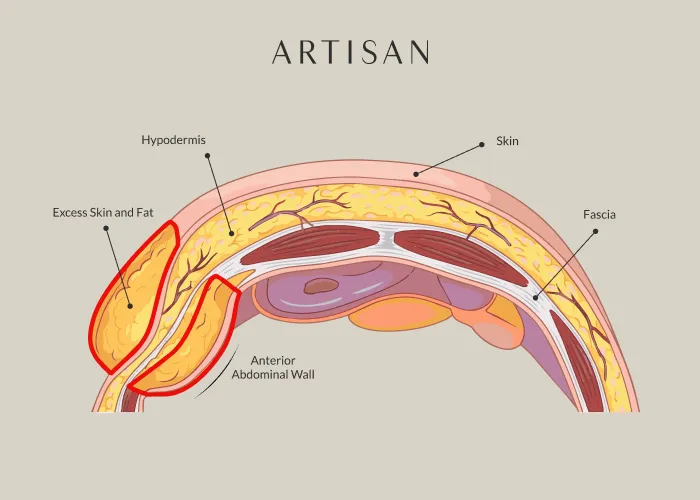
A full (standard) tummy tuck addresses the entire abdomen, from above the belly button down to the pubic area. Your surgeon removes excess skin and fat, tightens separated muscles, and repositions the navel. Before and after photos usually show a dramatic change in waistline definition and a flattened lower belly.
Recovery runs longer than a mini. Close to the final shape emerges over about three to six months as swelling resolves, with refinement continuing through the first year. This is the category most often photographed in post-pregnancy or post-weight-loss galleries.
Mini tummy tuck
A mini tummy tuck treats only the lower abdomen, below the navel. The scar is shorter, the belly button isn’t repositioned, and recovery moves faster. In photos, you’ll see improvement in the pooch below the waistline, but the upper abdomen stays the same.
This is a smaller procedure for a smaller concern. If skin laxity extends above the belly button, a mini won’t reach that tissue.
Extended tummy tuck
An extended abdominoplasty carries the incision past the hips and onto the lower back. It’s built for patients with more substantial skin excess, often after major weight loss. Photos typically show changes in both the front and the sides, with a more continuous contour from the waist around to the back.
Tummy tuck combined with liposuction
Combining liposuction, one of the popular fat reduction surgeries explained, with a tummy tuck (sometimes called lipoabdominoplasty) targets fatty areas the tummy tuck alone won’t address, especially the flanks and upper abdomen. The result in photos is a more sculpted waist-to-hip ratio than either procedure produces alone.
Tummy tuck for men
Men are a growing share of tummy tuck patients, most commonly after major weight loss. Male galleries aim for a flatter lower abdomen and a defined midsection rather than an hourglass curve. The surgical principles of skin removal and muscle repair are the same.
Here’s a quick reference for comparing the main types.
| Type | Best for | What it does |
|---|---|---|
| Full tummy tuck | Moderate to severe laxity, post-pregnancy or weight loss | Tightens full abdomen and muscles, repositions navel |
| Mini tummy tuck | Lower belly pooch only, minor laxity | Removes lower skin, no muscle repair above navel |
| Extended tummy tuck | Major weight loss with back or flank laxity | Extends incision toward hips and lower back |
| Tummy tuck with liposuction | Fat pockets plus loose skin | Sculpts flanks and waist in one procedure |
| Tummy tuck for men | Post-weight-loss male patients | Firms lower abdomen and waist |
Because each type produces a different silhouette, filter galleries by procedure before you start comparing photos. That single step sets more realistic expectations than anything else.
What do tummy tuck before and after photos really show after pregnancy?

If you’ve had a baby (or two, or four), you don’t need a medical textbook to describe what happened to your midsection because you live with it every day. The lower belly that won’t flatten no matter what you do. The loose skin that bunches when you sit down. The stretch marks. Maybe a C-section shelf that makes jeans fit differently than they used to. You did something incredible with your body, and it left marks that no amount of crunches will undo.
Post-pregnancy tummy tuck photos tell that story in reverse. The excess skin is removed, the waist comes back toward its pre-baby shape, and something you might not expect happens underneath: the two vertical bands of abdominal muscle that separated during pregnancy, a condition called diastasis recti, get stitched back together. That repair is a big part of why so many moms describe feeling like themselves again afterward. It’s not just about looking flatter. It’s about their core actually working the way it used to.
For moms at Artisan, post-pregnancy contouring often pairs a tummy tuck with breast and body enhancement after pregnancy that includes a breast lift or augmentation. But there’s no preset package here. Our team builds a plan around your body and your goals, because what pregnancy changed for you is different from what it changed for someone else.
When you browse post-pregnancy galleries, look for these common changes:
- A flatter, firmer lower abdomen with the pooch reduced or gone
- A defined waistline that returns toward the pre-pregnancy curve
- Repaired core muscles, visible as a more continuous contour
- Fewer visible stretch marks below the navel, because that skin is removed
- Improved fit in fitted clothing, denim, and swimwear
Taylor R., a patient at our Northside office who chose a mommy makeover after four C-section deliveries, shared her experience:
“My experience with Dr. Ashraf, Dr. Alexander, and Jordan Beasley has been nothing short of life-changing. I’m 45 years old, and I had 4 children via c-section (not the plan) and nursed all 4 for a combined total of 9 1/2 years. I wanted a mommy makeover (breast implants and tummy tuck).”
Timing matters, too. Most surgeons recommend waiting until you’re done having children and your weight is stable. If you’re close to that point but not sure, a consultation can help map out your timeline.
What results do weight-loss patients see from a tummy tuck?
If you’ve lost a lot of weight, whether it was bariatric surgery, GLP-1 medications, or years of steady lifestyle changes, you showed up for yourself in a way that took real commitment. And then the scale reflected that work, but the mirror didn’t, at least not the way you expected it to.
That’s one of the most frustrating parts of major weight loss that nobody warns you about. The skin doesn’t always follow where the scale went. You’re left with an apron of loose skin, clinicians call it a pannus, hanging below your waistline, and no amount of continued effort is going to change that. It’s not a fitness problem. It’s a skin problem, and it deserves a solution that matches the work you’ve already put in.
A tummy tuck removes that hanging tissue and gives your waistline back. For some patients, that’s the full answer. But if the excess skin wraps around your flanks and lower back, which is common after significant weight loss, a tummy tuck alone may not reach all of it. That’s where circumferential lift surgery Atlanta comes in, extending the correction around the trunk so the result matches from every angle. At consultation, our post-weight-loss patients usually hear both options laid out side by side, a standard tummy tuck or an extended approach, so you can make the choice that fits your body and your goals.
Here’s what changes, and what doesn’t, in post-weight-loss galleries.
- The lower belly apron is gone, and the waistline is visible again
- Stretch marks below the navel are removed with the skin
- The upper abdomen may still show some residual laxity if the procedure is limited to the lower half
- Scars fade over time but do not disappear, and sun protection in the first year matters most
- Future weight fluctuations can change the result, so stable weight protects the outcome
A tummy tuck isn’t a weight-loss tool in itself. Patients usually lose only the weight of the removed tissue, which is not a replacement for the work that got them to a stable baseline. What it does is make that work visible.
When will you see your final tummy tuck results?
Final tummy tuck results take time to reveal themselves. Swelling is the main reason. In the first two to three weeks, the abdomen is swollen, sometimes firm, and often higher than its final contour.
A clearer outline starts to emerge around six weeks, and most patients see close to their “after” shape between three and six months. Full maturation, including scar fading, continues through the first year.
Recovery isn’t one long flat line. It’s a staircase of milestones, and knowing them ahead makes the waiting easier. The table below summarizes the typical arc.
| Phase | Timeframe | What’s normal | Activity |
|---|---|---|---|
| Immediately after surgery | Day 1 to 3 | Swelling, bruising, drains, soreness | Rest at home, short gentle walks |
| Early recovery | Week 1 to 2 | Reduced swelling, tightness when standing | Light daily activity, no lifting over 10 pounds |
| Mid recovery | Week 3 to 6 | Most swelling subsides, tightness eases | Return to desk work, walking, no exercise yet |
| Shape emerging | Month 2 to 3 | Contour becoming visible, scar still pink | Gradual return to low-impact exercise |
| Near final shape | Month 3 to 6 | Most residual swelling gone, scar flattening | Full exercise with surgeon approval |
| Scar maturity | Month 12 plus | Scar fades, contour fully settled | All activity, no restrictions |
A few habits speed results along. Following post-op compression garment instructions and sleeping slightly elevated helps the body clear fluid. Sun protection on the scar matters most during the first year. If you’d like to see how results evolve at different stages, browse the before-and-after gallery of real patient transformations.
What realistic expectations should you have for tummy tuck outcomes?
A tummy tuck, the surgical route to how to get a smoother abdominal profile, does one specific thing well: it removes excess skin and fat and tightens separated core muscles, producing a firmer, flatter shape. It does not guarantee the flat stomach you had at nineteen. It doesn’t replace fitness work, and it can’t protect your result from major weight changes or a future pregnancy.
Expectations fall into two columns. Here’s what a tummy tuck can and can’t do.
- What it can do: remove sagging skin from the lower abdomen; tighten abdominal muscles separated by pregnancy or weight changes; eliminate stretch marks on the removed skin; improve posture and core support; restore a hidden waistline.
- What it can’t do: produce a perfectly flat, hard-sculpted stomach on its own; remove deep visceral fat inside the abdomen; replace core strength work; prevent future weight gain or pregnancy changes; erase stretch marks on skin that stays.
Results are long-lasting when they’re protected. Weight stability is the biggest factor. Patients who stay within a consistent range tend to keep their contour for years.
Artistry, not a template, is how Artisan approaches every plan. Treatment decisions aren’t about a preset package. They’re about refining what’s already yours, the way an artist might rebalance the proportions of a composition. The aim is a natural-looking result that suits your frame, not a dramatic “reveal” that belongs to someone else’s body.
Mya W., a patient at our Northside location who combined a breast reduction with a tummy tuck, described her outcome this way:
“I recently had a breast reduction and tummy tuck performed by Dr. Sybile Val, and I couldn’t be happier with my results. Dr. Val is not only an exceptionally skilled surgeon but also a genuinely kind and compassionate person. She went above and beyond to make sure I was comfortable and informed every step of the way.”
Where can you watch real tummy tuck videos and see your own possibilities?
Real tummy tuck videos fill in the gaps that still photos leave out. Patient video updates at 1 week, 6 weeks, and 12 months show how swelling evolves and how the contour actually settles. Surgeon-narrated animations explain what happens during the operation without showing anything graphic.
Different video formats answer different questions. Animations explain the procedure step by step. Patient updates show real-life recovery pacing, including the week they stopped holding their breath when they stood up. Side-by-side time lapses compress a year of healing into a minute and a half.
Digital galleries are a useful starting point, but they can’t replicate an in-person visit. At Artisan’s Atlanta practice, the consultation includes a hands-on evaluation and a review of photo sets that match your anatomy. An in-person visit lets you see results a screen simply can’t render.
If you’re ready to look at real Atlanta-area before and after photos in person, schedule a personal consultation at our Northside or Johns Creek location. Our team will walk through the options that fit you specifically.
What should you do next?
Those before-and-after photos, the one you keep going back to when no one’s looking? We think the reason those images stay with you isn’t really about the results themselves. It’s about what you imagine those women’s mornings feel like now. Getting dressed without thinking about it. Pulling on something fitted and not adjusting. Looking in the mirror and just…moving on with the day. That’s what you’re really looking at.
If you’re not ready to pick up the phone yet, that’s completely fine. A good next step can be a quiet one. Browse the patient photos that match where you are right now, and just sit with what feels possible when you picture yourself in their place. There’s no rush. When the photos start raising more questions than they answer, that’s usually the moment an in-person conversation becomes the thing you actually need.
And when that moment comes, we’d be honored to be the ones sitting across from you. Reach our team at Artisan in Atlanta, or call (404) 851-1998, even if all you want to do is ask a few questions. We offer financing through Alphaeon Credit, Cherry, and CareCredit so the timeline stays yours, not your budget’s.
Frequently asked questions
Do tummy tuck scars fade over time?
Tummy tuck scars fade significantly over 12 to 18 months, though they do not disappear. A well-placed incision usually sits below the bikini line, which helps most patients feel comfortable in swimwear once healing is complete. Sun protection during the first year is the single highest-impact thing you can do.
Can I get a tummy tuck after weight loss?
A tummy tuck is often ideal after significant weight loss, once your weight has been stable for several months. The procedure removes the loose skin and pannus that diet and exercise can’t address. Patients within a stable BMI range tend to see the cleanest contour changes.
What is the difference between a mini and a full tummy tuck?
A mini tummy tuck treats only the lower abdomen below the navel, with a shorter scar and faster recovery. A full tummy tuck addresses the entire abdomen, tightens separated muscles along the full length, and repositions the navel. If laxity extends above the belly button, a mini won’t reach it.
Does a tummy tuck fix separated abs from pregnancy?
Yes. Pregnancy can separate the two vertical bands of abdominal muscle, a condition called diastasis recti. A full tummy tuck stitches those muscles back together. Patients often report a flatter profile and better core support alongside the cosmetic change.
How much weight can I lose from a tummy tuck?
A tummy tuck is not a weight-loss procedure. Patients typically lose only the weight of the removed skin, fat, and fluid, which can be several pounds. The change in appearance usually looks larger than the number on the scale because the removed tissue was concentrated in one area.
When can I exercise after a tummy tuck?
Gentle walking starts within the first few days. Most patients return to low-impact exercise around two to three months. Full core work or high-impact activity waits until three to six months, with your surgeon’s clearance. Pushing the timeline can undo muscle repair.
Are tummy tuck results permanent?
Results are long-lasting when weight stays stable and you don’t become pregnant after surgery. Significant weight changes or pregnancy can stretch the repaired skin and muscles. That’s why surgeons generally recommend completing your family and reaching a stable weight first.
Can men get tummy tucks and what do the results look like?
Men are a growing share of tummy tuck patients, most commonly after major weight loss. Results aim for a flatter lower abdomen, a firmer waist, and a more defined midsection rather than an hourglass curve. The surgical principles of skin removal and muscle repair are the same.
Does combining liposuction with a tummy tuck improve waist definition?
Yes. Liposuction added during a tummy tuck sculpts areas the main procedure doesn’t reach, especially the flanks and upper abdomen. That often produces a more defined waist-to-hip ratio than either procedure alone.
What happens if I get pregnant after a tummy tuck?
Pregnancy after a tummy tuck is medically possible and usually safe for the baby, but it can stretch the repaired skin and muscles. Most surgeons recommend completing your family first. If a pregnancy happens afterward, a revision tummy tuck is an option.
How do I choose the right surgeon for natural-looking results?
Start with board certification in plastic surgery, then look at their gallery for results in your body type and procedure category. Ask how they define “natural,” and listen for a customized plan rather than a standard package. At our practice, every plan is built around your anatomy and goals.
*Disclaimer: This content is for educational purposes only and does not constitute medical advice. A consultation with a qualified board-certified surgeon is required to determine the best treatment plan for your individual needs and any questions you may have about a medical condition or procedure.

