



You’ve done the work. You’ve eaten well, stayed active, and shown up for yourself; and still, when you catch your reflection, something doesn’t feel like you anymore. That gap between the effort you’ve put in and the body looking back at you isn’t a failure. Pregnancy, significant weight change, and the simple passage of time can reshape abdominal tissue in ways that no amount of discipline can reverse. If that frustration feels familiar, you’re not alone in it.
The number of people seeking help tells part of the story. According to ISAPS, more than 1.15 million abdominoplasties were performed worldwide in 2023, making the tummy tuck the fourth most common surgical cosmetic procedure globally.
At Artisan Plastic Surgery in Atlanta, choosing a skilled aesthetic surgeon in Georgia starts with a board-certified surgical team that sits with each patient long before any decision is made, because understanding your options matters just as much as the procedure itself. This article covers three essentials: who makes a good candidate, what the procedure involves from prep to full recovery, and what results you can realistically expect.
Key takeaways
Here is a short preview of what every prospective patient should understand before the first consultation.
- A tummy tuck is a body contouring surgery that removes excess skin, tightens separated abdominal muscles (diastasis recti), and reshapes the midsection. It is not a weight loss procedure.
- Good candidates are at a stable weight, are done with future pregnancies, do not smoke, and have realistic goals about what the surgery can reshape and what it cannot.
- Techniques range from a mini tuck focused on the lower belly to a full, extended, or fleur-de-lis approach. Your surgeon matches the technique to your anatomy, not the other way around.
- Most surgeries take two to three hours under general anesthesia. Incisions sit low enough to hide under swimwear, and the belly button is carefully repositioned.
- Recovery is gradual. Expect three to four weeks for the most visible return to normal, a few months for swelling to finish resolving, and longer for scars to mature and fade.
Am I a good candidate for a tummy tuck?
Tummy tuck candidacy is less about body type and more about the combination of what you are dealing with and where you are in life. Loose abdominal skin and separated muscles usually come from pregnancy, meaningful weight loss, aging, or a mix of all three. Those are not failures of effort. They are structural changes that diet and exercise were never built to reverse.
A thoughtful evaluation looks at skin elasticity, fat distribution, muscle separation (diastasis recti), overall health, and whether future pregnancies or major weight loss are still on the horizon. According to the American Society of Plastic Surgeons, ideal candidates are within a stable weight range, in good general health, and have realistic expectations about the outcome.
Some criteria are less flexible. Smoking is one of them. Nicotine constricts blood flow to the skin and dramatically increases the risk of wound healing problems, so surgeons typically ask patients to stop at least four to six weeks before surgery. Uncontrolled diabetes, active heart or lung disease, and certain bleeding disorders don’t rule out a tummy tuck permanently, but they do mean the timing isn’t right yet. Getting those conditions stable comes first, and surgery follows when your body is ready for it.
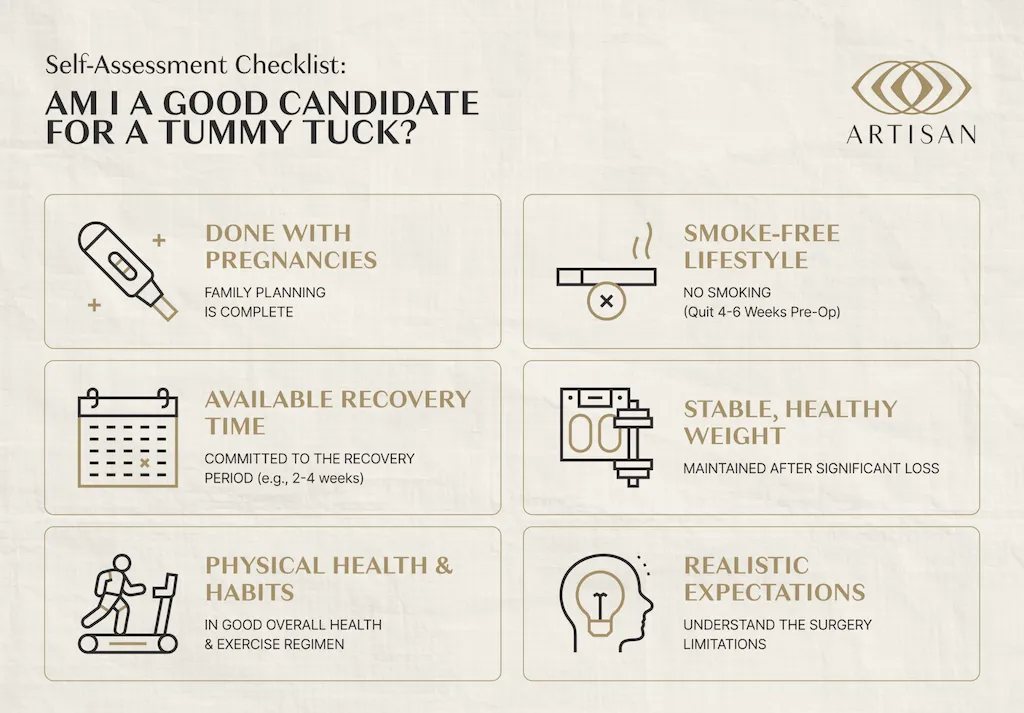
You may be a strong candidate if:
- You are at or near your stable goal weight and have kept it there for at least six to twelve months.
- You have loose abdominal skin, a protruding lower belly, or separated abdominal muscles that exercise has not corrected.
- You are done with future pregnancies, since pregnancy after a tummy tuck can stretch the repair.
- You do not smoke, or you are willing to quit well before surgery.
- You are in good overall health and can take two to three weeks off for initial recovery.
Our team generally recommends abdominoplasty for patients with a BMI below 30, and when candidacy is not a clean fit today, our surgeons may suggest a medical weight loss clinic first. As Atlanta’s first woman-led plastic surgery practice, Artisan spends real time on this conversation. Deciding whether now is the right moment matters as much as whether the surgery is right at all.
If you are wondering where you stand, reach out to our team to sit with our surgeons in person and get a candid read on your options. There is no expectation to commit during the visit, and an in-person evaluation gives your surgeon information a screen simply cannot capture.
What types of tummy tucks are available?
Not every tummy tuck is the same surgery. The right technique depends on how much loose skin you have, where it sits, whether the abdominal muscles are separated, and whether stubborn fat needs to come out at the same time. Picking the wrong technique is one of the more common reasons patients feel underwhelmed by their results, so this decision matters.
Most abdominoplasty approaches fall into four main categories, with a few less common variations for specific situations. Your surgeon will recommend one after a hands-on evaluation, not from a menu.
| Type | What it treats | Who it’s best for | Incision |
|---|---|---|---|
| Mini tummy tuck | Lower belly skin and small muscle separation below the navel | Patients with mild concerns isolated below the belly button | Short, low, hip-to-hip or shorter |
| Full tummy tuck | Loose skin from upper and lower abdomen plus full muscle repair | Most post-pregnancy and moderate weight-loss patients | Hip-to-hip, low enough to hide under swimwear |
| Extended tummy tuck | Full abdomen plus loose skin that extends to the flanks and lower back | Patients after significant weight loss with skin laxity into the sides | Runs past the hips into the flank |
| Fleur-de-lis | Excess skin in both horizontal and vertical directions | Patients after very large weight loss, often with a vertical skin fold | Hip-to-hip plus a vertical incision up the midline |
Mini tummy tuck
A mini tummy tuck focuses on the area between the pubic bone and the belly button. The incision is shorter, the skin removal is smaller, and muscle repair is limited to the lower abdomen. Recovery tends to be a little quicker, but the trade off is real: if loose skin or separated muscles extend above the belly button, a mini will not reach them. Many patients who want a mini actually need a full.
Full tummy tuck
The full, or complete, tummy tuck is the technique most people picture when they hear the word abdominoplasty. Your surgeon makes a hip-to-hip incision low on the abdomen and separates the skin from the muscle wall. The rectus abdominis muscles (the “six pack” muscles that pregnancy often splits apart) are tightened with internal sutures, excess skin and fat are removed, and the belly button is repositioned. It is the broadest reshaping option, and the one most post-pregnancy and moderate weight loss patients end up choosing.
Jin K., a Northside patient who had a tummy tuck with diastasis recti repair, talks about her experience:
“I had a tummy tuck and diastasis recti repair surgery with Dr. Val. The surgery was very satisfactory and professional. I’m beyond happy with my results and I’m very glad I went with Dr. Val for this procedure. On top of the stellar surgery, the entire staff has been very sweet and delightful to interact with.”
Extended and fleur-de-lis tummy tuck
Patients with more significant skin laxity, especially after large weight loss, sometimes need more reach than a full tummy tuck can offer. An extended tummy tuck carries the incision past the hips into the flanks, which addresses skin that droops toward the back.
A fleur-de-lis adds a vertical incision from the breastbone down, which is the only way to remove excess skin in two directions. Both are bigger surgeries with more scarring, and both trade a longer incision for a tighter, smoother contour.
Tummy tuck with liposuction
Liposuction, one of the procedures performed by board-certified fat removal surgeons in Atlanta, is frequently added to an abdominoplasty, especially in a technique called lipoabdominoplasty, where the surgeon sculpts the waistline and flanks while removing skin from the lower belly. A meta-analysis of more than 14,000 patients found that lipoabdominoplasty had a lower overall complication rate than traditional abdominoplasty. It is not always needed, but when it is, the combination produces a more refined silhouette than either procedure alone. For a deeper comparison, our tummy tuck combinations guide walks through how lipo fits alongside the other body options.
A panniculectomy, which removes a hanging apron of lower abdominal skin without tightening muscles, is a separate procedure sometimes covered by insurance for medical reasons. It is not a cosmetic tummy tuck, and patients who need both usually plan them in stages.
How do I prepare for a tummy tuck?

Preparing for a tummy tuck is less about willpower and more about logistics. The more carefully you handle the weeks leading up to surgery, the smoother recovery tends to be. This is the phase where the surgical outcome starts to be decided.
Medical clearance and health
Expect a thorough health history, standard labs, and possibly an EKG or pregnancy test depending on your age and medical background. If you have a chronic condition, your surgeon may coordinate with your primary doctor before clearing you for surgery. Patients over 40 sometimes need cardiac clearance; patients on certain medications may need to adjust dosing in advance.
Lifestyle changes
A few weeks of preparation matter as much as the surgery itself. Smoking must stop. Blood thinners, anti-inflammatories, certain supplements, and some prescription medications are paused before surgery because they increase bleeding risk. Alcohol is off the table for at least a week on either side of the procedure.
Nutrition does quiet work here. Patients who enter surgery well nourished and well hydrated tend to heal faster, and a steady weight in the months before the procedure helps the result settle the way you want it to. The pre-op checklist covers the essentials:
- Stop blood thinners, NSAIDs, and supplements at least two weeks before surgery.
- Skip food and drink after midnight the night before.
- Wash with antibacterial soap each day for a week pre-op.
- Switch to a liquid diet 24 hours before surgery if you are on a GLP-1 medication.
Home and recovery setup
You will not be able to bend, twist, lift, or stand fully upright for the first one to two weeks. Plan for it before the day of surgery, not the day after. A few small decisions make a real difference.
- Arrange a responsible adult to drive you home and stay with you for at least the first 24 hours.
- Set up a recovery spot with pillows, entertainment, chargers, and essentials within arm’s reach.
- Freeze easy meals or stock the fridge with soft, bland options for the first few days.
- Move anything you use daily down to waist level; you will not be reaching overhead comfortably.
- Line up childcare and pet care for at least the first week if that applies.
Anesthesia and day of instructions
Most tummy tucks are performed under general anesthesia, which keeps you fully asleep and comfortable through the procedure. You will shower with an antibacterial soap, skip makeup and lotions, brush your teeth without swallowing water, wear loose clothing, and arrive having fasted per your surgeon’s instructions. Cost planning often fits alongside these logistics.
To help make the investment manageable, we offer flexible financing through Alphaeon Credit, Cherry, and CareCredit, so you can choose a payment plan that fits your budget. Most patients weigh financing options during the weeks before surgery rather than at the consultation itself.
What happens during tummy tuck surgery?
A tummy tuck is surgery, not a procedure. Understanding the sequence helps demystify it and removes the anxiety that comes from imagining a black box.
Incisions and access
At Artisan, your surgeon makes the main incision low across the lower abdomen, positioned to hide under underwear or swimwear, along with a second small incision around the belly button. The skin and fatty layer are carefully lifted away from the underlying muscle wall so the full canvas can be evaluated.
Muscle repair
If the abdominal muscles have separated, which is extremely common after pregnancy, your surgeon uses internal sutures to bring the rectus abdominis muscles back together. This step is called diastasis recti repair, and it is the difference between a flatter appearance and a genuinely tighter core. The tightened wall acts as a natural corset around the spine, which is part of why patients often notice better posture after they heal.
Skin removal and belly button repositioning
Excess skin and fat are removed, the remaining skin is pulled smooth, and the belly button is repositioned to look natural on the new abdominal contour. Belly button shape is a small detail that makes or breaks the aesthetic result, which is why the step takes more time than you might expect.
Duration, anesthesia, and combinations
Most abdominoplasties run two to three hours under general anesthesia. Our team commonly uses an Exparel nerve block that lasts about three days to meaningfully reduce post-operative discomfort during the first, hardest stretch of recovery. Many patients combine a tummy tuck with breast surgery, liposuction, or a body lift as part of surgical body contouring for new moms. Combined surgeries typically run three to five hours and should be planned carefully, since longer operating times carry higher anesthesia exposure.
What are the risks and complications of a tummy tuck?
Every surgery carries risk, and a tummy tuck is larger than most cosmetic procedures. The vast majority of patients go through the process without any serious issues, but informed consent means knowing what can happen and how it is managed when it does. A complete safety guide to tummy tuck risks covers the research in detail
Healing concerns
Most post-surgical experiences are part of normal healing rather than complications, but a few warrant attention. Seroma, which is a small pocket of fluid that the body reabsorbs naturally, is the most common. It is usually handled with a quick in office drainage and resolves without long term consequences. Scarring is permanent but can be minimized with careful placement, tension free closure, and diligent scar care in the months after surgery. Wound healing problems are more common in patients who smoke, have diabetes, or have a higher BMI.
Serious but uncommon issues
A landmark analysis of roughly 25,000 abdominoplasties found a major complication rate of about four percent, with hematoma and infection being the most common serious issues. Blood clots in the legs or lungs are rare but serious, and most surgeons use a combination of early walking, compression devices, and sometimes blood-thinning medication to lower the risk. Anesthesia complications are also uncommon in healthy patients operated on in an accredited facility.
Who carries higher risk
Some factors move the odds:
- Smoking at any time in the weeks leading up to surgery.
- A higher BMI, which raises the risk of wound healing problems.
- Combining a tummy tuck with other procedures in one operation, which lengthens anesthesia time.
- Uncontrolled diabetes or other chronic conditions.
- Age over 55, which carries a modestly higher cardiovascular risk profile.
None of these are automatic disqualifications, but they are worth honest conversation during consultation. Choosing a board-certified plastic surgeon, a stable health baseline, and a carefully followed pre-op and post-op plan are the three levers that move the risk picture most.
What is tummy tuck recovery like?
Recovery is the phase most patients underestimate, and it is where the result is protected or compromised. A realistic mental model helps you plan your life around the healing, rather than feeling blindsided by it.
| Phase | Timeframe | What is normal | Activity |
|---|---|---|---|
| First few days | Day 1 to 3 | Soreness, swelling, drains, difficulty standing fully upright | Rest, short walks, compression garment on |
| Early recovery | Week 1 to 2 | Bruising, ongoing swelling, fatigue | Gentle walking, no lifting, prescribed pain management |
| Return to desk work | Week 2 to 4 | Energy returning, swelling easing | Light activity, back to work, no strenuous exercise |
| Mid recovery | Month 2 to 3 | Most visible swelling resolved, scar is pink | Gradually resume normal exercise |
| Long recovery | Month 6 to 12 | Scars continue to mature, soften, and fade | Full activity, including core exercise |
The first two weeks
The first several days are the hardest and the most important. You will walk hunched forward to protect the muscle repair, spend most of your time in a recliner or propped up bed, and wear a compression garment around the clock. Our Artisan follow-up schedule includes several visits to the Northside office in the first two weeks to check wound healing, manage drains, and adjust pain medication as needed.
That close follow-up makes a difference, not just medically, but in how supported you feel during the stretch when recovery asks the most of you.
Our patient Mya W. describes the care she received after surgery:
“I recently had a breast reduction and tummy tuck performed by Dr. Sybile Val, and I couldn’t be happier with my results. Dr. Val is not only an exceptionally skilled surgeon but also a genuinely kind and compassionate person. She went above and beyond to make sure I was comfortable and informed every step of the way—checking on me regularly after the procedure and even calling once I returned home. Her level of care and attention truly put me at ease throughout the entire process. I wholeheartedly recommend Dr. Val to anyone considering these procedures.”
The way the team treats you throughout the process is something patients mention again and again, and it matters most during those early days when you’re relying on your surgical team to guide you through each step.
Returning to work and daily life
Most desk-job patients feel ready to work again somewhere in the third or fourth week, depending on how physical their role is. Driving typically resumes around the two week mark, once you are off prescription pain medication and can respond quickly in traffic. Strenuous exercise, core work, and heavy lifting are off the table for six to eight weeks, and rushing that timeline is one of the easier ways to stretch a scar or loosen muscle repair.
Warning signs to watch for
Healing follows a rough rhythm, but some signs need a real conversation, not a wait-and-see approach. Call your surgical team promptly if you notice any of the following:
- Severe pain that does not respond to prescribed medication.
- A fever of 100.4 degrees or higher.
- Redness or heat spreads around the incision.
- Excessive bleeding through the dressings.
- Rashes, hives, wheezing, or tightness in the chest.
- Swelling or calf pain isolated to one leg.
If the recovery rhythm sounds like something you want to plan with a real surgeon, reach out to our team for a candid conversation about your timeline.
What results can I expect from a tummy tuck?
A tummy tuck, one of the most effective procedures performed by experienced tummy tuck surgeons near Atlanta Georgia, produces some of the most dramatic and lasting changes in plastic surgery, but the best outcomes come from knowing what it will do and what it will not. The contour you see immediately after surgery is not the final result; swelling and scar maturation take months to finish their work.
The most visible improvement lands around three to four weeks, when the compression garment comes off for most waking hours and your abdomen looks meaningfully flatter. The final contour usually settles somewhere between three and six months, and scars continue to mature, soften, and fade for up to a year. Stretch marks below the navel are often removed with the excess skin; those above tend to stay, though some may look less pronounced as the skin is stretched smooth.
Results can last for years when weight stays stable and future pregnancies are not in the plan. Significant weight changes can stretch the skin again, and pregnancy can separate the muscle repair. This is why surgeons typically recommend waiting until your family is complete.
What should you do next?
If you’ve read this far, chances are this isn’t a passing thought, it’s something you’ve been sitting with for a while. That’s okay. A tummy tuck is a big decision, and the space between thinking about it and actually doing something about it is where most people spend the longest. There’s no rush, and there’s no wrong time to start asking questions.
When you’re ready to explore, browsing real patient before-and-after photos that match your starting point can help you picture what’s possible for your body, not someone else’s. And when photos aren’t enough, an in-person consultation fills in everything a screen can’t. You’ll walk out with a plan built around your anatomy, a realistic sense of timing, and honest answers from a surgeon who’s seen where you are a thousand times before.
Whenever that moment comes, our team at Artisan is here, at our Northside or Johns Creek office, ready to listen before we ever talk about next steps. Call (404) 851-1998 to book a consultation and start the conversation on your terms.
Frequently asked questions
How long does a tummy tuck surgery take?
A standard tummy tuck takes two to three hours under general anesthesia. Combined procedures such as a mommy makeover can take three to five hours. Surgery length is a clue to complexity, not a measure of surgical skill.
What is the difference between a tummy tuck and liposuction?
Liposuction removes fat; a tummy tuck removes excess skin, repairs separated abdominal muscles, and reshapes the entire midsection. They solve different problems. Some patients need both, and your surgeon will tell you after a hands-on assessment.
Can a tummy tuck remove stretch marks?
Stretch marks sitting on the skin that gets removed (usually below the belly button) will be gone after surgery. Stretch marks above the navel or on the upper abdomen generally stay, though they may appear less pronounced once the surrounding skin is tightened.
Will I need drains after surgery?
Most tummy tucks include one or two small drains that collect fluid from the surgical site for the first several days to two weeks. Drains reduce the risk of seroma and are removed in a quick office visit. Some newer techniques skip drains, and your surgeon will tell you whether that applies to your case.
Can I get pregnant after a tummy tuck?
Yes, medically it is safe to carry a pregnancy after a tummy tuck. The cosmetic concern is that pregnancy can stretch the skin and separate the muscle repair, so most surgeons recommend waiting until you are done having children to protect your result.
What is diastasis recti and does a tummy tuck fix it?
Diastasis recti is a separation of the two halves of the rectus abdominis muscle, most often from pregnancy. Exercise alone often cannot close the gap once it is wide. A tummy tuck repairs diastasis recti by stitching the muscles back together, which tightens the core and improves posture.
Is a mini tummy tuck enough for me?
Only if your concerns are isolated below the belly button and your upper abdomen looks the way you want it to. A mini cannot reach loose skin or separated muscles above the navel. If you are unsure, a surgeon can tell you in five minutes with a hands-on exam.
Can men get tummy tucks?
Yes. Men make up a small but meaningful share of tummy tuck patients, most commonly after significant weight loss or as part of aging related changes. The technique is adapted for male anatomy and musculature, and the post-weight-loss subgroup often benefits most.
Will I have a new belly button?
Not exactly. Your surgeon preserves your original belly button and repositions it to sit naturally on the reshaped abdomen. Shape, size, and placement all receive careful attention because a natural looking navel is part of a natural looking result.
Can a tummy tuck be combined with a mommy makeover?
Yes, this is one of the more common combinations. A mommy makeover, which often means combining breast augmentation with abdominoplasty, typically pairs a tummy tuck with breast surgery (lift, augmentation, or both), with liposuction added where helpful. Combined procedures save one recovery instead of two, but they also lengthen the operation, so careful candidate selection matters.
How do I choose a board-certified plastic surgeon?
Look for certification by the American Board of Plastic Surgery and hospital privileges to perform the procedure in your area. Review a before-and-after portfolio that resembles the result you want. Pay attention to whether the consultation feels like a two way conversation rather than a sales pitch. The surgeon’s listening matters as much as their credentials.
Are tummy tuck results permanent?
Results can last for years when weight stays stable and pregnancies are not planned afterward. Significant weight change or pregnancy can alter the outcome. Our team offers flexible financing through Alphaeon Credit, Cherry, and CareCredit to make a thoughtful, once and done decision more accessible when you are ready.
*Disclaimer: This content is for educational purposes only and does not constitute medical advice. A consultation with a qualified board-certified surgeon is required to determine the best treatment plan for your individual needs and any questions you may have about a medical condition or procedure.

