




There is usually one spot. The roll that folds over a bra band, no matter how the shirt is cut. The pocket under the chin that shows up in every photo. Or the outer thigh that stays full while the rest of you slims down. You have done the work, the eating well, and the moving more, and that one area still will not budge.
Here is what the data shows. Liposuction is the second most common surgical cosmetic procedure in the world, with ISAPS recording 2,087,189 procedures in 2024. It stays this popular because it removes fat from a specific place, which diet and exercise cannot reliably do.
At Artisan Plastic Surgery, the city’s first woman-led source for plastic surgery options in Atlanta, our team treats each body as its own composition. This guide covers which areas liposuction treats best, what the procedure and recovery involve, and how to know if you are a candidate.
Key takeaways
Here is what matters most when you are weighing liposuction for a specific part of your body:
- Liposuction contours localized, pinchable fat in a targeted area, from the abdomen and flanks to the back, arms, thighs, and chin. It is a sculpting tool, not a weight-loss method.
- The abdomen and waist are the most treated areas. Denser fat, like back and bra-roll fat, needs ultrasound-assisted techniques to smooth it well.
- Cost tracks with surgical time, so it shifts with the area, its size, and how many zones you treat. Financing can spread the investment into monthly payments.
- Recovery follows a predictable arc, with the first few days the hardest. Most people resume normal routines within one to two weeks, and final contours settle over three to six months.
- Strong candidates are near a stable weight with good skin elasticity. Liposuction removes fat but does not tighten skin, so when loose skin is the real issue, a tummy tuck may be the better fit.
Which body areas can liposuction treat?
Liposuction, one of the most versatile forms of surgical fat elimination in Atlanta GA, can treat almost any area where the body stores stubborn fat, from the chin down to the knees. The areas that respond best all hold localized fat just under the skin, the kind you can pinch, rather than the deeper fat around your organs.
The abdomen and waist top the list, and for good reason. Liposuction here clears the diet-resistant fat that won’t go away, creating a flatter stomach and a defined waist. The flanks, those love handles above the hip, are often treated in the same visit to bring the whole silhouette into balance.
The inner and outer thighs rank second in popularity, according to a 2025 review of 175 body-contouring cases. Treatment here slims the thigh circumference and softens the saddlebag area. The upper arms respond well, too, though arm skin sometimes needs added tightening support to settle smoothly.
| Body area | What liposuction does there | Good to know |
|---|---|---|
| Abdomen and waist | Flattens the midline, defines the waist | Most commonly treated area |
| Flanks (love handles) | Smooths the side bulge above the hip | Often paired with the abdomen |
| Inner and outer thighs | Slims circumference, softens saddlebags | Second most popular area |
| Upper arms | Reduces fullness, reveals the arm contour | Skin quality affects the result |
| Back and bra rolls | Smooths rolls and bulges under clothing | Fat here is denser and more fibrous |
| Chin and neck | Sharpens the jawline and neck contour | Quick procedure, short recovery |
Back fat behaves a little differently. The fat across the upper back and the bra-roll area is denser and more fibrous than belly fat, so it takes a more deliberate technique. Done well, back liposuction smooths out the rolls that show through fitted clothing.
At the other end of the body, the chin and neck are quick to treat. ASPS recorded around 24,000 chin and neck procedures in the United States in 2024, and recovery from this small area is short.
Most patients do not treat just one spot, since liposuction is routinely done across several areas in one session. Because results vary so much from one body to the next, it helps to see real outcomes in the gallery at Artisan. Which areas make sense for you, though, also comes down to cost.
How much does liposuction cost by body area?
There is no single price tag for liposuction, because cost shifts with the body area, its size, and how many areas you treat. What stays constant is that cost tracks closely with surgical time.
A small, soft area like the chin takes far less time than the abdomen or several areas combined. Denser, fibrous fat, the kind in the back or male chest, also takes more careful work to smooth. The more zones on your plan, the longer the procedure, and time is the main thing you pay for.
A quoted number usually folds several costs into one. A complete liposuction estimate typically includes:
- The surgeon’s fee for the procedure itself
- Anesthesia, so you stay comfortable and feel nothing during surgery
- The surgical facility fee
- Pre-operative medical tests and lab work
- Your compression garment and any prescriptions
- Follow-up appointments during recovery
Treating more than one area at once does raise the total, since each zone adds surgeon time. The trade-off is that anesthesia and facility fees are shared across the whole procedure, which is part of why so many patients combine.
Cost should never be the reason you stay uncomfortable in your own skin. Artisan partners with three financing providers, Alphaeon Credit, Cherry, and CareCredit, so you can spread the investment into monthly payments. Your consultation includes a personalized cost breakdown, since the only accurate number is the one built around your plan.
What is the liposuction procedure like for different body areas?
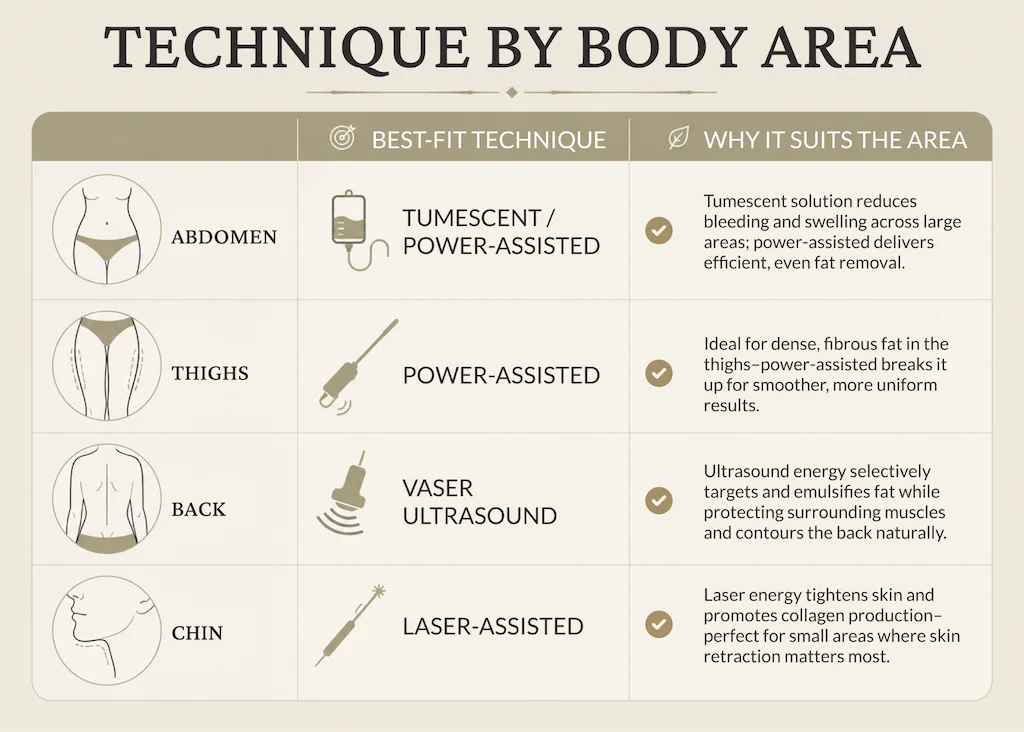
At its core, liposuction works the same way everywhere on the body. Your surgeon makes a few tiny openings, places a thin tube called a cannula, and uses it to loosen and suction out fat. What changes from area to area is the technique.
For the abdomen and other large, soft areas, surgeons usually start with tumescent fluid, a numbing solution that makes fat easier to remove with less bruising. Power-assisted liposuction, which uses a gently vibrating cannula, suits the soft fat of the thighs and legs.
Denser, more fibrous areas call for more. The back and the male chest often respond best to ultrasound-assisted techniques like VASER, which break up tough fat before it is removed. For smaller, delicate areas like the chin and neck, laser-assisted methods can remove fat while encouraging a little skin tightening.
| Body area | Technique often used | Why it suits the area |
|---|---|---|
| Abdomen and waist | Tumescent, power-assisted | A large area of soft, mobile fat |
| Thighs and legs | Power-assisted, suction-assisted | Soft fat that responds to gentle motion |
| Back and male chest | Ultrasound-assisted (VASER) | Dense, fibrous fat needs breaking up first |
| Chin and neck | Laser-assisted methods | Small area; adds mild skin tightening |
Anesthesia is matched to the scope of the work. Small areas like the chin or arms can often be done with local anesthesia and light sedation. Larger or multiple areas are typically done under deeper sedation or general anesthesia, so you stay comfortable throughout.
A multi-area procedure is a bigger undertaking, so it helps to sort out the practical side early. Reviewing financing options is a sensible first step, right alongside understanding what recovery looks like.
What does recovery look like after liposuction by body area?

Recovery from liposuction is gradual, and it follows a predictable arc no matter which area you treat. The first few days ask the most of you, and each week after asks a little less.
| Phase | Timeframe | What is normal | Activity |
|---|---|---|---|
| First few days | Days 1 to 3 | Swelling, bruising, soreness | Minimal activity, short walks |
| Early recovery | Weeks 1 to 2 | Swelling begins to ease | Back to non-strenuous work, no lifting over 5 pounds |
| Mid recovery | Weeks 3 to 6 | Bruising fades, contours emerge | Light activity, no gym or sports yet |
| Settling in | Months 2 to 6 | Remaining swelling resolves | Full activity once your team clears you |
The treated area mostly affects the details, not the overall timeline. Back liposuction recovery, for instance, tracks closely with abdominal recovery, even though that surgery is done with you face down. Most patients are back to their routine within one to two weeks, while vigorous exercise, like the gym, waits until around the six-week mark.
Amanda, a patient at our Northside office who found recovery easier than expected, shared her experience:
“Highest level of expertise and care. Dr Diane Alexander and her team go above and beyond for beautiful, natural results with an emphasis on wellbeing. She takes time to listen to your concerns and does her magic. The recovery process is very easy with her knowledgeable team to support you on your way.”
Compression is the unsung hero of recovery, and at Artisan, every liposuction patient goes home with a garment. You wear it around the clock for the first three to four weeks, then about 12 hours a day after that. The garment reduces swelling and helps the skin settle against your new contour.
Swelling and bruising are normal early on, and some areas feel less sensitive for a few weeks as the nerves settle. Minor wound issues stay uncommon, affecting about 0.4 percent of outpatient procedures in a large 2024 analysis. Wearing your garment, walking gently, and keeping your follow-ups are the simplest ways to stay on track.
Who qualifies for liposuction, and what happens at a consultation?
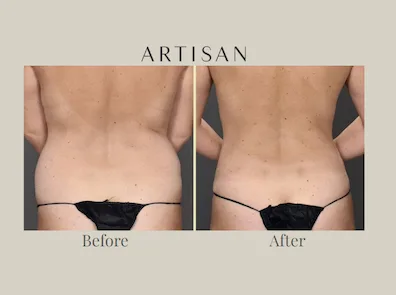
The best liposuction candidates have a few things in common, and weight is only part of the picture. Liposuction is a contouring tool, not a weight-loss method, so it works best for people near a stable weight who have specific pockets of resistant fat.
Skin quality is the factor people tend to overlook. Liposuction removes fat, but it does not tighten loose skin, so the skin needs enough elasticity to draw in smoothly. Where skin has lost some of its bounce, energy-based body reshaping procedures can be paired with liposuction to support a smoother result.
Back fat raises its own question, since it is denser and more fibrous than fat elsewhere. The good news is that it still responds well when the right ultrasound-assisted technique is used, so a fuller upper back or stubborn bra rolls are very much treatable.
Pulling those factors together, you may be a good fit for liposuction if:
- You are near your ideal weight and have held it steady for several months
- You have localized fat in one or more areas that diet and exercise have not touched
- Your skin still has good elasticity, so it can shrink to your new contour
- You are in good general health, with no conditions that slow healing
- You are a non-smoker, or willing to stop 6 weeks before surgery
Sometimes liposuction is not the whole answer. When loose skin, stretch marks, or separated abdominal muscles come along with the excess fat, surgical options for a firmer abdomen address what liposuction alone cannot.
A consultation is best understood as a two-way evaluation. It is your surgeon’s chance to assess your anatomy and goals in person, and equally your chance to weigh their approach. Every plan is built around your body rather than pulled from a template, which is the heart of how our team works.
Consultations happen in person at our Northside and Johns Creek locations, where your surgeon can do the hands-on assessment that a screen cannot replicate. If you are ready to find out which areas make sense for you, schedule a consultation with Artisan or call (404) 851-1998.
What results and risks come with liposuction by body area?
Liposuction results are reliably good when expectations match the procedure, and the risks are low for most people. A large 2024 analysis of 29,368 patients found an overall complication rate of about 2.6 percent.
What a good result looks like depends on the area. After abdominal liposuction, most people see a flatter midsection and a more defined waistline once swelling settles. Arm liposuction reveals more of the natural contour, and one 2024 study reported significant improvement in 92.3 percent of arm cases.
The minor issues that can come up vary a little by area:
- Mild unevenness as swelling goes down, which usually smooths out, and is the most common effect everywhere
- A small pocket of fluid that the body reabsorbs on its own, a little more likely in the abdomen and flanks
- Temporary numbness that fades as the nerves settle, common in the arms
- Looser skin where elasticity was already limited, which is why skin quality is checked beforehand
For nearly everyone, these issues are minor and short-lived. Final results take their time to arrive, with swelling peaking early and then receding steadily until most of your true contour shows by three to six months. The fat cells removed during liposuction are gone for good, so as long as your weight stays stable, the result holds.
Jin, a patient at our Northside office who chose a body-contouring procedure suited to his needs, shared his experience:
“I had a tummy tuck and diastasis recti repair surgery with Dr. Val. The surgery was very satisfactory and professional. I’m beyond happy with my results and I’m very glad I went with Dr. Val for this procedure.”
Conclusion
That one stubborn spot, the one that would not follow the rest of your body, has options now. Liposuction works because it does something that diet and exercise cannot. It removes fat from a specific place, area by area, until the proportion looks like you again.
The most useful next step is often the simplest one. Spend time with real before-and-after photos of the area you are considering, and when you are ready for specifics, a personal consultation fills in the rest.
Liposuction is not about chasing a flawless picture. It is about bringing your body into the proportion that feels like you, guided by a team that listens first. The team at Artisan in Atlanta would be glad to talk it through, in person and without pressure. When the timing feels right, reach out to our team or call (404) 851-1998.
Frequently asked questions
Is liposuction permanent for love handles?
Yes. Liposuction permanently removes fat cells from the flanks, so they do not return in that area. Your results hold as long as you keep a stable weight, since the fat cells that remain nearby can still enlarge with significant gain.
Does liposuction tighten loose skin?
No, and this is an important distinction. Liposuction removes fat but does not tighten skin, so your result depends on your skin having enough elasticity to shrink to the new contour. If skin laxity is a concern, a skin-tightening treatment can be added.
Can you get rid of back fat without surgery?
Non-surgical treatments that freeze away stubborn fat pockets can reduce a modest amount of fat in areas like the back, but stubborn back fat usually needs liposuction for a noticeable change. Diet and exercise help your overall health, though they rarely erase a localized pocket. A consultation can tell you which approach fits.
Can liposuction be combined with a tummy tuck?
Yes, and it is a common pairing. Liposuction refines the contour, while a tummy tuck removes loose skin and tightens separated abdominal muscles. The two are often combined for abdominal contouring as part of a customized plan, including after pregnancy or major weight loss, and if you are thinking long term, what tummy tuck results look like years later is worth understanding.
Can men get back liposuction for bra rolls?
Absolutely. Back liposuction, including the bra-roll area, is a common treatment for men and women alike. It is one of the areas that responds well to the ultrasound-assisted techniques used for denser, more fibrous fat.
*Disclaimer: This content is for educational purposes only and does not constitute medical advice. A consultation with a qualified board-certified surgeon is required to determine the best treatment plan for your individual needs and any questions you may have about a medical condition or procedure.

