

A tummy tuck has a reputation as a kind of finish line. You picture the surgery, then a flat stomach, and the story feels like it ends there. Real life is more interesting than that, because your body keeps living long after the operating room.
Here is what the long-term data actually shows. A 2025 report from the American Society of Plastic Surgeons found that most patients were not heavier years after their procedure. About 60% had actually lost weight five years on, an average of roughly 10 pounds.
At Artisan Plastic Surgery, a team of cosmetic surgeons in Atlanta GA, we hear the question of whether results will last longer than almost any other. This article looks at how long tummy tuck results hold up, how weight and aging factor in, and how to protect what the surgery achieves.
Key takeaways
Here is the short version of what life looks like in the years after a tummy tuck, and what keeps your result steady.
- The skin removed during surgery and the repaired muscle wall are permanent structural changes. The overall look still evolves with weight, pregnancy, and aging.
- Final results take time to arrive. Most swelling fades by 3 to 6 months, and the true contour is visible around the one-year mark.
- Weight is the single biggest factor in how your result ages. Small fluctuations barely show, while a gain of 20 pounds or more has a more lasting effect.
- Aging continues after surgery, but a tummy tuck gives your abdomen a firmer starting point, so changes tend to be less pronounced than they would have been otherwise.
- Maintenance is mostly lifestyle: a steady weight, core strength, scar care, and thoughtful timing around pregnancy. Most patients never need a revision.
When will you see the final results of your tummy tuck?

The final shape of a tummy tuck takes time to arrive. The body you see in the first few weeks is swollen, tight, and still healing, and it isn’t the body you keep.
Swelling is the main reason for the wait. It eases significantly by the 3 to 6 month mark, though full resolution can take close to a year. According to ISAPS, the abdomen keeps refining its contour across that entire first year.
| Stage | Timeframe | What is normal |
|---|---|---|
| The first weeks | Weeks 1 to 6 | Noticeable swelling, a tight pulling feeling, raised pink scars |
| Settling in | Months 3 to 6 | Most swelling fades, the pulling sensation eases, you can stand fully upright |
| Refining | Months 6 to 12 | A smoother, firmer contour appears, scars begin to flatten and lighten |
| The true result | Around 12 months | Healing is essentially complete, and the shape is the one that stays |
So, when is it fair to judge your belly after a tummy tuck? Around the 12-month point, once internal healing is complete and your weight has held steady. Trying to evaluate the result earlier than that is a bit like grading a painting while it’s still wet.
It’s completely normal to feel impatient during that window, and most patients do. If you’re trying to make sense of your own healing, a board-certified plastic surgeon can map a timeline to your specific recovery. Knowing where you stand tends to replace worry with a plan.
Are tummy tuck results permanent, or do they change over time?
A tummy tuck delivers results that are built to last, but lasting and unchanging are not the same thing. Two of the changes are structural and permanent. The rest of the picture keeps moving with you.
The permanent structural changes
The excess skin removed during surgery is gone for good. Skin doesn’t regenerate once it’s excised, so that part of the contour improvement is genuinely durable.
The muscle repair is the other lasting piece. When separated abdominal muscles are stitched back together, that internal repair is built to hold. Studies that follow patients with ultrasound imaging show that it stays intact over the years for most people.
The parts that keep evolving
Scars are the most visible thing that shifts, and they shift in your favor. Over the first year or two, they fade from raised and pink to flat and pale, settling like a line that finally finds its place.
The overall contour is where weight and aging quietly do their work. Most patients who keep their weight steady still have a flat, firm abdomen five years after a tummy tuck, and often well beyond. At Artisan, our co-founders, who specialize in plastic surgery for the midsection, have spent decades watching how these results age.
Our team frames the surgery as a strong foundation rather than a freeze-frame. That distinction is what matters most, because the patients who understand it tend to be the happiest with their results years later. The structure holds, while the finish keeps responding to how you live.
How do weight changes affect your tummy tuck results?
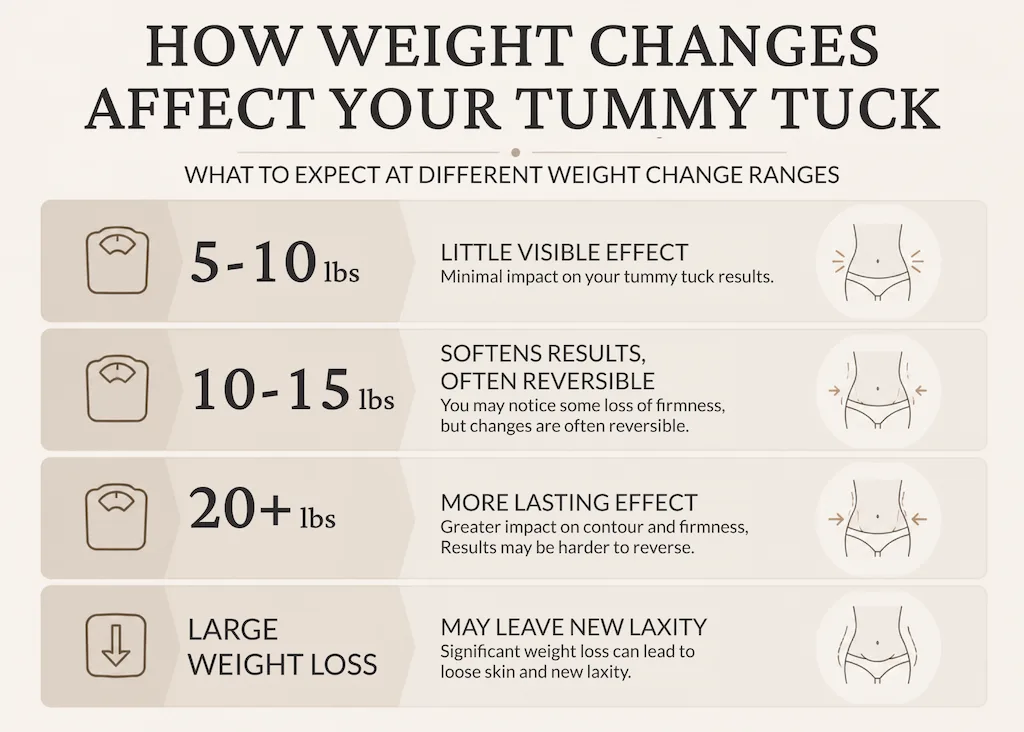
Weight is the single biggest factor in how your result ages. A tummy tuck removes skin and tightens muscle, but it doesn’t stop the fat cells you still have from changing size. That’s why getting fat after a tummy tuck is one of the most common worries we hear.
Here is how different amounts of change tend to play out:
- A shift of about 5 to 10 pounds is normal in life and usually has little visible effect on your contour.
- Around 10 to 15 pounds can soften the result, though that softening is often reversible if your weight comes back down.
- A larger gain, roughly 20 pounds or more, stretches the remaining skin and expands fat cells, which has a more lasting effect.
- Losing a moderate amount of weight after surgery often sharpens your contour, while a very large loss can leave new skin laxity.
When fat does come back, it doesn’t all return to your abdomen, because a tummy tuck changes how your body stores it. Fat after a tummy tuck often redistributes to the hips, thighs, or back instead, areas where minimally invasive body reshaping can refine the contour later if it bothers you.
Weight moves. It moves with holidays, with stress, with age, with medication, and with life. None of that makes you a failure, and a few pounds in either direction is not the thing that undoes a tummy tuck.
What’s harder on a result is the pattern, not the number. Repeated cycles of loss and regain stretch skin and muscle again and again, wearing on a contour more than a single steady weight would. Newer medications like semaglutide are usually introduced once your weight is stable, rather than right before surgery.
Taylor, a patient at our Northside office who came to us after four pregnancies, shared her experience:
“My experience with Dr. Ashraf, Dr. Alexander, and Jordan Beasley has been nothing short of life-changing. I’m 45 years old, and I had 4 children via c-section (not the plan) and nursed all 4 for a combined total of 9 1/2 years. I wanted a mommy makeover (breast implants and tummy tuck).”
At Artisan, our team often talks with patients about timing. Going into surgery near a weight you can realistically maintain gives the result its best chance.
Want a sense of what a steady, long-term outcome looks like? Browsing a before-and-after gallery of patients years out from surgery can be more grounding than any single number.
How does aging affect your tummy tuck results over time?
Aging doesn’t stop because you had surgery. Your skin keeps maturing, your hormones shift, and gravity keeps doing its quiet work. The encouraging part is that a tummy tuck gives all of that a firmer starting point.
Skin and elasticity over time
Skin naturally loses elasticity as collagen production slows, a process that picks up speed after about age 40. The skin that remains after a tummy tuck is still subject to that change. Sun exposure and lifestyle add their own effects over the years.
What that looks like in practice is subtle, gradual softening rather than a sudden return to where you started. The contour you see a decade out is usually still a clear improvement, just a slightly gentler version of the one-year result.
Menopause and hormonal shifts
Menopause adds its own chapter. As estrogen declines, skin firmness decreases, and the body tends to redistribute fat toward the abdomen, which can soften a previously crisp contour.
Here’s the reassuring part. Because a tummy tuck already removed excess skin and rebuilt the muscle wall, you’re aging from a tighter baseline. These shifts often read as less dramatic than they would have been without the surgery.
Researching how your body will change over time is exactly the kind of thoughtful planning that leads to long-term satisfaction.
How can you maintain your tummy tuck results long-term?

Life after a tummy tuck settles into a rhythm, and protecting your result is mostly about habits you already understand. None of it is dramatic. It comes down to consistency rather than perfection.
A few practices do most of the work:
- Keep your weight steady, ideally within about 10 pounds of where you were at surgery.
- Eat for tissue health, with enough protein, vegetables, and whole foods to support your skin and muscles.
- Rebuild your core gradually, starting only once your surgeon clears you, usually around 6 to 8 weeks after surgery.
- Care for your scar with sun protection, moisturizer, and silicone gel or sheets over the months it takes to fade.
- If you’re planning more children, consider waiting, since a future pregnancy can re-stretch the repair.
Core strength deserves a little extra attention, because it’s the habit most people skip. Gentle, surgeon-approved exercises like bridges and planks keep the repaired muscle wall strong. A strong core is part of what holds your body after a tummy tuck in place over the years.
Skin firmness can also be supported beyond the operating room. For the gradual laxity that aging brings, muscle-toning body sculpting Atlanta can help. Options like radiofrequency skin tightening and muscle-toning treatments such as CoolTone are available, where surgical results and non-surgical maintenance work together.
Mya, a patient at our Northside office who valued feeling informed at every step, shared her experience:
“I recently had a breast reduction and tummy tuck performed by Dr. Sybile Val, and I couldn’t be happier with my results. Dr. Val is not only an exceptionally skilled surgeon but also a genuinely kind and compassionate person. She went above and beyond to make sure I was comfortable and informed.”
None of this requires a rigid routine. Patients who stay roughly consistent are the ones still happy with their result many years later, and that’s a genuinely reachable bar.
What should you do if your tummy tuck results change years later?
Sometimes, years down the road, something changes. A pregnancy, a stretch of weight gain, or simply time can soften what your surgery achieved. If that happens, you have options at every level, and none of them mean starting over.
Common reasons that results shift
The usual causes are familiar by now: significant weight changes, a pregnancy after surgery, and the natural elasticity loss that comes with aging. Less often, the muscle repair can relax, especially after a later pregnancy stretches it again.
Pregnancy is worth a specific note. A pregnancy after a tummy tuck is considered safe, but it can re-stretch both the skin and the repaired muscles, partially reversing the contour. That’s why surgeons generally suggest completing your family before surgery when that’s a realistic plan.
Options for addressing changes
The good news is that most changes don’t call for a repeat of the original surgery. A 2024 analysis of nearly 9,000 cases put revision rates at roughly 8 to 10 percent. The large majority of patients never need one.
| Option | What it involves | Often a fit for |
|---|---|---|
| Non-surgical skin tightening | Radiofrequency or similar energy treatments, no surgery | Minor laxity or early softening |
| Liposuction touch-up | Removing pockets of fat that have built up over time | Fat accumulation with good skin tone |
| Mini tummy tuck | Tightening and removing skin in the lower abdomen only | New laxity below the belly button |
| Full revision | A repeat of the original procedure, skin and often muscle | A larger change after pregnancy or major weight shifts |
Which path makes sense depends on what actually changed. For fat that has crept back with good skin tone, liposuction broken down by body area shows what a touch-up can refine, and the rest is best answered in person rather than guessed at online.
Inside an in-person evaluation
An evaluation isn’t only a chance for a surgeon to assess your abdomen. It’s equally your chance to evaluate them, their approach, and whether the plan they describe fits what you actually want.
As Atlanta’s first woman-led plastic surgery practice, our team understands how women experience changes in their bodies over the years. Every plan we build is customized to your anatomy and goals, and consultations happen in person at our Northside and Johns Creek offices. Cost is a common concern with a later procedure, and flexible financing through Alphaeon Credit, Cherry, and CareCredit can help spread it out.
If something feels different about your contour, you don’t have to sit with the guesswork. You can schedule a consultation with our team at Artisan to have those changes looked at in person.
Conclusion
That idea of a tummy tuck as a finish line is worth letting go of. Your result is really a foundation you get to keep building on, not a single moment frozen in a photo. The patients who do best are the ones who understand that the structure holds while the finish keeps responding to how they live.
Browsing real patient photos that match your own starting point is one of the most useful things you can do next. Our before-and-after gallery is a grounded place to begin, and when you’re ready for specifics, a personal conversation fills in what photos can’t.
Every patient deserves to feel heard, respected, and confident in a decision this personal. That’s the care we aim to bring at Artisan, here in Atlanta. When you’re ready, you can request a consultation or call (404) 851-1998 to start the conversation.
Frequently asked questions
Do tummy tuck scars fade after five years?
Tummy tuck scars fade significantly over the first year or two, lightening and flattening as they mature. By five years, they have usually blended considerably, though they don’t disappear completely. Consistent sun protection and scar care make a real difference in the final look.
Can I lose weight after my tummy tuck?
Yes. Many patients continue to lose weight in the years after surgery, and a modest loss often sharpens your contour. A very large loss can leave some skin laxity, so it’s worth discussing major weight-loss plans with your surgeon first.
Does weight gain ruin tummy tuck results?
Not usually. A few pounds in either direction won’t undo your result, and the muscle repair stays intact even with some weight gain. A significant gain can stretch the remaining skin and expand fat cells, which softens the contour, but it rarely erases the change entirely.
What if I get pregnant after a tummy tuck?
Pregnancy after a tummy tuck is considered safe, but it can re-stretch the skin and the repaired muscles, partially softening your result. Many patients choose to complete their families before surgery for that reason. If a pregnancy is still a possibility, our team can help you think through the timing.
Can I exercise normally after a tummy tuck long-term?
Yes. Once you’re fully healed, usually around 6 to 8 weeks with your surgeon’s clearance, you can return to normal exercise. Long-term, core work actually helps maintain your result by keeping the muscle wall strong.
*Disclaimer: This content is for educational purposes only and does not constitute medical advice. A consultation with a qualified board-certified surgeon is required to determine the best treatment plan for your individual needs and any questions you may have about a medical condition or procedure.