


There’s a particular kind of research you’ve probably already done, the late-night kind. You typed “is liposuction safe” into a search bar, found a forum thread and a worst-case story, and closed the tab. But the question didn’t close with it.
Here’s what the research actually shows. A 2024 analysis of nearly 250,000 liposuction procedures in accredited surgical facilities found an overall complication rate of well under 1 percent, with serious problems rarer still. The honest picture is far steadier than a midnight search makes it feel.
At Artisan Plastic Surgery in Atlanta, a team of tummy tuck and liposuction specialists, we understand that wanting a procedure and worrying about it aren’t opposites. They usually arrive together. Our approach, grounded in the philosophy of personalized beauty, is to give you the full picture so your decision feels informed rather than fearful. This article walks through what can go wrong in the short and long term, which factors raise or lower your risk, and how to make the safest possible choice.
Key takeaways
Liposuction safety is less about luck and more about the choices made before, during, and after surgery. A few ideas anchor everything below.
- In accredited facilities with experienced surgeons, liposuction has a low overall complication rate. Most short-term effects are normal healing, not true complications.
- Serious complications exist but are uncommon. Nearly all of them trace back to preventable factors like facility standards, surgeon experience, and how much fat is removed at once.
- Long-term side effects are usually mild. A few, like skin texture changes or fat returning to untreated areas after weight gain, are worth understanding upfront.
- Your health, your surgeon’s training, and the facility’s accreditation shape your risk far more than the procedure itself.
- The safest liposuction starts with a board-certified plastic surgeon, an honest health conversation, and a recovery plan you actually follow.
What are the common short-term side effects of liposuction?
Most of what you’ll experience in the first few weeks after a tumescent fat removal procedure isn’t a complication at all. It’s healing. Bruising, swelling, and soreness show up for nearly everyone, and they fade on their own. Knowing what’s normal makes the early weeks far less unsettling.
A handful of effects come up often enough that it helps to see them laid out plainly.
| What you might notice | Why it happens | What helps it settle |
|---|---|---|
| Bruising and swelling | Your body’s normal response to the procedure | Time, rest, and a compression garment |
| A small pocket of fluid, called a seroma | Fluid can collect in the space where fat was removed | Compression, and sometimes a quick in-office drainage |
| Areas that feel less sensitive | The thin tube used in surgery can briefly irritate nearby nerves | Usually settles on its own over a few weeks |
| Mild unevenness as swelling goes down | Swelling rarely fades at exactly the same pace everywhere | Patience, since contours keep refining for months |
True complications sit at the less common end of the spectrum. A seroma, the small pocket of fluid your body often reabsorbs on its own, shows up in well under 1 percent of cases in a 2024 meta-analysis. Infections are rarer still.
None of that means nothing ever goes sideways. It does mean the odds sit firmly in your favor. What matters most is catching anything unusual early.
Compression garments, worn as directed, lower the chance of a seroma and help swelling resolve. Our team builds in structured follow-up visits, around one week, three weeks, and six weeks, so healing is watched closely. If something feels off between visits, a quick phone call sorts it out.
What are the more serious complications of liposuction?
The complications people read about most are the ones that almost never happen. That’s worth saying clearly before naming any of them. Serious events are genuinely uncommon, and the surgical world has spent decades building safeguards around exactly these scenarios.
Here are the rare but serious risks, along with what keeps each one rare:
- Blood clots in the legs or lungs, which is why your surgeon screens for clotting risk beforehand and encourages gentle movement soon after surgery.
- Fat enters the bloodstream, an event that careful, controlled surgical technique is specifically designed to prevent.
- The thin surgical tube reached deeper than intended, which experienced hands and conservative technique guard against.
- A reaction to the numbing medication, avoided by keeping doses within well-established safe limits that anesthesia experts have studied thoroughly.
- Strain on the heart, kidneys, or lungs from removing very large volumes of fat, which is why surgeons cap how much they remove in a single session.
Notice the pattern in that list. Almost every serious complication traces back to something a qualified team controls: the facility, the technique, the dose, the volume removed, the screening done in advance. That’s not a coincidence, and it’s the most reassuring thing about this section.
What are the long-term side effects of liposuction?
Liposuction long-term side effects tend to be subtle rather than dramatic, and for most patients they’re minor. Still, a clear-eyed look at the years after surgery, not just the weeks, helps you set expectations you can actually live with.
Numbness and changes in sensation
Some areas may feel less sensitive for a while as nerves settle after surgery. For most people this fades within several months. A small percentage notice a longer-lasting change, and a 2024 study found persistent altered sensation in roughly 3 percent of aesthetic cases. It’s usually mild, and it rarely affects daily life.
Skin texture and looseness
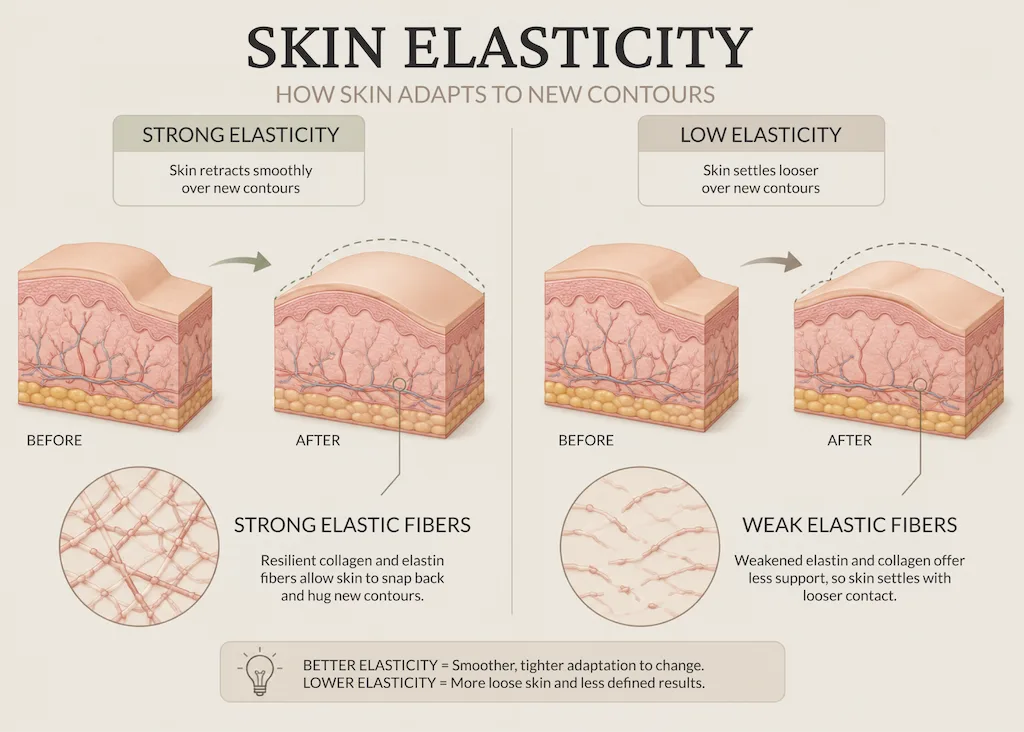
Skin needs good elasticity to shrink smoothly over your new contours. When elasticity is strong, results tend to look refined and even. When skin is naturally looser, or when a large volume of fat is removed, some rippling or unevenness can persist. Your surgeon can usually predict this during your evaluation, and for borderline elasticity, fat reduction with simultaneous skin firming can address looseness during the same procedure. That’s why the assessment matters as much as the surgery itself.
Jin, a patient at our Northside location who is well past her body-contouring surgery, shared her experience:
“I had a tummy tuck and diastasis recti repair surgery with Dr. Val. The surgery was very satisfactory and professional. I’m beyond happy with my results and I’m very glad I went with Dr. Val for this procedure.”
Fat redistribution if your weight changes
The fat cells removed during liposuction don’t grow back. But the cells left behind can still enlarge, and research shows that significant weight gain after surgery tends to send fat to untreated areas. Liposuction isn’t a weight-loss method, and it was never meant to be. It refines a shape, and a stable weight is what protects that shape. If the abdomen is your main concern, what stomach liposuction can and cannot do for belly fat is worth understanding before you decide.
Firmness, fibrosis, and lingering swelling
Some patients feel firm or lumpy areas as scar tissue forms beneath the skin. For most, this softens within a few months, especially with gentle massage. Longer-lasting swelling is uncommon and tends to affect people whose lymphatic system is already compromised.
The throughline here is that long-term results respond to long-term care. A personalized plan, realistic expectations, and steady aftercare do more to protect your outcome than any single technique. At Artisan, our team treats each body as its own composition, and that means a plan built around your anatomy rather than a template. Which raises a fair question: what actually tips your odds one way or the other?
What factors raise your risk during liposuction?
Liposuction safety isn’t fixed. It shifts based on who you are, how the procedure is planned, and who’s holding the instruments. Understanding these factors turns risk from something abstract into something you can act on.
Your health and body
Your overall health shapes how well you heal. Several personal factors can raise your risk, and most of them surface during a thorough consultation:
- Conditions that affect healing or circulation, such as diabetes or heart disease
- Smoking or vaping, which narrows blood vessels and slows the healing process
- Skin with less natural elasticity, which changes how smoothly it settles over new contours
- A weakened immune system, which can make recovery less predictable
None of these automatically rules you out. They simply mean your surgeon needs the full picture to plan safely, which is exactly why honesty during your evaluation protects you.
The size and scope of your procedure
How much fat is removed, and how many areas are treated, both influence your risk. Larger-volume liposuction and procedures that combine several surgeries at once carry more risk than a single, focused treatment.
This is why a careful surgeon may suggest staging your procedures or setting a conservative volume limit. It can feel like a slower path. It’s also a safer one.
Your surgeon and surgical facility
This is the factor with the most leverage, and the good news is that it’s entirely within your control. Surgeons who perform liposuction frequently have lower complication rates than those who do it occasionally. Board certification by the American Board of Plastic Surgery signals years of specialized training, and ASPS notes that board-certified surgeons operate only in accredited facilities equipped for emergencies.
Facility accreditation is just as worth verifying, since it means the surgical setting is prepared to respond if something goes wrong.
How safe is liposuction, according to the research?
When you step back from individual stories and look at large studies, a steady pattern emerges. Liposuction performed in the right setting has a strong safety record, and the data is reassuring precisely because it’s so consistent.
| Safety measure | What recent research shows |
|---|---|
| Overall complication rate, accredited facilities | About 0.40 percent |
| Overall complication rate, all settings combined | About 2.62 percent |
| Risk of a life-threatening outcome, accredited facilities | Roughly 1 in 11,000 procedures |
That gap between accredited and all-settings numbers is the headline. It tells you the setting matters enormously, and choosing well genuinely changes your odds. When complications do occur, the most common are minor and treatable, like a seroma or an unplanned follow-up visit. A 2023 study found that the most frequent issues were exactly these manageable ones, not catastrophic events.
Liposuction is also considerably safer today than it was in earlier decades. The tumescent technique, better patient screening, and accreditation standards have all pushed serious outcomes down dramatically. Large reviews looking at long-term results report high patient satisfaction, which suggests the procedure tends to do what people hoped it would. None of this erases risk, but it does put it in proportion.
How can you make your liposuction as safe as possible?
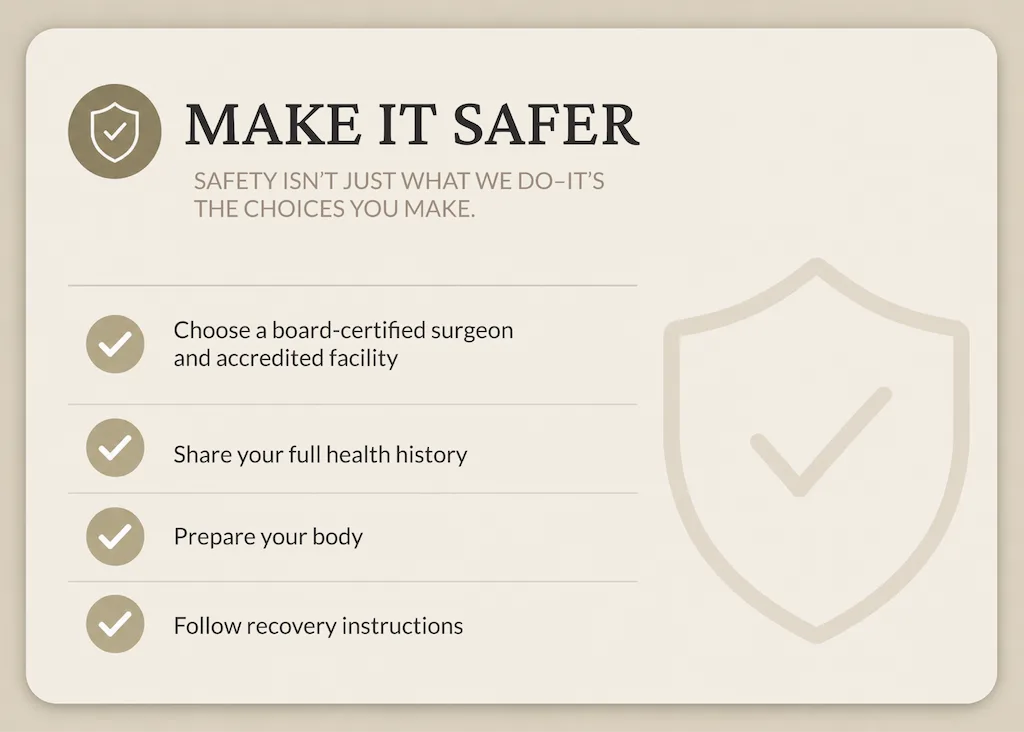
Here’s the empowering part. Most of what determines your safety isn’t left to chance. It’s a series of choices you make before you’re ever in an operating room, and they stack up in your favor.
Start with the right surgeon and facility
This is the single most important decision you’ll make. Look for a surgeon who is board-certified in plastic surgery, performs liposuction regularly, and operates in an accredited surgical facility.
Think of the consultation as a two-way evaluation. It isn’t only your surgeon assessing your candidacy. It’s equally your chance to evaluate them, their approach, and the space where you’d have surgery.
As Atlanta’s first woman-led plastic surgery practice, Artisan brings a perspective shaped by surgeons who understand how women experience their bodies. Every plan is customized to you, never pulled from a template. To make that step manageable, we offer flexible financing through Alphaeon Credit, Cherry, and CareCredit.
Prepare your body and share your full health picture
The weeks before surgery are an opportunity, not just a waiting period. A few steps make a measurable difference:
- Disclose every medication, supplement, allergy, and health condition, even the ones that feel minor
- Complete any lab work or medical clearance your surgeon requests
- Stop smoking or vaping well before surgery, since it meaningfully improves how you heal
- Pause blood-thinning medications and supplements like NSAIDs as directed, typically a couple of weeks ahead
This honesty isn’t about being judged. It’s the information your surgeon needs to keep you safe.
Protect your results during recovery
After surgery, your job is to follow the plan you were given. That means wearing your compression garment as directed, easing back into activity rather than rushing it, and keeping your follow-up appointments. It also means calling your team if you notice severe pain, a fever, swelling that’s worse on one side, or anything that simply feels wrong. Trust that instinct.
Mya, who had body-contouring surgery at our Northside office, described what attentive care felt like:
“Dr. Val is not only an exceptionally skilled surgeon but also a genuinely kind and compassionate person. She went above and beyond to make sure I was comfortable and informed every step of the way.”
Conclusion
Think back to that closed browser tab and the question that wouldn’t quite go away. You wanted a real answer, not a headline and not a sales pitch. The honest one is this: liposuction carries risk, like any surgery, but in the right hands and the right facility, that risk is small and largely manageable.
A good next step is gentle. Browsing real patients results in a before-and-after gallery showing you what’s realistic for someone starting where you are. A personal consultation then fills in the details photos can’t.
Every patient who walks through our doors in Atlanta deserves to feel heard, respected, and steady in their decision, never rushed and never pressured. That’s what the art of personalized beauty means to us. When you’re ready to talk it through, book your consultation with Artisan or call (404) 851-1998.
Frequently asked questions
Is liposuction safe when performed by a qualified surgeon?
Yes. When liposuction is performed by a board-certified plastic surgeon in an accredited facility, the overall complication rate is low and serious problems are uncommon. The biggest variable in your safety is the qualifications of your surgeon and the standards of the facility, not the procedure itself.
What is the death rate from liposuction?
In accredited surgical facilities, a life-threatening outcome occurs in roughly 1 in 11,000 procedures, making it exceptionally rare. The causes are usually preventable factors like inadequate facility standards or removing too much fat at once. Choosing a qualified surgeon and an accredited setting is what keeps this risk extremely low.
Does liposuction fat come back elsewhere?
The fat cells removed during liposuction are gone permanently. However, if you gain significant weight afterward, the fat cells that remain can enlarge, and fat may settle in untreated areas. Maintaining a stable weight is what preserves your results over time.
What is the most common complication of liposuction?
The most common complication is a seroma, a small pocket of fluid that collects where fat was removed. It occurs in well under 1 percent of cases and is easily managed, often resolving on its own or with a quick in-office drainage. Wearing your compression garment as directed lowers the chance of one forming.
Does liposuction cause long-term pain?
Long-term pain is uncommon. Soreness is normal in the first few weeks and fades steadily during recovery. Persistent discomfort is rare and worth raising with your surgeon, since it can usually be addressed.
*Disclaimer: This content is for educational purposes only and does not constitute medical advice. A consultation with a qualified board-certified surgeon is required to determine the best treatment plan for your individual needs and any questions you may have about a medical condition or procedure.