




There’s a tidy story we tell ourselves about belly fat. Eat cleaner, add more core work, stay consistent, and the stomach will eventually flatten. For a lot of people, that story quietly leaves out the fat that refuses to follow the rules.
The honest version is more specific. According to ISAPS, liposuction was the most commonly performed surgical procedure in the world in 2023. The abdomen is one of the areas patients ask about most, often after diet and exercise have stalled.
At Artisan Plastic Surgery, a home for aesthetic plastic surgery in metro Atlanta, our team treats the abdomen as one of the most individual areas of the body. The right approach depends on the kind of fat you’re working with and how your skin behaves. This guide covers who stomach liposuction actually suits, how the procedure and recovery work, and what results are realistic.
Key takeaways
A few ideas carry through everything below. If you remember nothing else about stomach liposuction, hold onto these.
- Stomach liposuction removes the soft, pinchable fat just under your skin. It doesn’t touch the deeper fat around your organs, and it isn’t a weight-loss procedure.
- It also doesn’t tighten loose skin or repair separated abdominal muscles. Those concerns belong to a tummy tuck, which is a different operation.
- Good skin elasticity and a stable weight near your goal matter as much as the fat itself, because your skin has to settle smoothly over the new contour.
- The fat cells removed are gone for good, but the remaining ones can still enlarge with weight gain, so maintenance protects your result.
- Final contours take time. Most major swelling eases within four to six weeks, while the last refinements can take several months.
Are you a good candidate for stomach liposuction?
The honest answer is that stubborn fat removal techniques work beautifully for a specific person, and less well for everyone else. Knowing which group you fall into early saves a lot of disappointment later.
The procedure targets subcutaneous fat, the soft layer right under your skin that you can pinch between two fingers. It does very little for visceral fat, the deeper fat that sits around your organs and pushes the belly outward from the inside. That distinction matters more than almost anything else, because visceral fat responds to diet and exercise, not to a thin tube.
A few other things shape whether this is the right fit. You’re a stronger candidate if you’re within roughly 20 to 30 pounds of a stable, healthy weight, since liposuction isn’t a way to lose weight. Good skin elasticity helps your skin retract smoothly over a flatter contour, and being in good general health, as a non-smoker, supports a clean recovery.
That last piece is where many people get surprised. If your concern is a soft pooch from skin and muscle separation after pregnancy, liposuction alone can actually make loose skin look more obvious. According to StatPearls, the procedure isn’t suited to loose or thin skin, because the result depends on the skin conforming to the new shape on its own.
This is exactly the kind of nuance our team at Artisan looks at closely during an evaluation. Your skin quality, your fat type, and your goals get weighed together, not forced through a one-size template.
How is stomach liposuction performed?
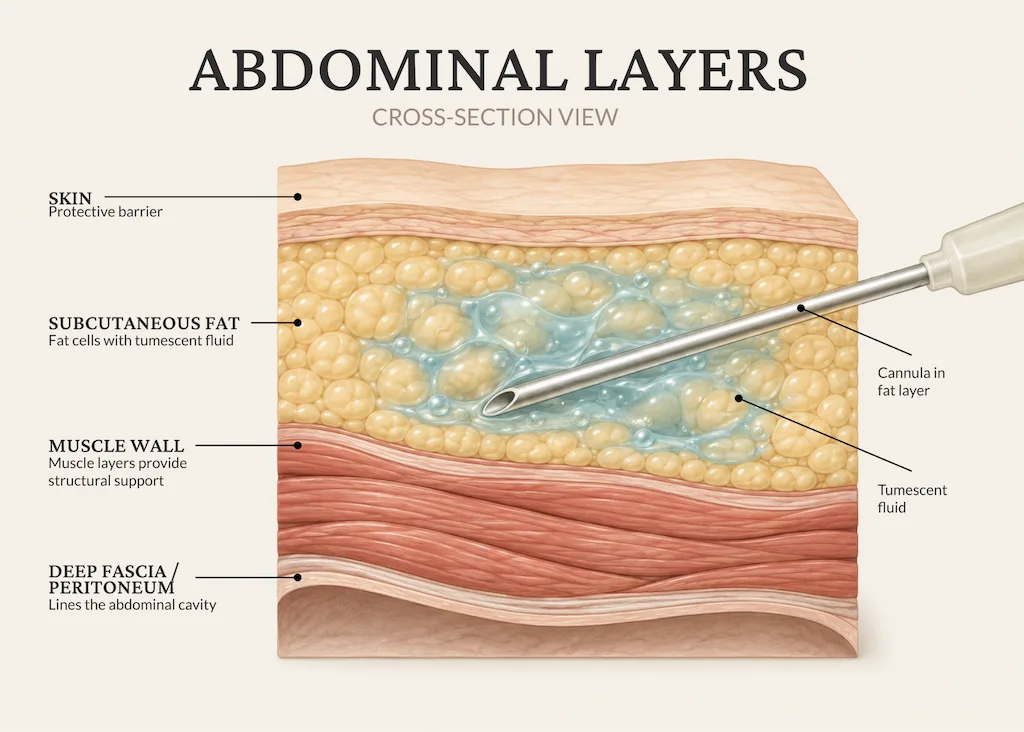
Stomach liposuction is an outpatient procedure, which means you go home the same day. The mechanics are more straightforward than most people expect, though the artistry lives in the details.
Getting ready for surgery
Preparation usually starts a week or two ahead. You’ll have a medical check, and you’ll be asked to pause blood thinners, certain supplements, and anything that raises bleeding risk. If you smoke, stopping well in advance genuinely changes how well you heal.
Because you’ll be under anesthesia, you won’t eat after midnight beforehand. You’ll also need someone to drive you home and stay with you the first night. None of this is dramatic, and our board-certified surgeons at Artisan follow the same careful routine for any abdominal procedure.
Anesthesia and technique
Stomach liposuction can be done under general anesthesia or, in some cases, with sedation and a numbing solution, so you stay comfortable throughout. Your surgeon chooses the approach based on your anatomy and how much fat is being treated.
Several techniques can be used. Tumescent liposuction places a large volume of numbing fluid first, which firms the area and limits bleeding. Power-assisted tools add a gentle vibration to loosen fat, while ultrasound-assisted methods liquefy fat first, which helps in denser, more fibrous areas. Your surgeon often combines these for finer control.
Removing the fat
Your surgeon makes a few tiny openings, usually 3 to 5 millimeters, tucked into discreet spots like the belly button or near the bikini line. A thin tube called a cannula passes through these openings to loosen and suction the fat in careful, even strokes. The goal is a smooth contour, not simply less fat, which is why an experienced hand matters so much.
The whole thing usually takes one to three hours, depending on how much ground is covered. Many patients also have the flanks, or love handles, treated in the same session through the same openings.
Waist definition often depends on what happens at the sides, not just the front. Knowing the steps ahead of time tends to make the day feel far less intimidating.
What does recovery after stomach liposuction look like?
Recovery from stomach liposuction is gradual and, for most people, more manageable than they brace for. The discomfort tends to feel like deep muscle soreness or a large bruise rather than sharp pain. Full swelling resolution can take three to six months, according to Cleveland Clinic, so patience really is part of the process.
| Phase | Timeframe | What’s normal | Activity |
|---|---|---|---|
| First few days | Days 1 to 3 | Swelling, bruising, soreness, some fluid drainage | Rest, short walks, minimal activity |
| Early recovery | Weeks 1 to 2 | Swelling and tenderness, gradually easing | Many return to desk work around one week; compression garment worn continuously |
| Mid recovery | Weeks 3 to 6 | Most major swelling subsides | Light activity; no strenuous exercise or heavy lifting until cleared, around four to six weeks |
| Settling in | Months 2 to 6 | Remaining swelling fades, contour refines | Back to full activity as final results become clear |
The compression garment does real work, so it’s worth wearing as directed. It reduces swelling, supports your tissues, and helps your skin settle against the new shape. Most plans involve wearing it almost around the clock for the first few weeks, then part-time after that.
Follow-up visits are part of the process, not an afterthought. Your care team typically checks in around one week, again at three weeks, and near the six-week mark. It’s completely normal to feel impatient with swelling, and a steady recovery is exactly what protects your final result.
Amanda, a patient at our Northside office who came through body contouring care, shared their experience:
“Highest level of expertise and care. Dr Diane Alexander and her team go above and beyond for beautiful, natural results with an emphasis on wellbeing. She takes time to listen to your concerns and does her magic. The recovery process is very easy with her knowledgeable team to support you on your way to feeling your best be it facial or body contouring.”
What results can you expect from stomach liposuction?

Here’s the thing about results: they arrive in layers, not all at once. The flatter, more defined contour you’re picturing is real, but it reveals itself as swelling fades over weeks and months.
You’ll likely notice early improvement within the first few weeks, with the finer details continuing to refine for up to three to six months. The final picture is a slimmer waistline and a smoother abdominal profile. What it usually isn’t, on its own, is a set of visible abs.
What stomach liposuction can and can’t deliver tends to look like this:
- It can remove stubborn, localized fat and sculpt a more balanced waist-to-hip line.
- It can permanently remove the fat cells it treats, so they won’t return to that area.
- It can’t tighten significantly loose skin or repair separated muscles.
- It can’t stop the remaining fat cells from enlarging if your weight climbs.
That permanence point deserves a fair reading. The treated fat cells are gone, but the ones left behind can still grow with weight gain, which is why a stable weight protects your investment. Think of it the way an artist protects a finished piece, the work holds, but it still needs care.
This is the part our team at Artisan spends real time on during planning. A natural-looking result depends on removing the right amount in the right places, not the most possible. It’s reasonable to want a clear sense of what’s achievable for your body, and a thorough evaluation is built to give you exactly that.
How does stomach liposuction compare to a tummy tuck and other options?
Choosing between procedures comes down to one question. What’s actually causing the shape that bothers you? Fat, loose skin, and separated muscle are three different problems, and they don’t all have the same answer.
| Option | Best for | What it involves |
|---|---|---|
| Stomach liposuction | Localized, pinchable fat with good skin elasticity and no muscle separation | Outpatient surgery, tiny incisions, fat suctioned through a thin tube |
| Tummy tuck (abdominoplasty) | Loose or excess skin and separated abdominal muscles, often after pregnancy or major weight loss | Surgery to remove excess skin and tighten the muscle wall, with a longer recovery |
| Liposuction plus tummy tuck | Stubborn fat together with loose skin or muscle separation | A single surgery addressing fat, skin, and muscle, often chosen for a fuller change |
| Non-surgical options | Smaller, earlier-stage concerns in patients not ready for surgery | In-office sessions with little or no downtime and more gradual, modest change |
A tummy tuck does what liposuction can’t, removing excess abdominal tissue and tightening a separated muscle wall, which is often the right call after pregnancy or major weight loss. For some patients, combining the two in one operation makes the most sense.
Non-surgical options like CoolSculpting®, a form of cryolipolysis for stubborn fat reduction, or CoolTone work well for early, milder concerns, while surgical procedures like liposuction and a tummy tuck address more advanced structural changes. As with any surgical procedure, stomach liposuction carries potential risks like swelling, bruising, and temporary numbness. Your surgeon walks through each one so nothing feels like a surprise.
Cost varies, and it depends on the volume of fat treated, the areas addressed, the technique used, and your surgeon’s experience. Rather than chasing a number, it helps to talk through the full picture with a surgeon who can tailor the plan. Flexible payment options exist to make that plan workable.
Jin, a patient at our Northside office who chose surgery to address muscle separation, shared their experience:
“I had a tummy tuck and diastasis recti repair surgery with Dr. Val. The surgery was very satisfactory and professional. I’m beyond happy with my results and I’m very glad I went with Dr. Val for this procedure. On top of the stellar surgery, the entire staff has been very sweet and delightful to interact with. I recommend this clinic for anyone looking for not just a professional service, but one that makes you feel pampered and cared for.”
What should you expect at a stomach liposuction consultation?

A consultation isn’t an audition. It’s just as much your chance to evaluate the practice, the space, and the surgeon’s approach as it is theirs to evaluate you. You’re deciding whether the fit feels right, and that goes both ways.
During the visit, your surgeon performs a hands-on assessment of your abdomen, skin quality, and overall health, the kind of evaluation a screen can’t replicate. You’ll talk openly about your goals and leave with a customized treatment plan rather than a one-size-fits-all recommendation. If cost is on your mind, our team will walk you through flexible financing through Alphaeon Credit, Cherry, and CareCredit.
Conclusion
Belly fat was never one simple thing, and that’s the quiet truth the tidy story leaves out. Once you know whether you’re dealing with pinchable fat, deeper fat, loose skin, or a separated muscle wall, the path forward changes. It stops feeling like guesswork and starts feeling like a decision you can actually make, especially once you see how surgical and non-surgical fat removal compare.
Browsing real patient photos that resemble your own starting point is one of the most grounding next steps. Our before-and-after gallery is a good place to begin when you’re ready to picture the change, and a personal consultation fills in the rest.
Every abdomen our team in Atlanta sees is treated as its own composition, and you deserve to feel heard, respected, and confident in whatever you choose. When you’d like to talk it through, reach out to our team at Artisan or call (404) 851-1998.
Frequently asked questions
Can stomach liposuction give you abs?
Not on its own. Stomach liposuction removes fat and refines your contour, but it doesn’t build or reveal muscle. If you already have a good underlying muscle tone, removing the fat layer above it can make the existing definition more visible.
How painful is stomach liposuction recovery?
Most patients describe it as soreness similar to a deep bruise rather than sharp pain. Discomfort is usually most noticeable in the first few days and is well managed with prescribed or over-the-counter medication.
How long is downtime after abdominal liposuction?
Plan on a few days of rest, with many people returning to desk work around one week. Strenuous exercise and heavy lifting usually wait until you’re cleared, often around four to six weeks. Swelling continues to settle gradually over the following months.
Is stomach liposuction safe for men?
Yes, it’s a common and well-established procedure for men, with the abdomen and flanks among the most frequently treated areas. The candidacy criteria are the same regardless of gender, centering on localized fat, good skin elasticity, and overall health. A consultation determines whether it’s a good fit.
Can you get pregnant after stomach liposuction?
Yes, liposuction doesn’t affect fertility or your ability to carry a pregnancy. That said, a future pregnancy can stretch the skin and shift your weight, which may change your results. Many patients choose to wait until they’re finished having children before pursuing the procedure.
*Disclaimer: This content is for educational purposes only and does not constitute medical advice. A consultation with a qualified board-certified surgeon is required to determine the best treatment plan for your individual needs and any questions you may have about a medical condition or procedure.

