




There has never been a longer list of ways to remove unwanted fat. There is surgery. And there are the treatments that promise to freeze it, heat it, or dissolve it, often with little or no downtime.
Somewhere between the glossy before-and-after photos and the competing claims, one honest question gets harder to answer. Which approach is actually right for you?
The honest answer depends on how genuinely different these options are. According to ISAPS, non-surgical fat reduction grew 7.6 percent worldwide in 2024, with more than 702,000 procedures performed. The alternatives to surgery are real and increasingly common, which is part of why the decision feels so layered.
At Artisan Plastic Surgery in Atlanta, our team works with both surgical and non-surgical fat removal options. The recommendation starts with you, not a single technique. This article compares how these options work, how they differ in results and recovery, and how to tell which one suits your goals.
Key takeaways
Before the details, here are the core ideas to carry with you.
- Liposuction and non-surgical fat reduction are not competing versions of the same thing. Liposuction removes a larger volume of fat surgically, while non-surgical treatments reduce smaller pockets gradually.
- Neither approach is a weight-loss method. Both work best for contouring specific areas in someone already near a stable weight.
- Recovery is the sharpest dividing line. Liposuction involves a real recovery period, while most non-surgical treatments have little to no downtime.
- Non-surgical options trade the deeper, faster results of surgery for a gentler risk profile. They usually need a series of sessions.
- The right choice depends on your anatomy, goals, and how much change you want. A personalized consultation matters more than any general comparison.
What is liposuction and how does it work?
Liposuction is plastic surgery for unwanted fat deposits that removes stubborn pockets of fat the body holds onto despite diet and exercise. It works by suctioning fat out through a thin tube, reshaping a specific area rather than shrinking your whole body. You might also hear it called lipoplasty or body contouring.
During the procedure, your surgeon makes a few tiny openings in the skin and inserts a cannula, a slender hollow tube. A numbing solution goes in first to ease the process and limit bleeding. Most liposuction is done under anesthesia so you stay comfortable, and it usually takes one to three hours.
Types of liposuction
Not all liposuction is the same. The core idea stays consistent, but the energy used to loosen fat before it is suctioned can vary from one technique to the next.
| Technique | How it works | Often chosen for |
|---|---|---|
| Traditional (suction-assisted) | A cannula and gentle vacuum remove fat after a numbing solution is placed | The most common approach; soft, accessible fat |
| Ultrasound-assisted (VASER) | Ultrasonic energy emulsifies fat before it is removed | Firmer, fibrous areas and detailed sculpting |
| Laser-assisted | Laser energy disrupts fat cells before suction | Smaller areas, with some skin-tightening effect |
Treatment areas and realistic results
Liposuction can refine many parts of the body. Common treatment areas include the abdomen, the hips and thighs, the back, the upper arms, and under the chin.
What it removes is meaningful but limited, usually a few pounds, because it is a contouring tool and not a substitute for weight loss. The Mayo Clinic notes it works best on localized fat in someone at a fairly stable weight. If one stubborn area never responds the way the rest of you does, this is the tool built for exactly that.
The results are lasting, since fat cells that are removed do not grow back. The fat cells that remain can still enlarge with weight gain, so a stable weight protects your result. Surgery is only one path, though, and for some goals you may not need an operation at all.
What non-surgical alternatives to liposuction are available?

If liposuction feels like more than you need, a whole category of treatments reduces fat without surgery. Non-surgical options tend to work well for earlier or milder concerns, while surgical procedures address more advanced, structural change.
Most non-surgical fat reduction shares a few traits:
- It works gradually, with results building over weeks to months
- It targets smaller, localized pockets rather than large areas
- It usually calls for more than one session per treated area
- It comes with little or no downtime
At Artisan Beaute, the medical spa side of the practice, several of these treatments are offered alongside surgical care. That makes honest, side-by-side comparison much easier. Because the options differ so much, weighing them well is hard from a website alone.
CoolSculpting and cryolipolysis
CoolSculpting® is the best known non-invasive fat reduction technology, using controlled cooling, a process called cryolipolysis, to freeze and kill fat cells. The body then clears them away gradually over the following months.
A single session typically reduces the fat in a treated area by 10 to 20 percent. The change builds slowly rather than appearing overnight, which is worth knowing up front, because it shapes what a realistic result looks like.
Kybella for the chin
Kybella® takes a different route. It is an injectable based on a substance the body already uses to break down fat, approved specifically for fullness under the chin. It permanently destroys fat cells in that area, with results showing over several weeks and a few sessions.
Energy-based and minimally invasive options
Another group of treatments uses energy instead of cold. Ultrasound devices like UltraShape and laser options like SculpSure break down or heat fat cells until they are disrupted. Radiofrequency devices such as truSculpt warm fat to trigger its breakdown, and all of these work gradually over more than one session.
A couple of options sit slightly apart. Emsculpt uses electromagnetic energy to drive strong muscle contractions, so it tones muscle rather than removing fat. BodyTite, which our practice offers, delivers radiofrequency assisted body contouring beneath the skin to melt fat while tightening the area.
That last detail matters: BodyTite is minimally invasive, not fully non-surgical or full surgery. Knowing the options is one thing, but seeing how they stack up is the next step.
How do liposuction and non-surgical fat removal compare?
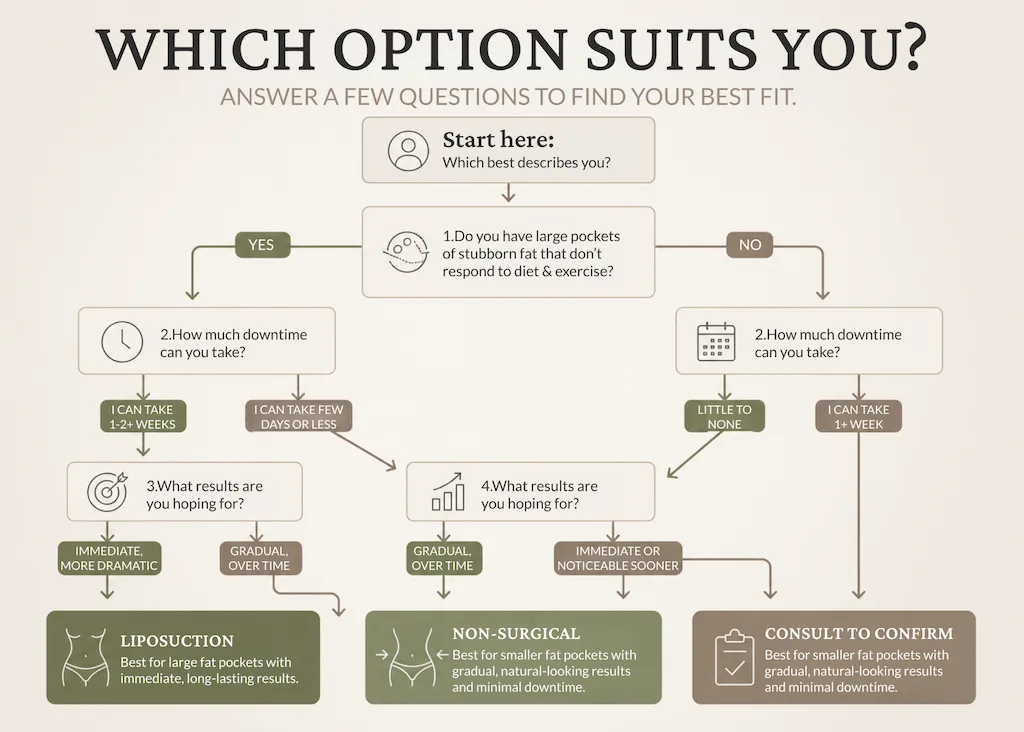
The clearest way to compare these options is by what each is built to do. Liposuction removes a larger volume of fat in a single session, which makes it the stronger choice for reshaping a noticeable area. Non-surgical treatments reduce modest pockets gradually and suit milder concerns.
Timelines differ too. After liposuction, you may see early changes within the first few weeks, though the final contour settles over a few months as swelling fades. Non-surgical results are slower by nature, building over two to three months as your body clears the treated fat cells.
Cynthia, a Beaute Buckhead patient who chose a non-surgical approach, shared her experience:
“Kim B @ Artisan Beaute’ is amazing! I had coolsculpting treatment and the results are amazing! She is the best! Artisan Beaute’ is a gorgeous Spa!!”
Skin tightening is another point of difference. Liposuction offers some natural skin contraction, and energy-based techniques can add a little more. Most fully non-surgical fat treatments do little for loose skin on their own.
There is also the question of how many visits each takes. Liposuction is typically one procedure, while non-surgical treatments usually need a series, often one to three sessions per area.
This is where a thoughtful consultation earns its place. At Artisan, the guiding idea is simple: there is no single right way to reduce fat, only the right way for your body and goals. That is why a recommendation may be surgical, non-surgical, or a careful combination.
| Factor | Liposuction | Non-surgical fat reduction |
|---|---|---|
| What it does | Removes a larger volume of fat in one session | Reduces smaller, localized pockets of fat |
| Best for | A noticeable change to a defined area | Earlier or milder concerns, fine-tuning |
| Results timeline | Early changes in weeks, final contour over months | Gradual, over two to three months |
| Skin tightening | Some natural contraction; a little more with energy techniques | Limited on its own |
| Sessions | Usually one procedure | Often a series, one to three per area |
| Downtime | A real recovery period | Little to none |
There is no universally better option, only the one that matches your goal. And recovery is often what tips the scale.
What is recovery and downtime like for each option?
Recovery is frequently the deciding factor, and it is where surgical and non-surgical options look most different. Liposuction asks for a real, if manageable, recovery period. Most non-surgical treatments ask for almost nothing.
After liposuction, the first few days call for rest, with limited lifting for the first couple of weeks. Many people return to a desk job within about a week, while strenuous exercise waits closer to the four to six week mark. Swelling and bruising are a normal part of healing, not a sign something is wrong, and they fade gradually over the following months.
A compression garment does a lot of quiet work during this time. Wearing it as directed helps control swelling and supports the new contour as your skin settles.
| Phase | Timeframe | What’s normal | Activity |
|---|---|---|---|
| Right after surgery | First 2 to 3 days | Swelling, soreness, bruising | Rest, short gentle walks |
| Early recovery | Week 1 to 2 | Swelling easing, tenderness | Light activity, return to desk work |
| Mid recovery | Week 3 to 6 | Most swelling subsiding | Gradual return to exercise |
| Settling in | Month 2 and beyond | Final contour emerging | Full activity as cleared |
Non-surgical fat reduction sits at the other end of the spectrum. With treatments like CoolSculpting, there is essentially no downtime. You may have mild redness, swelling, or tenderness that settles within days, and you can usually return to your routine the same day.
Aftercare is simpler than many people expect. Surgical recovery centers on the compression garment, gentle movement, and follow-up visits, while non-surgical aftercare is usually as light as staying active and a gentle massage. Recovery is only one piece of the picture, though, and cost, safety, and candidacy round it out.
What are the risks, costs, and ideal candidates for each?
Every fat removal option carries trade-offs, and understanding them is part of making a confident choice, so if you are still weighing the pros and cons of liposuction, that honest accounting is the place to start. The reassuring news is that both surgical and non-surgical approaches have strong safety records when performed by qualified providers.
The risks of liposuction
As a surgical procedure, liposuction does carry some risk, though serious complications are genuinely uncommon. The most common experiences are the expected ones: temporary swelling, bruising, and areas that feel less sensitive for a few weeks as the nerves settle.
Less common concerns include a small pocket of fluid the body usually reabsorbs on its own, or mild unevenness as swelling goes down. Choosing a qualified surgeon, following your aftercare instructions, and keeping your follow-up visits keep risk low.
Your care team will also tell you exactly which symptoms to watch for, so you are never left guessing during recovery.
Safety of non-surgical options
Non-surgical treatments avoid the risks tied to surgery and anesthesia, which is a genuine part of their appeal. Side effects are usually limited to temporary redness, swelling, or numbness in the treated area.
They are not entirely without considerations. CoolSculpting, for instance, has a rare effect called paradoxical adipose hyperplasia, where fat firms and enlarges instead of shrinking. It is uncommon, but worth asking about. As a general rule, non-surgical options trade the deeper results of surgery for a gentler risk profile.
Cost, candidacy, and finding your fit
Cost is rarely a single number. It depends on the technique, how many areas you treat, and whether you choose a surgical or non-surgical path. Non-surgical plans often involve multiple sessions that add up over time.
At Artisan, cost is discussed openly during your consultation, where you receive a personalized breakdown rather than a guess. To keep treatment manageable, the practice offers flexible financing through Alphaeon Credit, Cherry, and CareCredit.
As for who each option suits best, liposuction tends to be a good fit if you:
- Are generally healthy and at or near a stable weight
- Have specific pockets of fat that resist diet and exercise
- Have reasonably firm skin that can settle over the new contour
- Are a non-smoker, or are willing to quit before surgery
Non-surgical treatments tend to suit people with smaller pockets of fat who prefer minimal downtime and accept gradual results. Researching this carefully, the way you are now, is exactly the right instinct. It all points back to one step that ties the decision together.
What should you expect at your consultation?
By now, one thing is probably clear. The right fat removal choice is personal, and it is hard to finalize from a screen. That is exactly what a consultation is for.
An in-person consultation is not only a chance for your surgeon to assess your anatomy and health. It is equally your chance to evaluate them, their approach, their space, and whether their philosophy fits how you want to be cared for.
As Atlanta’s first woman-led plastic surgery practice, Artisan brings a particular sensitivity to that conversation. Your visit includes a hands-on assessment, an open discussion of your goals, and a customized treatment plan built around your body and lifestyle.
Michelle, a Johns Creek patient who came in unsure about surgery, shared her experience:
“I was extremely nervous as I had never considered Plastic surgery, however due to extreme weight loss it became necessary. This practice was recommended to me by a Dr and a friend and I have to say from start to finish they have all been wonderful. The very fact that it’s an all female practice is very comforting, Dr Ashraf-Wang was wonderful and I can now see at 61 a tummy I have never had since I was 18!! thank you all for the help and support.”
Conclusion
That long list of fat removal options can feel overwhelming at first. It gets simpler once you see it for what it is: not a competition between treatments, but a range of tools, each built for a different concern.
Browsing real patient photos that match your starting point is one of the most grounding next steps you can take. Our before-and-after gallery is a good place to begin. When you are ready, a personal conversation fills in the details a photo cannot show.
At Artisan in Atlanta, the belief is a simple one. Every patient should feel heard, unhurried, and confident in the choice they make, whether it is surgical, non-surgical, or simply waiting for the right time.
The Art of Personalized Beauty starts with that kind of listening. To take the next step, request an appointment or call (404) 851-1998.
Frequently asked questions
Is liposuction permanent?
Yes, the fat cells removed during liposuction are gone and do not grow back. Your results can last for years, with one important condition. Staying at a stable weight matters, since the fat cells that remain in the area can still enlarge if you gain weight.
What is the difference between VASER and traditional liposuction?
Traditional liposuction uses a thin tube and gentle suction to remove fat directly. VASER liposuction adds ultrasonic energy that loosens fat first, which can help with firmer, fibrous areas or detailed sculpting. Both remove fat effectively, and your surgeon will recommend the approach that fits your tissue and goals.
Can I have liposuction on multiple areas at once?
Yes, liposuction can often treat more than one area in a single procedure, which is common for related areas like the abdomen and flanks. The total volume removed and your overall health guide how much can safely be done at once.
Does CoolSculpting really work as well as liposuction?
CoolSculpting and liposuction are built for different jobs. CoolSculpting reduces smaller pockets of fat gradually, while liposuction removes more fat at once for a more noticeable change. At Artisan Beaute, CoolSculpting is offered for patients whose goals match what it does best.
Can non-surgical treatments tighten loose skin?
Non-surgical fat reduction does very little for loose skin on its own. Some energy-based treatments, like radiofrequency, can offer mild tightening for minor laxity, but meaningful loose skin usually needs a surgical solution. This is an important point to raise at your consultation if skin laxity is part of your concern.
*Disclaimer: This content is for educational purposes only and does not constitute medical advice. A consultation with a qualified board-certified surgeon is required to determine the best treatment plan for your individual needs and any questions you may have about a medical condition or procedure.

