




So, is it worth it? That question looms in the back of your mind once liposuction stops being a passing thought and becomes a real possibility. You have read the glowing before-and-after stories in one browser tab and the cautionary ones in another, and they can feel like two different procedures.
The honest answer has two sides, and the people weighing it are more varied than you might think. According to ISAPS, liposuction procedures in 2024 split fairly evenly between patients aged 18 to 34 and those aged 35 to 50. This is a personal calculation, and it deserves a clear look at both columns.
At Artisan Plastic Surgery in Atlanta, the city’s first woman-led practice and a team of experienced cosmetic surgeons to consider, we believe that calculations should be made with full information. This article walks through the genuine benefits of liposuction, the risks and limits worth knowing, and how to tell whether you are a good candidate. By the end, you should see which column carries more weight for you.
Key takeaways
Short on time? Here is the core of a clear-eyed liposuction decision.
- Liposuction is body contouring, not weight loss. It removes stubborn, localized fat permanently.
- The real benefit is a lasting change in shape, reaching pockets of fat that diet and exercise cannot.
- The cons come in two kinds: the normal, low risks of surgery, and the limits of what lipo can do.
- It will not tighten loose skin, smooth cellulite, or remove stretch marks.
- You are likely a good candidate if you’re near a stable weight, with elastic skin, good health, and realistic goals. A consultation confirms the rest.
What are the pros of liposuction?

Start with what liposuction does well, because the benefits are real. At its core, liposuction is one of the most direct fat removal surgery options, clearing fat from specific, stubborn areas that have resisted honest effort in the kitchen and the gym.
Here is the part that surprises people. The fat cells removed during the procedure are gone for good, because the body does not regrow fat cells in a treated area. ASPS is clear on this point, so the contour change holds as long as your weight stays stable.
That permanence is why liposuction is body contouring, not weight loss. It is a sculpting tool, not a shrinking one. It refines proportion, smooths a silhouette, and can even bring out muscle definition hidden under a softer layer.
The procedure is also versatile, used to contour areas across the body, including:
- The abdomen and flanks
- The hips and thighs
- The upper arms and underarms
- The upper back and the bra-line area
- The knees
- The neck and chin
For many people, the appeal is as much about ease as appearance. Clothes fit the way you hoped, movement feels less self-conscious, and the mirror stops being a daily frustration. Wanting that is a perfectly good reason to look into liposuction, and researching it carefully is exactly the right approach.
An honest look at any procedure, though, means turning over the other column too.
What are the cons and risks of liposuction?
Every surgical procedure carries risk, and liposuction is no exception. The reassuring news is that serious problems are genuinely uncommon, especially when the procedure is done well.
A 2024 meta-analysis of more than 29,000 patients found an overall complication rate of under 3 percent, with most issues minor and temporary. In accredited outpatient settings, one large review put it well under 1 percent. The serious concerns people worry about, like blood clots or a reaction to the numbing medication, are rarer still.
Swelling, bruising, and soreness are not complications at all. They are the expected signs of healing, and they ease over the following weeks. The most common cosmetic issue is mild unevenness as swelling settles, which usually smooths out on its own.
Here is how the two columns line up at a glance.
| Pros | Cons |
|---|---|
| Permanently removes fat from targeted, stubborn areas | Carries the normal risks of surgery, including swelling and bruising |
| Refines contour and proportion in ways diet and exercise cannot | Mild unevenness is possible as swelling settles |
| Results hold long-term when weight stays stable | Does not treat cellulite or remove stretch marks |
| Works across many body areas, from the abdomen to the chin | Does not tighten loose skin on its own |
| High patient satisfaction reported in recent studies | Not a substitute for weight loss |
When mild unevenness does linger, it can usually be refined later. The single biggest factor in keeping the risk profile low is the quality of your surgeon. At Artisan, liposuction is handled by board-certified plastic surgeons in an accredited surgical setting, with careful screening beforehand.
There is a second kind of con, and it has nothing to do with safety. It is about what liposuction simply cannot do. It does not smooth cellulite, erase stretch marks, or tighten loose skin.
That last limit catches people off guard, because liposuction relies on your skin to shrink back over the new contour. When skin tone is a concern, minimally invasive fat removal and skin tightening like BodyTite can be paired with it. None of these cons is a reason to walk away, only a reason to go in.
Are you a good candidate for liposuction?
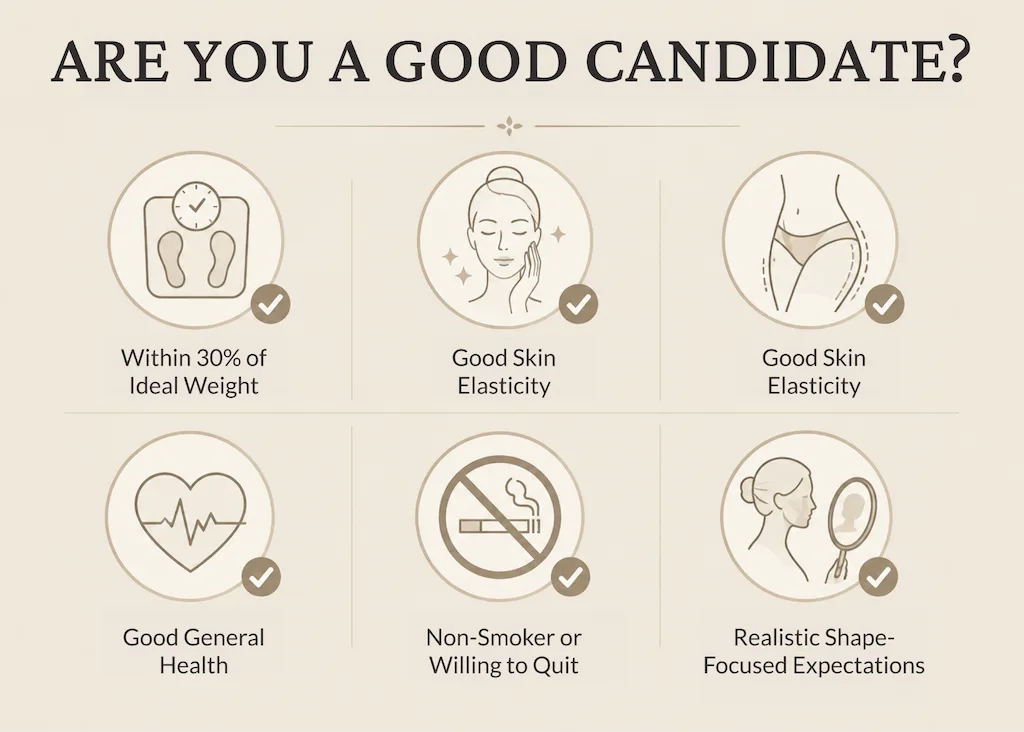
Liposuction works best for a fairly specific candidate, and the criteria are easy to self-check. The procedure refines rather than overhauls, so it suits people already close to where they want to be.
You are likely a strong candidate if most of the following sound like you:
- You are within roughly 30 percent of your ideal weight, with stubborn fat that diet and exercise have not budged
- Your skin still has decent elasticity, so it can settle smoothly over a new contour
- You are in good general health, without conditions that slow healing
- You are a non-smoker, or you are willing to stop well before surgery
- Your weight has been stable, not actively rising or falling
- Your expectations focus on shape rather than the number on the scale
Weight matters here for safety, not just for results. A 2024 study found that a BMI of 30 or above raised the risk of complications by roughly three and a half times. That is why a surgeon may suggest reaching a stable, healthier weight first.
Most of these factors are not something you score on your own. That is what the consultation is for, and it runs in both directions. Your surgeon assesses your skin, anatomy, and health, while you evaluate their approach and whether the plan feels built around you.
Kitty, a patient at our Northside office who valued how closely her care was tailored to her goals, shared her experience:
“Dr Alexander is an amazing surgeon and person. She takes her time to figure out what your goals are and advises accordingly. She has a strong supporting staff who are very knowledgeable and follow up closely. Dr. Alexander was always available to discuss any of my concerns (very few) after my procedure.”
That conversation always happens in person at our Northside or Johns Creek office. Our team builds a customized treatment plan around your anatomy and goals, never a one-size-fits-all template. If you are weighing whether you qualify, you can book your consultation with Artisan Plastic Surgery and get a clear, personal answer.
If a consultation confirms you are a good fit, the next question is practical. So what does the liposuction procedure actually involve?
What happens during the liposuction procedure?

On the day itself, liposuction is more straightforward than many people expect. The core idea has not changed in decades, though a complete patient’s guide to liposuction is the best way to see how each modern technique differs. A thin tube, called a cannula, moves through small openings in the skin to loosen and suction out fat.
What has evolved is the technology around that tube. A few techniques are common today:
- Tumescent liposuction, the longstanding standard, which uses a numbing fluid to ease fat removal and limit bleeding
- Ultrasound-assisted liposuction, which uses sound-wave energy to liquefy fat before removal
- Power-assisted liposuction, which uses a vibrating cannula to break up fat more efficiently
- Laser-assisted and water-jet techniques, which use light energy or a gentle fluid stream
Anesthesia depends on how much area is being treated. Smaller cases can use local numbing, while larger ones use sedation or general anesthesia so you feel nothing. Most procedures run one to three hours, done on an outpatient basis.
You go home the same day, with a friend or family member to drive you. Preparation starts a couple of weeks ahead. You will likely be asked to stop smoking or vaping, and to pause blood-thinning medications like aspirin.
Routine lab work and a ride home round out the checklist. The incisions are tiny, just a few millimeters, and the small scars they leave fade considerably over the months that follow. Once the procedure is done, the real work shifts to recovery.
What is recovery from liposuction like?
Recovery from liposuction is gradual, and most of it is comfortable rather than dramatic. The general arc is predictable, even though the pace varies with how much area was treated.
| Phase | Timeframe | What’s normal | Activity |
|---|---|---|---|
| The first few days | Days 1 to 3 | Soreness like a deep bruise, swelling, a snug compression garment | Rest, short walks around the house |
| Early recovery | About 1 to 2 weeks | Swelling and bruising easing, energy returning | Back to non-strenuous work, no lifting over 5 pounds |
| Building back | Weeks 3 to 6 | Most visible swelling diminishes | Light activity, then a gradual return to exercise |
| Full settling | Several months | The last of the swelling resolving, final contour emerging | All normal activity, no restrictions |
For most people, the discomfort is mild to moderate, closer to soreness than sharp pain. Compression garments do a lot of quiet work here. Worn over the first several weeks, they reduce swelling and help your skin settle smoothly.
Your surgical team will tell you exactly what to watch for. The rare warning signs include swelling much worse on one side, a fever, or calf pain. Just as important is the structured follow-up, and at Artisan, recovery includes scheduled post-operative visits over the first several weeks.
Della, a patient at our Johns Creek location who combined several procedures and still found recovery smooth, shared her experience:
“66 years old, had a Blepharoplasty, face lift, breast augmentation, and tummy tuck all at one time. priced fairly, surgeons excellent, after care superb. Not one problem after surgery, results are amazing.”
Recovery also has a practical cost: time away and the procedure itself. If cost is part of your calculation, you can explore your financing options through Alphaeon Credit, Cherry, and CareCredit. That way the timing can fit your budget, not the other way around.
With the healing behind you, what does the finished result actually look like?
What results can you expect from liposuction?

Liposuction results arrive in stages, not all at once. You will see a difference within the first few weeks as the early swelling lessens. The final contour, though, takes longer to emerge.
Over the next few months, the remaining swelling resolves, and the shape settles into what you keep. Because the fat cells removed are gone permanently, the result tends to be long-lasting, as long as your weight stays steady.
If weight does climb afterward, the fat cells that remain can enlarge. The gain may even show up in areas that were not treated. The procedure changes your shape, but it does not change how your body stores fat.
How a result looks depends on more than the surgery itself. A few factors carry real weight:
- Skin quality, since elastic skin retracts more smoothly over the new contour
- Surgeon skill, the difference between an even result and one that needs refining
- Weight stability afterward, which protects the result over time
- Whether the right technique was matched to the area treated
That second factor is worth dwelling on. Liposuction takes both precision and an artist’s eye, and at Artisan, our surgeons treat each body as a composition to be balanced. A 2025 study of 175 patients reported 95 percent satisfaction with body contour.
Sometimes the best result comes from pairing procedures. If loose skin or a separated abdominal wall is part of the picture, muscle tightening and skin removal for the belly may do what liposuction alone cannot. Your surgeon can tell you whether one procedure or a combination fits your goals.
Conclusion
Back to the question that started this: is it worth it? The honest answer depends on which column carries more weight for your body, your health, and your goals. For the right candidate, liposuction is a permanent, natural change in shape, and for someone it does not suit, a good surgeon will say so.
If you are still weighing it, browsing real before-and-after photos is a grounding next step. They show what the procedure does for bodies like yours, and a personal consultation later fills in what photos cannot.
That decision deserves a practice that takes it as seriously as you do. At Artisan in Atlanta, every patient is met with honest guidance and a plan shaped around them, not a script. When the timing feels right, schedule your visit or call (404) 851-1998 to talk it through.
Frequently asked questions
Is liposuction permanent?
Yes, in the way that matters most. The fat cells removed during liposuction do not grow back, so the contour change holds as long as your weight stays stable. A significant weight gain later can enlarge the fat cells that remain.
Does liposuction remove stretch marks?
No, liposuction does not remove stretch marks. Stretch marks sit in the skin itself, while liposuction works on the fat beneath it. Ask your surgeon about treatments designed for the skin’s surface.
Can men get liposuction?
Yes, men have liposuction routinely. Common areas include the abdomen, the flanks, the chest, and the back. The candidacy criteria are the same for everyone: stable weight, good skin quality, and good general health.
Is liposuction better than CoolSculpting?
Neither is simply better, they suit different goals. Liposuction is surgical and removes more fat from larger areas in one session. CoolSculpting® is a targeted fat cell freezing procedure for milder, smaller pockets of fat.
Can I get liposuction if I’m overweight?
It is possible, but it may not be the right time. Liposuction is most effective and safest for people within about 30 percent of their ideal weight. Above that, a surgeon often recommends reaching a stable weight first.
*Disclaimer: This content is for educational purposes only and does not constitute medical advice. A consultation with a qualified board-certified surgeon is required to determine the best treatment plan for your individual needs and any questions you may have about a medical condition or procedure.

