




You’re eating healthy, and you stay active, and most of your body responds to that effort. But there is usually one area that never gets the message: the lower belly, the outer thighs, or the fullness under the chin. It can start to feel like that one spot is working against everything else you do.
Here is what the research shows. According to ISAPS, liposuction was the most popular surgical procedure among women worldwide in 2024, with more than two million performed. If you have been quietly curious about it, you are in good company.
At Artisan Plastic Surgery, the city’s first woman-led team of plastic surgery specialists in Atlanta, we treat liposuction as a form of sculpting rather than simple fat removal. This guide covers who liposuction tends to suit, how the procedure and its techniques work, and what recovery and results realistically look like.
Key takeaways
A few core ideas carry through everything below. If you remember nothing else about liposuction, remember these.
- Liposuction is a contouring procedure, not a weight-loss method. It removes specific, stubborn pockets of fat, and it works best for people already near a stable, healthy weight.
- Good skin elasticity matters as much as the fat itself, because your skin needs to settle smoothly over the new contour.
- Several techniques exist, from tumescent to ultrasound-assisted, power-assisted, laser-assisted, and water-jet liposuction. No single one is best for everyone.
- Recovery is gradual. Most people return to desk work within one to two weeks, while swelling can take several months to fully resolve before final results show.
- Liposuction is considered safe when performed by a board-certified surgeon in an accredited facility, and most patients heal without any serious issues.
Am I a good candidate for liposuction?

Liposuction works best for a fairly specific kind of candidate. The encouraging part is that the criteria are easy to recognize in yourself.
Most guidance, including from ASPS, points to candidates within roughly 30 percent of a healthy weight for their height. You may be a good fit if you recognize yourself in most of these signs:
- Your weight has held fairly steady for several months, rather than rising or falling
- Your skin is still firm and elastic enough to settle over a new contour
- Specific pockets of fat have stayed put despite a genuine effort with diet and exercise
- You do not smoke, or you are ready to stop well before surgery
- Your general health is good, without conditions that slow healing, such as uncontrolled diabetes or a bleeding disorder
Skin elasticity deserves a closer look, because it quietly shapes the result. When fat is removed, the skin above it needs to retract smoothly. Skin with good tone does this well, while skin loosened by age or rapid weight changes may not.
Stable weight matters for a similar reason. Liposuction removes fat cells from a treated area, but significant weight gain afterward can still enlarge the cells that remain. Holding a steady weight is what protects the work.
Wondering whether a procedure is right for you is a normal part of this process, not a sign of doubt. The only way to know for certain is an in-person evaluation, which is exactly what a consultation at Artisan is built around.
If you are curious where you stand, you can schedule a consultation to get a clear, personalized answer. Knowing you are a candidate is one piece of the picture, and knowing what liposuction can actually treat is the next.
What body areas can liposuction treat effectively?
Liposuction is versatile, one of the cosmetic fat reduction treatments that can refine many parts of the body where fat tends to settle and resist diet and exercise. The areas below are the ones surgeons treat most often.
| Body area | What liposuction can refine there |
|---|---|
| Abdomen and flanks | Stubborn fullness across the midsection and the “love handles” along the sides |
| Thighs, hips, and buttocks | Outer-thigh “saddlebags,” inner-thigh fullness, and hip contour |
| Arms, back, and chest | Upper-arm fullness, “bra rolls” across the back, and chest fullness, including male chest fullness |
| Chin, neck, and face | A double chin and softness along the jawline, for a more defined profile |
Several of these areas can be addressed in the same session. When a plan combines multiple regions, it is sometimes called full-body liposuction, though in practice it is really a thoughtfully sequenced set of treated areas.
It also helps to know what liposuction cannot do, so your results match your expectations. It does not erase cellulite, because the dimpling comes from fibrous bands under the skin that suction does not affect. It will not tighten loose skin on its own, and it does not reach the deeper fat around the organs.
Think of it as refining a silhouette, not resurfacing it. With a clear sense of what the procedure treats, the next question is usually how it is actually done.
How is the liposuction procedure performed?
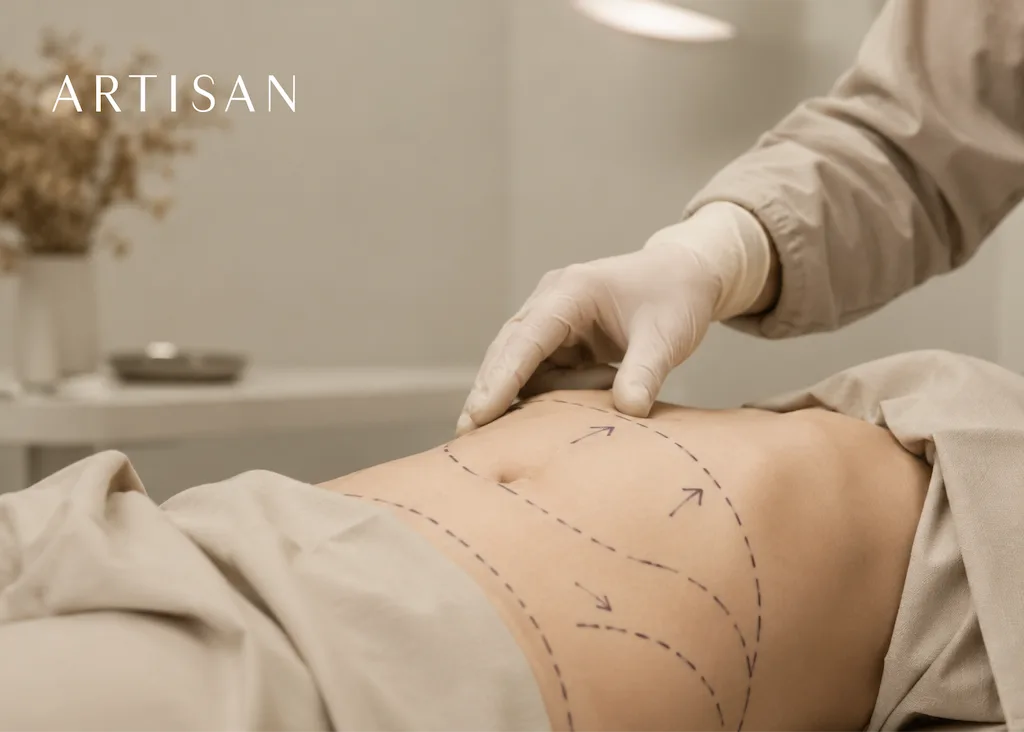
Liposuction follows a consistent set of steps, regardless of the treated area. Knowing the sequence ahead of time tends to make the whole idea feel less abstract and a good deal less intimidating.
Anesthesia and the tumescent technique
Your comfort is managed with anesthesia, and the options range from local anesthesia with sedation to general anesthesia. The choice depends on the size of the procedure. Most liposuction also uses the tumescent technique, where a large volume of dilute numbing fluid is placed into the fat first.
That fluid is a mix of saline, a local anesthetic, and a vessel-narrowing medication. It makes the fat firm and easier to remove while limiting bleeding.
Incisions, the cannula, and removing the fat
Once the area is ready, your surgeon makes very small incisions, often just a few millimeters wide, in discreet spots. Through these openings goes a cannula, a thin hollow tube.
The surgeon moves the cannula in controlled passes to loosen the fat, which is then gently suctioned out. The contour is shaped as they work. The term you may see for all of this is lipoplasty, which simply means surgical fat removal.
Timing and your procedure day
Most liposuction procedures take one to three hours, depending on how many areas are treated and how much fat is removed. At Artisan, liposuction is performed as an outpatient procedure, so you go home the same day. You are released into the care of a loved one who can drive you and help during the first night, and a compression garment usually goes on right away.
Jin, a patient who had a body procedure at our Northside location, shared their experience:
“I had a tummy tuck and diastasis recti repair surgery with Dr. Val. The surgery was very satisfactory and professional. I’m beyond happy with my results and I’m very glad I went with Dr. Val for this procedure. On top of the stellar surgery, the entire staff has been very sweet and delightful to interact with.”
The steps are fairly standard, but the tools used to loosen the fat are not all the same. That brings us to technique.
What types of liposuction techniques exist?
There is no single way to perform liposuction. Different technologies loosen and remove fat in different ways, and each has situations where it shines. Here is how the main approaches compare.
| Technique | How it works | Often used for |
|---|---|---|
| Tumescent liposuction | Dilute numbing fluid is placed in the fat first, making it firm and easier to remove with less bleeding | The widely used foundation technique, suitable across most areas |
| Ultrasound-assisted (VASER) | Ultrasound energy loosens fat before removal, which can be gentler on surrounding tissue | Denser or more fibrous areas, and more defined contouring |
| Power-assisted (PAL) | A motorized cannula vibrates rapidly to break up and remove fat more efficiently | Larger areas and fat that has been treated before |
| Laser-assisted (lipolaser) | A thin laser fiber liquefies fat and warms the skin from underneath | Smaller, precise areas where a little skin tightening is wanted |
| Water-jet assisted (Aqualipo) | A gentle, pressurized stream of fluid separates fat so it can be suctioned with less force | Gentle fat separation, often chosen for comfort and reduced bruising |
A couple of these are worth a closer note. Power-assisted liposuction uses a motorized cannula that speeds up the work and handles fibrous areas more easily. Laser-assisted liposuction, sometimes referred to as lipolaser, had the lowest overall complication rate of any technique in a recent analysis of 23 studies.
You may also come across the word liposculpture. It is not a separate machine at all, just a term for using these tools with an artistic, contouring focus.
So which one is right for you? That is genuinely a question for your surgeon. The answer depends on the treated area, your skin, the amount of fat, and your goals.
Artisan also offers BodyTite, a minimally invasive procedure delivering thermal skin tightening during fat removal for the right candidate.
Every treatment plan is built around you rather than a one-size-fits-all template. That is the whole point of a personalized approach.
Cost naturally enters the conversation here, since technique and the number of areas both influence it. There is no single price that fits every patient, so it helps to plan ahead. To keep the investment manageable, you can explore flexible financing through Alphaeon Credit, Cherry, and CareCredit.
What does recovery from liposuction look like?
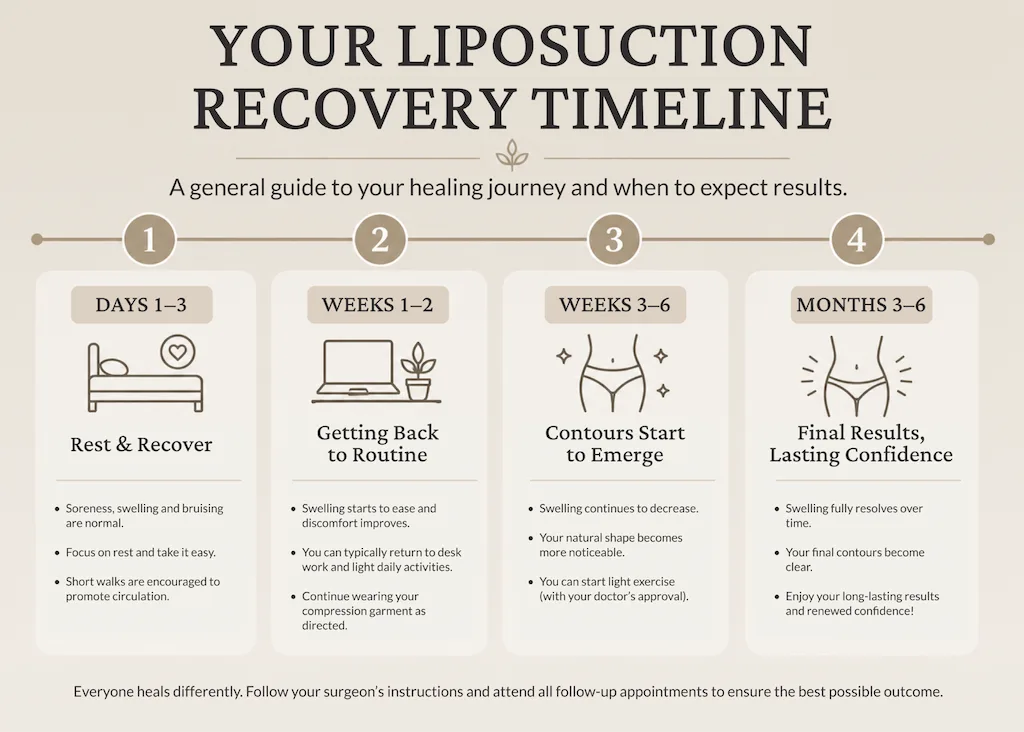
Recovery from liposuction is gradual rather than dramatic, and it tends to be more manageable than people expect. Soreness, swelling, and bruising are normal signs of healing, not signs that something has gone wrong. They ease steadily over the following weeks, and some patients look into how red light therapy can support skin healing during this phase.
| Phase | Timeframe | What is normal | Activity |
|---|---|---|---|
| The first days | Day 1 to 3 | Soreness, swelling, some bruising | Rest, short walks, minimal activity |
| Early recovery | Week 1 to 2 | Swelling and bruising begin to settle | Return to a desk job, no lifting over five pounds |
| Building back | Week 3 to 6 | Most swelling subsides, contours emerging | Light exercise first, then a gradual return to the gym |
| Final results | Month 3 to 6 | Remaining swelling fully resolves | All activity resumed, results settled |
Compression garments do a lot of quiet work in that timeline. They are usually worn around the clock for the first three to four weeks, then about 12 hours a day for several weeks after that. The garment reduces swelling, lowers the chance of fluid collecting, and supports the skin as it settles into its new shape.
A reasonable expectation helps here. You may glimpse improved contours within the first few weeks, but the final result reveals itself slowly as the last of the swelling fades. Being patient and trusting the process is part of the work, and choosing to do so is a sign you are approaching this thoughtfully.
Amanda, a patient who described an easy recovery supported by a knowledgeable team, shared her experience:
“Highest level of expertise and care. Dr Diane Alexander and her team go above and beyond for beautiful, natural results with an emphasis on wellbeing. She takes time to listen to your concerns and does her magic. The recovery process is very easy with her knowledgeable team to support you on your way.”
Recovery naturally raises the bigger question many people hold quietly. How safe is this, really?
What are the risks, and how safe is liposuction?
The honest answer is reassuring. The vast majority of patients move through liposuction and recovery without any serious issues, and it is considered safe when done well. A 2024 analysis of more than 29,000 patients found that serious complications were uncommon, affecting only a small share of cases.
That said, every surgery has a range of normal effects to expect. After liposuction, those typically include temporary bruising, swelling, and some areas that feel less sensitive for a few weeks as the nerves settle. These are part of healing, and they resolve on their own.
Less common, more serious concerns do exist, and they are worth understanding rather than fearing. They include a small pocket of fluid that the body usually reabsorbs, infection, and, rarely, issues tied to large-volume fat removal. Mild contour unevenness can also occur as swelling goes down, with a touch-up occasionally needed.
For each of these concerns, the strongest protection is the same: an experienced surgeon, a careful plan, and good aftercare. This is where your choice of surgeon does the heavy lifting.
Choosing a board-certified plastic surgeon who works in an accredited facility is consistently linked to lower complication rates. At Artisan, our co-founders are board-certified plastic surgeons who have built the practice over more than 25 years. A few practical steps further lower the odds of any problem:
- Choosing an accredited surgical facility and a board-certified surgeon
- Quitting smoking well before and after surgery, since nicotine slows healing
- Avoiding blood-thinning medications in the weeks beforehand, as your team directs
- Holding a stable weight going into the procedure
- Wearing your compression garment as instructed and sharing your full medical history
None of this should feel alarming. It is simply the framework that makes liposuction the well-tolerated procedure it is for most people. It is also exactly what a good consultation is designed to walk through with you.
What happens at a liposuction consultation?
A consultation is the moment liposuction stops being a general idea and becomes a specific, personal plan. It is worth knowing that this visit runs in both directions. Your surgeon is evaluating whether liposuction suits your goals, and you are also evaluating them, their approach, and whether the fit feels right.
A consultation at Artisan begins with an unhurried conversation. Your surgeon performs a hands-on assessment of the area, your skin quality, and your overall health, then talks through which approach would serve your goals best. The recommendation is a customized treatment plan rather than a standard package, the way an artist considers balance and proportion before touching the canvas.
These visits happen in person at our Atlanta-area surgical offices in Northside and Johns Creek, where a hands-on evaluation can do what a screen simply cannot. Cost is part of the discussion, too, and your consultation includes a personalized breakdown along with financing options.
Mya, a patient at our Northside location, described feeling cared for throughout her experience:
“I recently had a breast reduction and tummy tuck performed by Dr. Sybile Val, and I couldn’t be happier with my results. Dr. Val is not only an exceptionally skilled surgeon but also a genuinely kind and compassionate person. She went above and beyond to make sure I was comfortable and informed every step of the way.”
Conclusion
Think back to that one stubborn area, the spot that never seemed to respond, no matter how consistent you were. You now have a clearer picture of why that happens and what liposuction can, and cannot, do about it. That alone makes the decision feel less like a leap and more like an informed next step.
Browsing real patient photos that match your own starting point is one of the most grounding things you can do next. A before-and-after gallery shows what these techniques look like in practice, and a personal conversation fills in the details that photos cannot.
Every patient deserves to feel heard, respected, and confident in the choices they make about their own body. That belief is the heart of how Artisan approaches the art of personalized beauty here in Atlanta. When you are ready, reach out to our team or call (404) 851-1998, and we will meet you where you are.
Frequently asked questions
Will liposuction remove cellulite?
Not really. Liposuction removes fat beneath the skin, but cellulite comes from fibrous bands that tether the skin down, and suction does not change those bands. Some patients see a small visual improvement, but liposuction is not a cellulite treatment.
How painful is liposuction recovery?
Most people describe the first few days as soreness similar to an intense workout or a large bruise. It is manageable with the pain medication your surgeon provides. Discomfort eases noticeably within one to two weeks, and swelling lingers longer but is more of a nuisance than a pain.
Can you gain fat back after liposuction?
The treated fat cells do not return, but the fat cells that remain in your body can still enlarge with significant weight gain. That can soften your results. A steady weight, supported by normal diet and exercise, keeps the outcome looking the way it did at first.
Is liposuction safe for older patients?
Age by itself is not a disqualifier. What matters far more is your overall health, your skin quality, and any existing medical conditions. A thorough preoperative evaluation by our board-certified surgical team determines suitability for every patient, regardless of age.
Can men get liposuction for chest fat?
Yes. Liposuction is commonly used for men to address excess chest fullness, sometimes related to gynecomastia. It is one of the more frequently requested body procedures among male patients, and a consultation determines the right approach.
*Disclaimer: This content is for educational purposes only and does not constitute medical advice. A consultation with a qualified board-certified surgeon is required to determine the best treatment plan for your individual needs and any questions you may have about a medical condition or procedure.

