



You know the moment: you step out of the shower, catch a glimpse in the mirror, and can’t help but notice the subtle changes in your silhouette. Maybe it’s the result of breastfeeding, weight loss, or just the natural march of time, but the thought sneaks in: can I really lift my breasts naturally?
If you’ve ever paused at that question, you’re not alone, and you’re certainly not out of options. The world of non-surgical breast lifting is broader, more effective, and better researched than ever before. This shift toward less invasive options is reflected in global trends, as more women seek out technology-driven results over surgery.
According to ISAPS, 356,072 non-surgical skin-tightening procedures were performed worldwide in 2024, highlighting a massive surge in patients prioritizing rejuvenation with minimal downtime.
At Artisan Plastic Surgery in Atlanta, a practice known for breast augmentation and body sculpting services, our team is used to guiding that conversation honestly. We’ll walk through what causes sagging, which non-surgical methods live up to the hype, and when surgery is a better fit.
Key takeaways
Here’s a quick overview of the most important facts about non-surgical breast lifting:
- Sagging, medically called ptosis, is driven by stretched Cooper’s ligaments and loss of skin elasticity. Aging, pregnancy, weight changes, smoking, and sun damage all play a role.
- Chest exercises strengthen the pectoral muscles beneath the breast tissue and improve posture, which can make the chest look firmer, but they cannot lift sagging breast tissue itself.
- Lifestyle habits such as wearing a well-fitted, supportive bra, maintaining a steady weight, not smoking, and staying hydrated help slow further sagging rather than reverse existing sagging.
- Non-surgical treatments such as radiofrequency skin tightening, microneedling-plus-RF devices, PRP, and PDO thread lifts can provide subtle firming for mild-to-moderate sagging in patients with reasonable skin elasticity.
- For moderate-to-severe sagging, a surgical breast lift remains the only approach that repositions tissue, removes excess skin, and delivers a lasting change in shape.
What causes breasts to sag in the first place?
Before you can lift, it helps to know what you’re lifting against. Sagging, medically called ptosis, is the slow stretching of two support structures: the skin envelope and the internal Cooper’s ligaments. Understanding why they give way is the first step in choosing a strategy.
Aging and ligament changes
Skin and ligaments both lose structural integrity over time. A clinical reference describes breast ptosis as a multifactorial process involving reduced skin elasticity, gravitational forces, and stretching of supporting structures such as Cooper’s ligaments. Even with stable weight and activity levels, these changes can gradually alter breast shape and position.
Pregnancy, breastfeeding, and weight change
Pregnancy temporarily increases breast volume and stretches the skin and ligaments, and each additional pregnancy tends to worsen ptosis. Breastfeeding itself does not independently cause sagging, despite the common belief. The changes come from the pregnancy and the tissue shifts afterward. Major weight loss or repeated fluctuations above roughly 50 pounds also leave extra skin behind.
Gravity, support, and lack of bra support
Gravity pulls on breast tissue continuously, and larger breasts carry more load on the same ligaments. Research on running biomechanics has shown that high-impact activity without proper support produces significant skin strain. That kind of strain, repeated over the years, accelerates the stretching process.
Smoking, sun damage, and posture
Cigarette smoking breaks down elastin and is often cited as one of the strongest predictors of ptosis. Sun exposure reduces elastin and blood flow in the overlying skin. Poor posture, while not a true cause of sagging tissue, makes the chest read as droopier by rolling the shoulders forward.
Knowing the cause shapes the fix. If your goal is to prevent further change, lifestyle habits carry real weight. If your goal is dramatic reshaping, tools that actually address ligament and skin anatomy become relevant.
Which exercises can help lift and firm the chest area?

Exercise is often promoted as a non-surgical solution, but the reality is more limited and practical than headlines imply. While chest exercises can’t directly lift breast tissue, since it is composed of glandular and fatty tissue, they can strengthen the underlying pectoral muscles. This can alter the chest’s contour and enhance posture, giving the appearance of a firmer chest.
Here’s what the research actually supports for the chest area:
- Push-ups activate the pectoralis major at roughly 61%-63% of a trained subject’s maximum bench press effort, making them an efficient starting point for no-equipment training.
- Chest presses (seated or bench) activate the pectorals at about 79% of bench-press max, the highest in controlled EMG testing, per ACE Fitness research.
- Dumbbell flies isolate the pectorals and help round out the front of the chest.
- Dips activate the pecs at roughly 69% of bench-press load, though they also ask for significant shoulder stability.
- Upper-back moves such as rows, reverse flies, and cobra pose pull the shoulders back, correcting the forward-rounded posture that makes sagging look worse.
- Swimming and yoga backbends strengthen the chest and upper back together, helping maintain the silhouette longer.
Session frequency and timeline
To build muscle without overtraining, two to three sessions per week are sufficient. A study in the Journal of Exercise Science & Fitness found that eight weeks of low-load push-ups increased pectoralis thickness by roughly 22%. While you can expect to see a shift in chest shape within six to eight weeks, with more significant results at three to six months, it is important to note the limitations. Building the underlying muscle provides a firmer foundation, but exercise cannot physically lift sagging breast tissue or repair stretched skin.
What lifestyle changes help firm up sagging breasts?
If exercise sets the stage, daily habits determine how much ground you maintain. These steps will not reverse sagging that has already occurred, but they slow further change.
A well-fitted, supportive bra is the single most researched habit. High-support sports bras significantly reduce breast motion and cut peak skin strain during high-impact activity. A properly sized everyday bra distributes the load across your torso rather than hanging it from your shoulders.
Diet, hydration, and avoiding smoking all touch the same skin-quality lever. Harvard research indicates that water-rich foods such as cucumbers and celery contribute meaningfully to daily hydration.
Furthermore, a meta-analysis of 16 randomized trials found that 1 to 10 grams of collagen peptide daily increases skin hydration and elasticity. Conversely, smoking cessation is one of the most protective measures you can take, as nicotine actively degrades the collagen and elastin fibers that maintain the skin’s “envelope,” accelerating the sagging process.
Keeping body weight reasonably steady matters too. Rapid loss or repeated weight cycling leaves behind stretched skin that lifestyle alone cannot retighten. Posture work, firming creams, and massage all have smaller supporting roles. Creams may soften and hydrate the skin’s surface, but there is no strong evidence that they lift tissue. Massage helps circulation and comfort without an independent lifting effect.
If something on this list feels like it might apply to your situation, our team can help you sort out what’s worth prioritizing before you consider a clinical option.
What non-surgical treatments actually deliver a breast lift?
When lifestyle and exercise hit their ceiling, non-surgical in-office treatments can move the needle a little further for the right candidate. None of them replaces a surgical lift, but several can produce visible firming on mild to moderate sagging in patients with reasonably good skin elasticity. Here is how the main options compare.
Radiofrequency skin tightening
Radiofrequency devices deliver controlled heat to the dermis, causing immediate collagen contraction and stimulating new collagen production over the following weeks. A clinical review of RF for body laxity reported 67%- 78% improvement at 1-2 months in patients treated for skin laxity.
At Artisan, we offer Morpheus8, which delivers radiofrequency microneedling for firmer skin, and Sylfirm, which provides collagen stimulation treatment options for skin firming. Most patients need three or more sessions to achieve their goal.
Platelet-rich plasma
A Vampire Breast Lift uses platelet-rich plasma spun from your own blood and injected into the upper chest area to stimulate collagen and improve skin texture. Patients usually see subtle firming at 3-4 weeks, with results continuing to improve over two to three months. It’s most useful for texture and mild perkiness, not a visible reposition.
PDO thread lifts
Polydioxanone (PDO) threads are absorbable sutures placed under the skin to mechanically lift tissue and stimulate local collagen. A study of PDO thread lifts reported ptosis scores dropping from 2.3 to 0.7, with 80% patient satisfaction. Threads work best for mild to moderate sagging and are not a match for severe drop.
Microfocused ultrasound
Microfocused ultrasound creates tiny heating points at precise depths beneath the skin, prompting new collagen formation without breaking the surface. A study on MFU for the neck reported a 73% lift at the submental area in a blinded assessment. Outcomes on the chest are more variable, and realistic expectations are essential.
| Treatment | Best for | Sessions typically needed | Where it lives on the scale |
|---|---|---|---|
| Radiofrequency (Morpheus8, Sylfirm) | Mild to moderate skin laxity, collagen loss | 3 or more | Non-surgical |
| PRP (Vampire Breast Lift) | Texture, mild perkiness | 2 to 3 | Non-surgical |
| PDO thread lift | Mild to moderate sagging (grade I-II ptosis) | 1 initial, maintenance every 12-15 months | Non-surgical |
| Microfocused ultrasound | Mild skin tightening | 1 to 2 | Non-surgical |
Non-surgical options like RF and PRP work well for early concerns and skin-quality maintenance, while surgical procedures like a breast lift address more advanced structural changes. The ideal candidate for non-surgical lifting typically has mild-to-moderate sagging, good skin elasticity, and realistic expectations.
Every treatment plan at Artisan is customized to your anatomy, goals, and lifestyle, so the protocol is curated rather than pulled from a menu. Book your visit at Beaute Buckhead or Beaute Westside, and our team will design a plan around what your skin actually needs.
Kari C., a patient whose laser treatment plan shifted how she felt about her own skin, shared her experience:
“After playing tennis for several years in the hot Georgia sun my skin started really showing skin damage. I have been working with Lauren and she has been doing a combo of Moxi and BBL laser treatments which is helping me feel way more comfortable in my own skin. She is very professional and has really helped.”
How effective are these methods, and when is surgery the better choice?
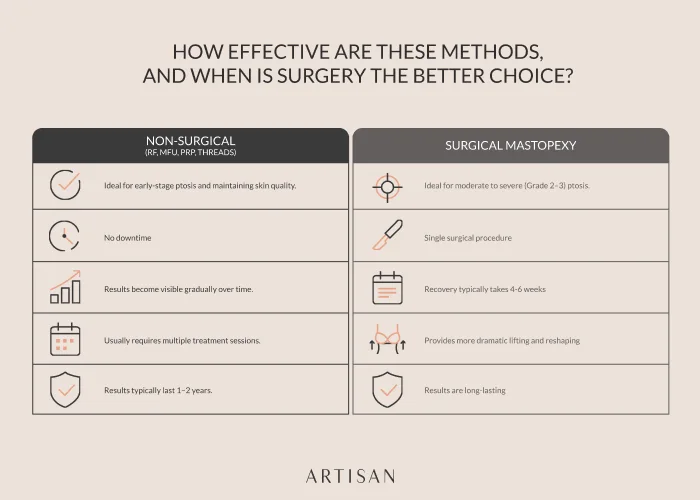
Here is the pattern research consistently shows. Natural methods and non-surgical devices can improve tone and deliver subtle firming for mild to moderate sagging. They cannot reposition nipple height or correct a severe drop. Sound familiar? Ptosis is a structural change, and anything that doesn’t address the structure can only go so far.
A surgical breast lift, known as mastopexy, is designed to lift and reshape sagging breasts, removing excess skin and lifting the tissue higher on the chest wall. It also refines the shape of the underlying support. The number of mastopexy procedures increased by about 30% from 2019 to 2022, indicating that more women are opting for this surgery after pregnancy, weight fluctuations, or natural aging. The results tend to last for years when lifestyle remains stable, though ongoing natural forces still cause sagging over time.
Signs that surgery is the better fit
A surgical lift is generally more suitable when the nipple is at or below the inframammary fold, skin elasticity is limited, or non-surgical methods have been attempted. Post-pregnancy and post-weight-loss bodies frequently fit this profile due to diminished elasticity reserves. Consulting with a board-certified surgeon can help determine the degree of ptosis.
The consultation experience
An in-person consultation is a two-way evaluation. It’s an opportunity for you to assess your surgeon’s approach and philosophy, not just a moment for your surgeon to evaluate your anatomy.
At Artisan, your visit starts with a discussion about your goals and a practical evaluation of your tissue and skin. Your surgeon explains all suitable options based on your anatomy and creates a personalized plan that aligns with your lifestyle. You depart with detailed, customized guidance rather than a generic template. Researching carefully before a decision this personal is exactly the right approach.
Melissa R., a patient who chose a surgical breast lift with implants after other routes, shared her experience:
“When I tell you Dr Val is the absolute best I truly mean it. I’ve had cosmetic surgery in the past (in 2016) and this time I decided to go with a different doctor and I’m so glad I did. Dr Val listened to me and understood what I wanted to look like and got the job done. I had a breast lift with implants.”
Conclusion
That peaceful moment in front of the mirror, when the question first arises, calls for a kind and thoughtful response, not a hurried one. Whether you’re exploring non-surgical options for prevention or thinking about surgery because your body has naturally changed, there’s no single right way to begin. The key is to remember that both options can be valuable, depending on your personal anatomy and what you hope to achieve.
To understand what’s achievable, explore our before-and-after gallery to find patients with similar starting points. Viewing real breast lift results sorted by procedure helps turn the question of “what if” into a tangible visualization. Afterwards, an in-person consultation allows us to apply what you’ve seen and create a personalized plan tailored to your lifestyle and goals.
At Artisan Plastic Surgery, we see each patient as a unique individual, and we would be truly delighted to be part of your journey. To help you make your transformation smoother and more affordable, we offer flexible financing options through Alphaeon Credit, Cherry, and CareCredit. This way, investing in yourself feels just right for your budget.
Ready to move from research to results? Whether you want to explore non-surgical firming or a surgical lift, our team is here to guide you with honesty and expertise. Book your personal consultation online at one of our four Atlanta-area offices, or call us at (404) 851-1998 to take the first step toward the silhouette you deserve.
Frequently asked questions
Do chest exercises actually lift sagging breasts?
Chest exercises strengthen the pectoral muscles beneath the breast tissue and can create the illusion of a firmer chest. They do not lift the breast tissue itself, since it consists of skin, fat, and glandular tissue.
What is the best bra for preventing sagging?
A well-fitted everyday bra with wide straps and a firm band offers the most support for daily wear. For high-impact activity, a dedicated sports bra that reduces motion is important. Fit matters more than brand.
Do firming creams really work on breasts?
Firming creams can provide temporary hydration and smoothing of the skin’s surface. However, there is no strong evidence that topical products can lift breast tissue. While they can complement a skincare routine, they do not replace more profound tissue-level treatments.
How effective are thread lifts for the breast area?
PDO thread lifts can offer a mechanical lift and stimulate local collagen for mild to moderate sagging. Clinical studies report meaningful improvement and high patient satisfaction at six months. They are not a match for a severe drop and usually need maintenance within a year or so.
Can I firm my breasts naturally after pregnancy?
Exercise, supportive bras, steady weight, and good skincare can improve chest tone after pregnancy. Significant sagging from the pregnancy itself often persists regardless of lifestyle, which is why many women revisit the question once they are done having children.
How soon do non-surgical lifts show visible results?
Subtle firming from radiofrequency or PRP usually appears at three to four weeks, with continued change over two to three months as collagen remodels. Thread lifts provide an immediate mechanical lift at the placement visit, then continue to refine over time.
Are there risks with PRP breast treatments?
PRP carries minor risks such as bruising, swelling, and tenderness at the injection sites. It is not recommended during pregnancy or breastfeeding or for patients with certain blood disorders. A consultation with a qualified provider is the safest way to assess fit.
Does smoking cause breast sagging?
Smoking is one of the stronger accelerators of ptosis because nicotine breaks down the collagen and elastin that keep skin resilient. Quitting does not reverse sagging that has already occurred, but it helps protect the skin quality you have.
What if natural methods don’t work for me?
If lifestyle changes and non-surgical treatments have reached their limit, consulting a board-certified plastic surgeon is the most logical next step. At Artisan, our team guides you through both surgical and non-surgical options and provides flexible financing to make the process comfortable and manageable.
*Disclaimer: This content is for educational purposes only and does not constitute medical advice. A consultation with a qualified board-certified surgeon is required to determine the best treatment plan for your individual needs and any questions you may have about a medical condition or procedure.