




Most of what people read as “aging” on a face is actually happening in the midface. The fat pads over the cheekbones drift downward, the line from cheek to jaw softens, and eventually it folds into a jowl. The skin shows the change, but it isn’t the source of it. A deep plane facelift is the technique built to address that descent at its source — repositioning the deeper tissues themselves, rather than stretching the skin above them.
It is also a procedure more patients are choosing. According to the American Society of Plastic Surgeons, about 79,058 facelift surgeries were performed by ASPS member surgeons in 2024. It’s a small uptick over the year before, and a sign that fillers and threads can no longer give some patients the lift they want.
At Artisan Plastic Surgery, the city’s first woman-led practice for personalized plastic surgery in Atlanta, our team approaches facial rejuvenation as an art of refinement. This article walks through what a deep plane facelift actually is, who it tends to suit best, and what to expect from the result.
Key takeaways
Before we go deeper, here is what we want you to leave with:
- A deep plane facelift works underneath the SMAS layer, repositioning deeper tissues rather than tightening only the skin.
- Compared with traditional skin-only or surface-level SMAS techniques, deep plane lifts address the midface, jowls, and neck more thoroughly.
- Good candidates typically have moderate to advanced midface descent, deep nasolabial folds, jowls, or neck laxity, and are in good general health.
- Recovery includes one to two weeks of meaningful downtime, with most patients returning to work within two weeks.
- Final results refine over several months as residual swelling resolves, and they tend to outlast non-surgical alternatives by years.
What is a deep plane facelift and how does it differ from other facelifts?

A deep plane facelift is among the advanced techniques for facial restoration that lift your cheek, jawline, and neck as a single composite unit. Instead of pulling the skin tighter, your surgeon works beneath a structural layer called the SMAS to move the underlying tissues back into place.
The SMAS, short for superficial musculoaponeurotic system, is a fibromuscular layer connecting the muscles of facial expression to the dermis above. As you age, this network and its anchoring ligaments loosen, which is why cheeks descend and jowls form. Working below the SMAS lets your surgeon release retaining ligaments and reposition tissue without putting tension on the skin itself.
Here is how the most common surgical lift options compare in practice.
| Technique | What it targets | Best suited for |
|---|---|---|
| Traditional skin-only lift | Skin only, no deeper tissue | Mild laxity; largely outdated as a stand-alone approach |
| SMAS facelift | Skin plus the SMAS layer | Mild to moderate aging in the lower face and jawline |
| Mini facelift | Smaller incisions, limited ligament release | Early signs of aging, mostly along the jawline |
| Deep plane facelift | Lifts skin, SMAS, and underlying fat as one composite flap | Moderate to advanced midface descent, jowls, neck laxity |
Because the deep plane technique repositions tissue at a structural level, it tends to avoid the windswept look that older methods sometimes produced. The face moves naturally when you smile or talk. The lift settles in along the cheekbones, jawline, and upper neck, not along the hairline.
The areas it tends to address most effectively include the midface, the deep folds running from the nose to the corners of the mouth, the jowls along the jawline, and the upper neck.
What are the main benefits of a deep plane facelift?
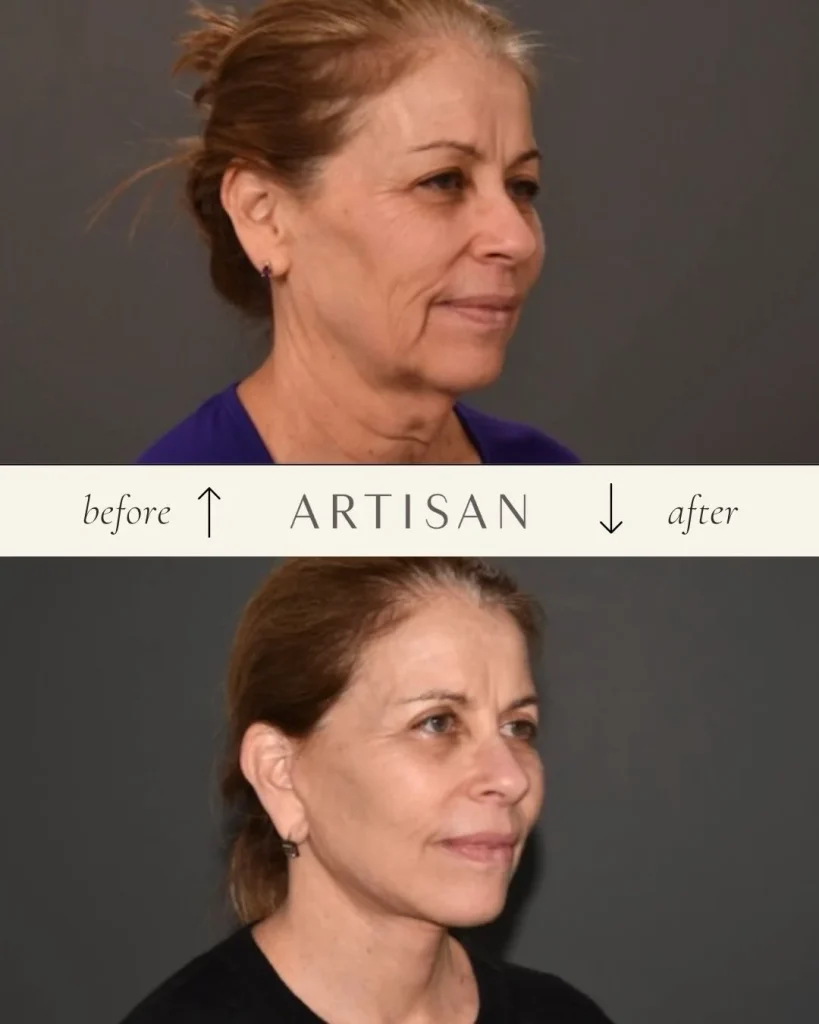
The benefits begin with how the result looks. Because your surgeon repositions deeper structural layers rather than pulling the skin, the lift tends to read as natural movement rather than a tightened mask. Cheek volume returns to a more youthful position, the line from mouth to chin softens, and the jawline regains a clearer edge.
A 2025 meta-analysis of 21 studies covering 2,896 patients reported a 94.4% satisfaction rate with the deep plane technique, compared with 87.8% for traditional SMAS approaches. What patients tend to describe in their own words is that they look like themselves again, just rested.
There is a structural reason the results last longer too. By releasing retaining ligaments and supporting the lift at the deeper fascia level, the face is held in place by tissue rather than skin tension. That foundation tends to age more gracefully than a surface lift.
Healing also tends to benefit. Because the skin and underlying tissues stay attached as a single flap, blood supply through small vessels remains intact, which supports faster healing and helps reduce skin issues during recovery.
At Artisan, our board-certified plastic surgery team approaches every facelift as an artistic composition, refining the underlying structure rather than imposing a generic outcome.
How is the deep plane facelift procedure performed?
A deep plane facelift is an outpatient surgical procedure performed under general anesthesia. It typically takes around three to five hours, depending on the extent of the lift.
Here is what generally happens during the surgery, step by step:
- You receive general anesthesia so you are comfortable and asleep for the entire procedure.
- Your surgeon makes carefully planned incisions along the hairline, around the front of the ear, and behind the ear, where healed scars sit in natural creases or are hidden by hair.
- Working beneath the SMAS layer, your surgeon releases the retaining ligaments, including the zygomatic, masseteric, and mandibular ligaments. These small bands of tissue anchor the SMAS to the bones underneath.
- The skin and SMAS are then lifted as a single composite unit and repositioned upward and slightly outward. Suspension sutures hold the deeper tissue in its new position.
- Excess skin is trimmed conservatively, and incisions are closed with fine sutures. A small drain may be placed behind the ear, and a soft dressing is applied.
Most patients are observed for several hours after surgery before going home with a caregiver. Some surgeons admit patients overnight for monitoring depending on the case.
Am I a good candidate for a deep plane facelift?
A good candidate for a deep plane facelift typically has moderate to advanced facial aging that injectables can no longer fully address. Candidacy is less about a specific age and more about what your face is showing and what your goals are, though how facelift timing changes with age is still worth understanding.
The signs that often point toward a deep plane lift include:
- Visible midface descent, where the cheek has dropped and the line under the eye looks longer
- Deep nasolabial folds running from the nose to the corners of the mouth
- Marionette lines extending downward from the corners of the mouth
- Pronounced jowls along the jawline
- Loose skin or banding in the upper neck
Skin quality also matters, though perhaps less than people assume. The deep plane technique relies on structural support more than skin tension, so it can work for patients whose skin has thinned with time.
General health, on the other hand, is non-negotiable. Most surgeons prefer non-smokers (or patients willing to stop for several weeks before and after surgery), people without conditions that impair healing, and patients with stable weight and blood pressure.
Carey, A., a patient at our Northside office who described how the consultation experience shaped her confidence, shared:
“Highest level of expertise and care. Dr Diane Alexander and her team go above and beyond for beautiful, natural results with an emphasis on wellbeing. She takes time to listen to your concerns and does her magic. The recovery process is very easy with her knowledgeable team to support you on your way.”
At Artisan, every consultation is held face-to-face. You get a hands-on assessment, an honest conversation about your goals, and a customized plan, never a one-size-fits-all recommendation. If a complementary procedure such as eyelid surgery or a deep neck lift would round out the result, our team will walk you through those options in the same visit.
If you are weighing whether this is the right next step, schedule a consultation and we will help you sort through the options at a pace that feels right.
What is recovery like after a deep plane facelift?
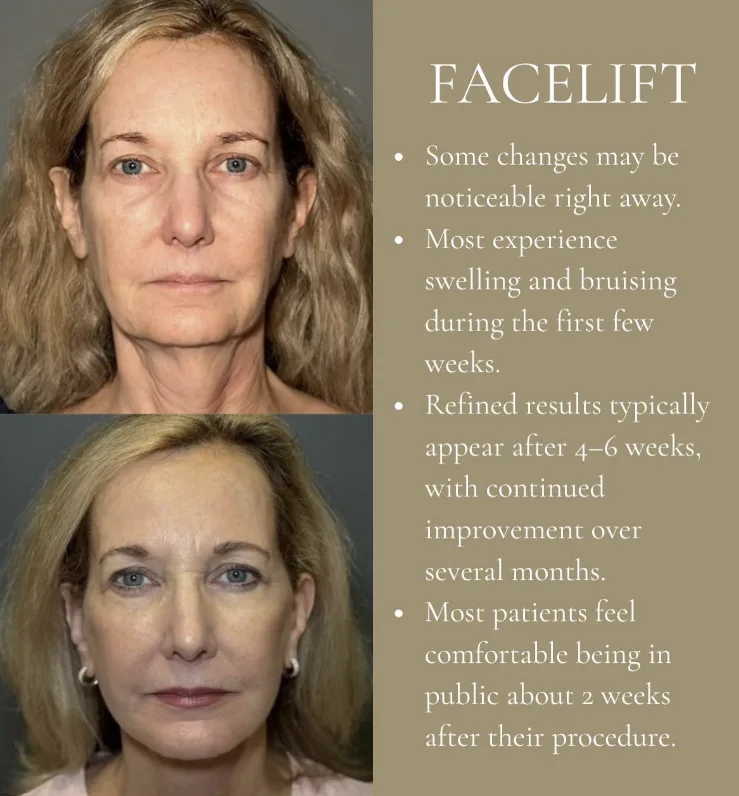
Recovery from a deep plane facelift unfolds in phases, and most patients are surprised by how quickly the worst of it passes. Swelling and bruising peak in the first few days, then ease meaningfully in the second week.
Here is a general guide to what is normal at each stage.
| Phase | Timeframe | What is normal | Activity |
|---|---|---|---|
| Immediate recovery | Days 1 to 3 | Tightness, mild soreness, peak swelling and bruising | Rest, short walks, head elevated 24/7 |
| Early recovery | Week 1 | Bruising starts fading, soreness becoming stiffness | Gentle activity, no bending or lifting |
| Social recovery | Weeks 2 to 3 | Most bruising resolved, swelling settling | Return to desk work, light social outings |
| Active recovery | Weeks 4 to 6 | Residual swelling continues to ease, scars softening | Resume moderate cardio, then full exercise as cleared |
| Final settling | Months 3 to 6 | Final contours emerge as remaining swelling resolves | Full activity, ongoing skincare and sun protection |
Pain in the first week is typically described as a 3 to 4 out of 10, more like firm tightness than sharp pain. Most patients return to desk work around 10 to 14 days. Many feel comfortable in public around two to three weeks once bruising fades enough for makeup to do its job.
Restrictions during the first few weeks protect the lift and limit swelling. Bending, heavy lifting, vigorous exercise, and hot showers are off the table for the first two to four weeks. Sleeping with your head elevated, staying hydrated, and a protein-rich diet all support healing.
At Artisan, our team supports recovery with follow-up appointments at three days, seven days, two weeks, four weeks, and six weeks. Many of those visits are paired with lymphatic massage, red light therapy, and specific guidance on what to expect.
What results and longevity can I expect from a deep plane facelift?
Initial results begin to emerge in the second and third week as bruising fades and swelling subsides. The final result of a deep plane facelift takes time to settle. Contours continue to refine over the following months as deeper tissues find their new position.
By the three to six month mark, most patients see the result the surgery was designed to deliver. Cheeks are lifted into a more youthful position, the midface looks smoother, nasolabial folds soften, and the jawline regains a clearer edge.
By six to twelve months, almost all swelling has resolved, scars continue to fade, and the upper neck looks tightened. Many patients say their satisfaction actually grows during this final settling year.
One of the things that defines a successful deep plane lift is what other people see, or rather, what they do not see. Friends notice that you look rested, refreshed, less tired, without being able to put their finger on what you have done.
Mobley, S., a recent facelift patient at our Northside location, described her experience this way:
“I had a facelift with upper and lower eye surgery with Dr. Diane Alexander at Artisan, and I’m so pleased with my experience so far. Dr. Alexander and her entire medical staff have been wonderful — attentive, caring, and professional every step of the way.”
How long the result lasts depends on a mix of factors, including your skin quality, sun exposure, weight stability, smoking status, and overall health. The deep plane technique is widely considered one of the longer-lasting facelift options. Results persist for years, and excellent skincare, daily SPF, and a stable lifestyle extend that timeline meaningfully.
If touch-ups become useful later, they tend to be less involved than the original surgery. At Artisan, we treat facial rejuvenation as a relationship, and our Deep Plane Facelift patient results gallery gives you a sense of how that long view tends to play out.
Conclusion
That quiet shift you noticed in the mirror has a lot of company, and a lot of options behind it. A deep plane facelift is one of the more comprehensive ones, designed for the kind of structural change that softer treatments cannot reach.
The most useful next step is rarely a decision, it is a look. Browsing our before-and-after gallery of real patients tends to clarify what is possible, and a personal conversation fills in the rest.
When you are ready, our team at Artisan in Atlanta would be honored to be part of that conversation. You can reach out to our team or call (404) 851-1998 to speak with someone about a personal consultation. The Art of Personalized Beauty is, in the end, a way of saying that your face deserves a plan as specific as you are.
Frequently asked questions
How much does a deep plane facelift cost?
The cost of a deep plane facelift varies based on the extent of the lift, your surgeon’s experience, the surgical facility, anesthesia, and any complementary procedures. Because every plan is customized, the most accurate number comes from a personal consultation.
How long does the surgery take?
A deep plane facelift typically takes around three to five hours under general anesthesia. More complex cases or combinations with a cosmetic eyelid lift procedure, brow lift, or neck refinement can extend the time. Your surgeon will give you a specific estimate at your consultation.
Will I have visible scars after a deep plane facelift?
Incisions are placed along the hairline, in front of the ear, and behind the ear, where they are designed to heal in natural creases or be hidden by hair. Scars typically fade and become less noticeable over the following months, especially with sun protection and gentle scar care. Visible permanent scarring is uncommon when an experienced surgeon performs the procedure.
Is a deep plane facelift painful?
Discomfort is generally moderate, often described as tightness or soreness rather than sharp pain. Most patients rate it around 3 to 4 out of 10 in the first week. Prescribed medication manages it well during the early days, and many patients shift to over-the-counter relief sooner than they expect.
What are the risks of a deep plane facelift?
As with any surgical procedure, there are potential risks. These include small pockets of fluid or bruising under the skin, temporary nerve weakness, infection, asymmetry, and changes in scar appearance. Permanent nerve injury is uncommon when an experienced surgeon performs the procedure. Our team walks through every risk in detail at your consultation.
How soon can I wash my hair after surgery?
You will typically keep your head bandaged for the first day or two and avoid showering until your surgeon clears it. Most patients are able to gently shampoo around 24 to 48 hours after surgery once dressings are adjusted. Specific timing depends on your individual surgical plan.
Can smokers have a deep plane facelift?
Smoking interferes with healing and increases the risk of skin issues, so most surgeons require patients to stop smoking for several weeks before and after surgery. The deep plane technique tends to be a more forgiving option in this respect. Quitting is still strongly recommended for the safest result.
How is a deep plane facelift different from a ponytail facelift?
A deep plane facelift is a comprehensive surgical lift performed beneath the SMAS layer, addressing the midface, jowls, and neck through full-length incisions. A “ponytail” facelift is a marketing term for a smaller, more limited lift, typically performed on younger patients with mild laxity and shorter incisions. The two are designed for very different stages of facial aging.
How does the surgery affect the facial nerves?
The deep plane technique requires careful dissection near branches of the facial nerve. This can cause temporary weakness or numbness as the nerves recover. Permanent nerve injury is uncommon in experienced hands. Our board-certified surgical team plans every dissection to protect those nerves.
When can I wear makeup again after my facelift?
Most patients are able to wear makeup around two weeks after surgery, once incisions have closed and swelling has settled. Your surgeon will confirm timing at your follow-up appointment. Sun protection over makeup is especially important during the early months.
Can a deep plane facelift fix a sagging neck or “turkey neck”?
Yes. The technique addresses neck laxity by repositioning the platysma muscle, releasing supporting ligaments, and restoring the angle between the chin and neck. Many patients combine it with focused neck refinement for a smoother result through both the jawline and upper neck.
*Disclaimer: This content is for educational purposes only and does not constitute medical advice. A consultation with a qualified board-certified surgeon is required to determine the best treatment plan for your individual needs and any questions you may have about a medical condition or procedure.

