



You catch a glimpse of your reflection in a store window and pause. The jawline has softened, the skin along your cheeks has begun to drift, and your neck tells a story you are not quite ready to tell. The face looking back does not match the energy you feel inside.
That feeling is something many people understand deeply. In fact, many individuals begin exploring their options when their appearance no longer aligns with how they feel internally.
According to the American Society of Plastic Surgeons, 79,058 facelifts were performed by board-certified plastic surgeons in 2024 alone.
Globally, the International Society of Aesthetic Plastic Surgery (ISAPS) reported that more than 737,000 facelifts were performed worldwide in 2024, a 7.4% increase from the previous year and a remarkable 75.9% jump compared to 2020. That kind of growth tells a clear story: more people than ever are choosing to invest in how they look and feel.
Modern facelift techniques have evolved well beyond the tight, pulled look of decades past. Today, facial rejuvenation surgery is about restoring your natural contours, not changing who you are.
As the city’s first woman-led plastic surgery practice, Artisan Plastic Surgery, a skilled Atlanta cosmetic surgeon team, brings over two decades of facial rejuvenation expertise to every consultation. The practice’s board-certified plastic surgeons take an artistic, highly personalized approach to every facelift, treating each patient as a unique canvas.
Patients exploring facial plastic surgery in Atlanta can discuss their facial rejuvenation goals and treatment options during a personalized consultation.
Every procedure is artfully tailored to deliver results that honor the features that make you unique. This guide walks you through everything from what a facelift involves and how it works, what to expect during recovery, to choosing the right technique for natural-looking results.
At a Glance
- A facelift (medically called a rhytidectomy) lifts and repositions sagging facial tissues to restore a more youthful appearance, turning back the clock by several years without stopping the aging process
- Modern techniques like SMAS (the muscular layer just beneath your skin) and deep plane facelifts work on deeper tissue layers, delivering long-lasting results that vary based on technique, skin quality, and lifestyle
- Ideal patients are generally 40 to 70 years old or older, in good health, non-smokers, with realistic expectations about outcomes
- Recovery typically involves two weeks of initial downtime, with final results becoming apparent over 3 to 6 months
- Financing options are available through Alphaeon Credit, Cherry, and CareCredit to help make your investment more accessible
What Is a Facelift and How Does It Work?
If you are wondering whether a facelift can help you look refreshed without looking “done,” the answer is almost always yes. A facelift, also known as a rhytidectomy, is a surgical procedure that lifts and firms sagging facial tissues by addressing the deeper causes of aging, not just tightening the surface skin.
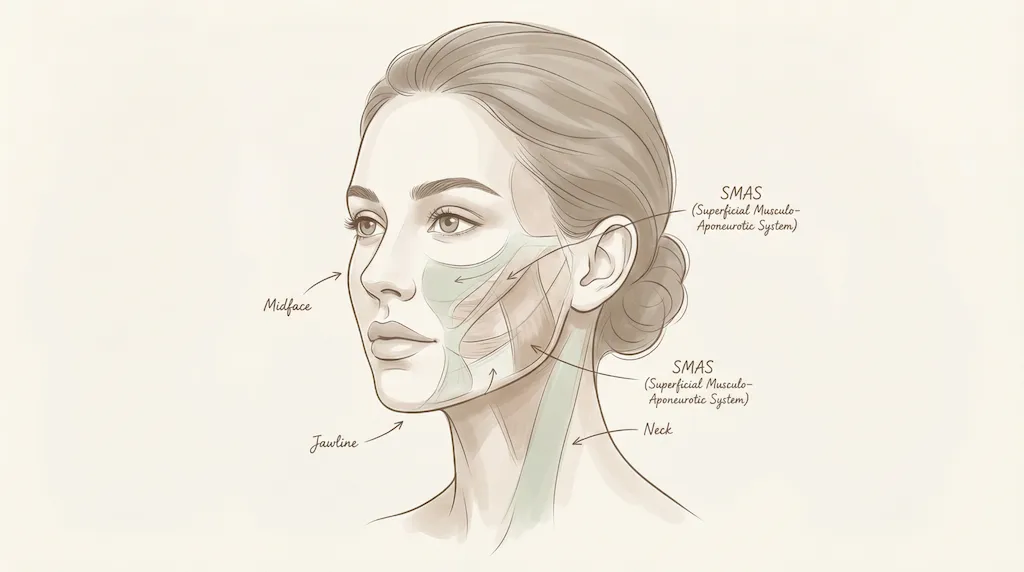
The procedure involves repositioning the deeper tissue layers, specifically the SMAS (short for Superficial Musculoaponeurotic System), which is a layer of muscle and connective tissue beneath the skin that acts like the structural framework of your face.
Think of it as the internal scaffolding that holds everything in place. Over time, gravity and aging cause this layer to shift downward, which is why jowls form and the cheeks lose their lift. A facelift repositions this foundation, removes excess skin, and recontours the face and neck. This restores definition to the jawline, smooths out the deep creases that run from your nose to the corners of your mouth (called nasolabial folds), and reduces jowling. If those lower-face changes bother you most, here’s how surgeons target the jawline and neck specifically.
A typical facelift takes about three to four hours. You will be comfortably under general anesthesia (fully asleep) or local anesthesia with sedation (awake but deeply relaxed and pain-free). The procedure focuses on the mid-to-lower face and neck, while brow and eyelid concerns are addressed through separate procedures.
Modern techniques avoid that tight, “windswept” look you might picture from years past by working beneath the skin rather than simply pulling it tight. The result is a face that looks refreshed and naturally younger, like you, just well-rested.
What Are the Different Types of Facelift Techniques?
The variety of facelift options can feel overwhelming at first, and that is completely understandable. But here is the reassuring part: each technique targets a different depth and degree of facial aging, and a skilled surgeon will recommend the one that matches your unique anatomy rather than applying a one-size-fits-all approach.
| Technique | Best For | Recovery | Cost Range (Atlanta) |
| Mini Facelift | Early jowling, mild laxity (late 30s to 40s) | 7 to 10 days | $7,500 to $12,000 |
| SMAS Facelift | Moderate lower face sagging (40s to 50s) | 10 to 14 days | $12,000 to $18,000 |
| Deep Plane Facelift | Significant midface-to-neck aging (late 40s to 70s) | 2 to 3 weeks | $15,000 to $24,000 |
| Mid-Facelift | Isolated cheek descent, nasolabial folds (late 30s to 50s) | About 2 weeks | Varies |
In simple terms: a mini facelift uses smaller incisions and a shorter recovery for patients with early signs of aging. An SMAS facelift goes a step deeper, repositioning the muscular layer beneath the skin for longer-lasting correction. A deep plane facelift is the most comprehensive option. It releases and lifts both the deep tissue layer and the overlying skin together, creating the most dramatic and longest-lasting results.
Many patients also benefit from complementary procedures such as neck rejuvenation surgery in Atlanta or eyelid surgery for aging eyes for a more complete rejuvenation. The field of facial rejuvenation has evolved significantly, and the days of a one-size-fits-all approach are behind us. To achieve the most natural, long-lasting results, patients benefit from a surgeon who can design a comprehensive, customized treatment plan that addresses their unique anatomy and goals rather than relying on a single procedure alone.
At Artisan Plastic Surgery, the team’s unique 360-degree approach to facial rejuvenation means your full facial anatomy is evaluated, not just one area, to recommend the technique that delivers the most natural, lasting results. View facelift before and after photos.
Who Is a Good Candidate for Facelift Surgery?
“Am I too young, or too old, for a facelift?” It is one of the most common questions patients ask, and the honest answer is that age matters far less than you might think.
Good candidates typically show visible signs of facial aging that non-surgical treatments have not been able to fully correct things like sagging cheeks, jowling (the drooping skin that causes that heavy, rounded look along the lower jaw), deepening creases around the nose and mouth, loose neck skin, or a general softening of the face where sharp contours used to be.
Most facelift patients are between 40 and 70, but what truly matters is your skin quality, overall health, and how much aging has progressed, not a number on your birthday. You are likely a good fit if you are in good general health, a non-smoker (or willing to quit 4-6 weeks before surgery), at a stable weight, and have realistic expectations about what surgery can achieve.
If your concerns are more about fine lines, minor volume loss, or early skin looseness, you may find that non-surgical options like Morpheus8 collagen remodeling or dermal fillers, or a minimally invasive treatment like FaceTite jowl reduction, give you the results you are looking for without a full surgical facelift.
During your consultation, your surgeon will carefully evaluate your skin quality, facial structure, and personal goals to help you determine whether a surgical facelift or a non-surgical approach is the best path forward for you.
Claudia went through this process and shared her experience:
“Dr Alexander did a lower face and neck lift on me. I could not be more pleased! She and her entire staff are truly wonderful people! My results are better than expected! Dr Alexander is a truly gifted surgeon. I HIGHLY recommend her and her staff.”
What Should You Expect During a Facelift Consultation?
It is completely natural to feel a mix of excitement and nerves before your first consultation. This visit is the most important step in your facelift experience, and it is where you and your surgeon align on goals, discuss technique options, and build a personalized surgical plan.
You can expect to talk through your medical history, current medications, and lifestyle habits (including smoking and sun exposure), as well as what specifically concerns you about your appearance. Your surgeon will then carefully evaluate your facial bone structure, skin thickness, skin elasticity, and how the deeper tissues have shifted over time.
Here is what a typical facelift consultation involves:
- Review of your medical history, medications, and health status
- Discussion of your aesthetic goals and specific concerns
- Physical examination of facial skin quality, bone structure, and tissue laxity (how loose or stretchy the skin has become)
- Recommendation of the most appropriate technique
- Review of before-and-after photos of patients with similar anatomy
- Discussion of risks, recovery timeline, and pre-operative preparation
- A personalized cost estimate including all fees
A reputable, board-certified surgeon recommends a technique based on your anatomy and goals, not cost. If a surgeon pushes a more expensive procedure without explaining why it is the right fit for you, that is a red flag.
How Is Facelift Surgery Performed?
Understanding what happens during surgery can go a long way in easing any pre-procedure nerves, and we want you to feel as prepared and comfortable as possible. A facelift is performed in an outpatient surgical facility under general anesthesia (fully asleep) or local anesthesia with sedation (relaxed and pain-free), depending on the technique and extent of the procedure.
The procedure typically takes three to four hours, though more comprehensive techniques or combined procedures may require additional time. Incisions are carefully placed in natural creases and along the hairline to minimize visible scarring.
Here’s what the process looks like step by step:
- Anesthesia is administered (you’ll either be fully asleep or deeply relaxed and pain-free)
- Incisions are made along the hairline at the temples, continuing around the front of the ear and into the natural creases behind the ear
- The skin is gently separated from the deeper tissue layer (SMAS) underneath
- The deeper facial tissues and muscles are carefully lifted and repositioned into a more youthful position
- Excess fat may be sculpted or redistributed around the jowls and neck
- The skin is smoothly re-draped over the newly shaped foundation, without being pulled tight
- Excess skin is trimmed and incisions are closed with fine sutures
- Temporary drainage tubes may be placed to reduce swelling
“Will it hurt?” is a question almost everyone asks, and it is a completely valid concern. The reassuring answer is that you will not feel anything during the procedure itself thanks to anesthesia. Afterward, most patients describe the discomfort as more of a manageable tightness rather than actual pain.
What Does Facelift Recovery Look Like Week by Week?

Here is some good news: most patients are back to their daily routine within two weeks, though your full results will continue to emerge beautifully over the following months. Recovery is gradual and predictable, and knowing what to expect at each stage can make the process feel much more manageable, both physically and emotionally.
| Recovery Phase | What to Expect | Activity Level |
| Days 1 to 3 | Peak swelling and bruising, tightness, numbness, head elevated | Bed rest, light walking only |
| Week 1 | Swelling begins to subside, sutures removed around day 7 | No driving, no strenuous activity |
| Week 2 | Bruising fades significantly, makeup can be applied | Return to desk work and light errands |
| Weeks 3 to 4 | Most visible swelling resolved, refreshed appearance | Light exercise, social activities |
| Months 2 to 3 | Residual puffiness resolves, numbness improves | Full exercise and all normal activities |
| 6 to 12 Months | Final results fully apparent, scars continue to soften | Maintenance skincare and sun protection |
The first week is the most challenging, both visually and emotionally, and that is completely normal. Be gentle with yourself during this time. By weeks three to four, most patients report feeling like themselves again, and many say that is when the excitement really starts to build.
Temporary numbness around the ears and jawline is common and nothing to worry about. It typically resolves on its own within three to six months. Your final results will continue to refine as any remaining swelling settles, scars soften, and full sensation returns.
Artisan Plastic Surgery has spent years perfecting a thoughtful post-operative care protocol designed to help you heal faster and more comfortably, including pre-surgery supplements, healing facials after your procedure, and carefully selected recovery products that genuinely support your body’s healing process.
Five weeks after her lower face and neck lift with Dr. Alexander, Carol said her results were already amazing:
“The whole process included pre op vitamins and post op included very helpful facials and products to make the recovery so easy and painless. Dr Alexander is a perfectionist and her work was flawless. Would highly recommend her services to anyone considering plastic surgery.”
How Much Does a Facelift Cost in Atlanta?
We understand this is a significant investment, and you want to make sure every dollar is spent wisely. Let us break down what goes into the cost so you can make an informed decision.
Facelift costs in Atlanta range from approximately $7,500 for a mini facelift to $24,000 or more for a deep plane facelift. The total price includes the surgeon’s fee, anesthesia, facility costs, and post-operative care.
The national average surgeon’s fee for a facelift is $12,000 to $19,000 according to the American Society of Plastic Surgeons. This does not include anesthesia ($1,200 to $2,500), facility fees ($1,000 to $3,000), or other related costs.
| Cost Component | Typical Range |
| Mini Facelift (all-in) | $7,500 to $12,000 |
| SMAS Facelift (all-in) | $12,000 to $18,000 |
| Deep Plane Facelift (all-in) | $15,000 to $24,000 |
| Anesthesia | $1,200 to $2,500 |
| Facility Fee | $1,000 to $3,000 |
| Add-on: Neck Lift or Fat Grafting | $3,000 to $6,000 |
Your total cost depends on the complexity of the technique, your surgeon’s experience, facility location, and whether you choose to combine additional procedures at the same time. It is worth noting that cosmetic facelifts are not covered by health insurance.
Artisan Plastic Surgery offers flexible financing through Alphaeon Credit, Cherry, and CareCredit, because investing in yourself should not feel out of reach. Explore financing options.
How Long Do Facelift Results Last?
“Is it worth the investment if aging continues?” It is a fair question, and one most patients ask before committing. Here is what the evidence shows.
How long your results last depends on several factors, including the surgical technique used, your skin quality, genetics, lifestyle habits, and how you care for your skin afterward. In general, deeper corrections tend to produce longer-lasting results because they address the structural causes of aging rather than surface-level skin looseness alone. Every patient is different, and your surgeon will give you a realistic picture of what to expect based on your unique situation.
A facelift does not stop the clock, but it does permanently turn it back. Years down the road, you will still look noticeably younger than you would have without the procedure. Patients consistently tell us that the renewed confidence they feel makes it one of the best investments they have ever made in themselves.
Your daily habits play a real role in how long your results last. Wearing SPF 30 or higher sunscreen every day, staying away from smoking, keeping your weight stable, and using quality skincare products like retinoids and antioxidants all help protect your investment. Think of your facelift as the foundation, and your skincare routine as what keeps it looking beautiful for years to come.
What Are the Risks and Potential Complications?
It is completely natural to have concerns about surgical risks, and an informed patient is an empowered patient. Facelift surgery is considered safe when performed by a board-certified plastic surgeon, but like all surgical procedures, it carries risks you should understand.
A large prospective study of 11,300 facelift patients found an overall complication rate of just 1.8%. Here is how the most common complications break down:
- Hematoma (a collection of blood under the skin, similar to a deep bruise): approximately 1.1% of cases. This is the most common complication and is higher in men (up to 8%) and in patients with uncontrolled high blood pressure
- Infection: fewer than 1% of cases, typically managed with antibiotics
- Temporary nerve changes (like numbness or tingling): relatively common but typically resolve on their own. Permanent nerve damage is rare
- Scarring: incisions are placed in natural creases to minimize visibility. Most scars fade significantly over time
Male patients have roughly 3.9 times the risk of hematoma compared to female patients, a difference often attributed to the greater vascularity of male facial skin.
Choosing an experienced, board-certified surgeon who performs facelifts regularly is the single most important step you can take to minimize risk. Keeping your blood pressure well-controlled around the time of surgery and avoiding blood-thinning medications beforehand also help reduce the chance of complications.
How Does a Surgical Facelift Compare to Non-Surgical Alternatives?
If you are weighing your options, you may be wondering whether a non-surgical approach could deliver similar results with less downtime. Let us break that down.
Non-surgical options like dermal fillers, BOTOX®, and RF microneedling (a treatment that uses tiny needles with radiofrequency energy to tighten skin and stimulate collagen production) can address early or mild signs of aging with less recovery time.
Minimally invasive treatments like FaceTite (a device that uses controlled heat energy beneath the surface to firm skin) go a step further but still target different concerns than a facelift. These options work well for fine lines, minor skin laxity, and volume loss, but they do not lift or reposition the deeper facial tissues that cause sagging, jowling, and structural aging. Only a surgical facelift provides that level of comprehensive correction.
| Feature | Surgical Facelift | FaceTite | Morpheus8 / RF Microneedling | Fillers/Fat Transfer |
| Best For | Moderate to severe sagging | Mild to moderate laxity | Fine lines, texture, mild laxity | Volume loss, wrinkles |
| Downtime | 2 to 3 weeks | 3 to 5 days | 1 to 3 days | None |
| Anesthesia | General or local with sedation | Local | Local or topical | None |
| Structural Lift | Yes | Mild | No | No |
Dermal fillers use injectable gel to temporarily restore volume and smooth wrinkles, while fat transfer uses your own fat for longer-lasting volume restoration. A surgical facelift remains the gold standard for moderate-to-severe facial sagging, jowling, and neck looseness. No non-surgical treatment can lift and reposition deep tissue the way surgery can.
Many patients use non-surgical treatments as maintenance between surgical procedures or as a way to ease into their rejuvenation journey before deciding on surgery. Thread lifts (where dissolvable threads are placed under the skin to gently lift tissue) offer a temporary improvement lasting 6 months to 2 years depending on thread type, but they provide minimal structural correction.
Artisan Plastic Surgery offers the full spectrum of facial rejuvenation, from surgical facelifts to minimally invasive options and injectables, so your treatment plan is tailored to exactly what your face needs, wherever you are in your journey.
Susan recently shared her experience with the surgical approach:
“I had a facelift with upper and lower eye surgery with Dr. Diane Alexander at Artisan, and I’m so pleased with my experience so far. Dr. Alexander and her entire medical staff have been wonderful, attentive, caring, and professional every step of the way. The level of care and communication has been excellent.”
Your Consultation and Next Steps
Your facelift journey begins with a warm, personalized consultation where your facial anatomy, skin quality, and aesthetic goals are thoughtfully evaluated. During your visit, you will have the chance to discuss technique options, look through before-and-after photos of patients with similar concerns, and receive a transparent cost estimate that includes all fees, no surprises.
Consultations are available at two convenient surgical locations: the Northside office in Atlanta and the Johns Creek location. Both offer private, comfortable settings where you can explore your options at your own pace, completely free of pressure.
Ready to explore your options? Here is how to get started:
- Schedule your consultation to discuss your goals and receive a personalized treatment plan by requesting a consultation online
- Review before-and-after photos and ask any questions about technique, recovery, and results
- Choose your preferred financing option through Alphaeon Credit, Cherry, or CareCredit
Conclusion
A facelift is one of the most personal decisions you can make, and you deserve to make it with full confidence, honest information, and a surgeon who genuinely sees you.
If this guide has done one thing, we hope it has made the process feel a little less overwhelming and a little more possible. Because the truth is, the best results do not just come from surgical skill. They come from a practice that takes the time to understand who you are, what you want, and how to get you there naturally.
The team at Artisan Plastic Surgery is ready to have that conversation with you, at your pace, on your terms, with zero pressure.
Call (404) 851-1998 or request your consultation online to begin your journey. Your experience will be entirely private, thoughtfully personalized, and guided at your pace, without pressure.
Frequently Asked Questions
How long does a facelift take to perform?
Most facelifts take three to four hours, though more comprehensive techniques or combined procedures may take longer. The exact time depends on the technique and whether complementary procedures like a neck lift are performed simultaneously.
What is the difference between a mini facelift and a deep plane facelift?
A mini facelift addresses early jowling and mild skin looseness with smaller incisions and a shorter recovery, while a deep plane facelift corrects significant aging from the midface to the neck. Deeper techniques generally produce longer-lasting results, though individual outcomes vary based on skin quality, lifestyle, and post-operative care.
Will my facelift scars be visible?
Incisions are carefully placed along the hairline and in natural creases around the ears, making scars well-concealed once healed. Over time, scars fade significantly and become barely noticeable for most patients.
Can a facelift be combined with other procedures like a neck lift or eyelid surgery?
Yes, many patients combine a facelift with a neck lift, eyelid surgery, or fat grafting (where a small amount of your own fat is transferred to restore lost volume in the face) for a more comprehensive result. Your surgeon will recommend complementary procedures based on your anatomy and goals.
What is the difference between a surgical facelift and non-surgical alternatives like FaceTite or Morpheus8?
A surgical facelift lifts and repositions deep tissues for comprehensive, long-lasting correction. Minimally invasive treatments like FaceTite and non-surgical options like Morpheus8 address milder concerns with less downtime but do not provide the same structural correction.
*Disclaimer – This content is for educational purposes only and does not constitute medical advice. A consultation with a qualified board-certified surgeon is required to determine the best treatment plan for your individual needs and any questions you may have about a medical condition or procedure.

