



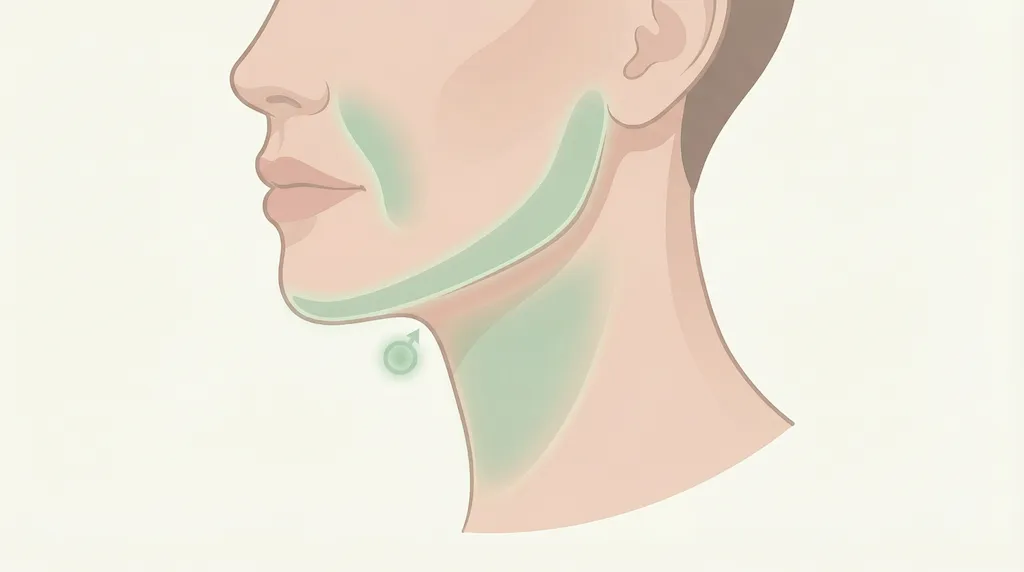
You catch your reflection in a passing window, and for a moment, you don’t recognize the contour of your own jaw. The definition you once took for granted has softened into something heavier, and vertical cords are starting to frame your neck in ways that feel unfamiliar.
Jowls and neck laxity rank among the most common issues of facial aging. They develop not because skin simply loosens, but because the deeper structural support layers of the face gradually descend with time.
According to the American Society of Plastic Surgeons, 22,445 neck lift procedures were performed in the U.S. alone in 2024. Globally, demand speaks for itself: the 2024 ISAPS International Survey on Aesthetic/Cosmetic Procedures recorded 737,028 facelifts performed, a 7.4% year-on-year increase, with cosmetic procedures overall up 42.5% over the past four years.
At Artisan Plastic Surgery in Atlanta, our board-certified surgeons bring over 20 years of facial plastic surgery expertise to every lower facelift and neck lift. As the city’s first woman-led practice offering experienced Atlanta plastic surgeon options, we combine surgical precision with an artist’s eye, tailoring each procedure to honor the natural architecture of your face. This guide covers how a lower facelift and neck lift work, how surgical techniques compare, and what to expect from recovery and cost.
Patients seeking a Buckhead plastic surgeon can also explore these facial rejuvenation options with our team.
At a Glance
- A lower facelift targets the jawline and jowls, while a neck lift addresses platysma bands, submental fat, and neck skin, and they’re often performed together for complete lower facial harmony
- These procedures address deeper structural layers (SMAS, platysma) rather than simply tightening skin, which is the key to natural, long-lasting results
- In Atlanta, a combined lower facelift and neck lift typically ranges from $12,000 to $20,000, depending on technique and complexity
- Recovery is predictable. Most patients are socially presentable by weeks 3 to 4 and see final results by months 2 to 3
- Deep plane technique offers up to 94% patient satisfaction and 10 to 15+ year longevity, while SMAS approaches deliver excellent results with a lower complication profile
What Is a Lower Facelift and Neck Lift, and What Does It Actually Fix?
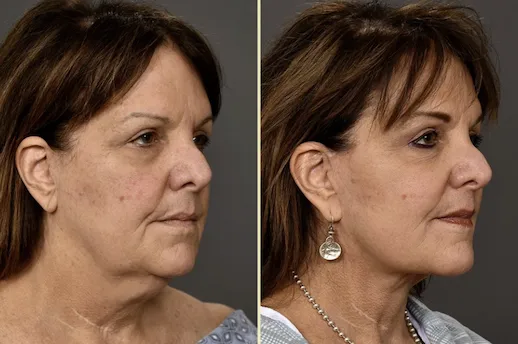
The jawline is the frame of the face, and when that frame loses its definition, it changes your entire profile. The first step towards a more refreshed you is understanding why this happens, and how a lower facelift and neck lift can precisely restore those contours.
A facelift for sagging facial skin focuses on the bottom third of your face, lifting and repositioning the SMAS to correct jowling along the jawline. A neck lift for turkey neck rejuvenates the area from the angle of the jaw to the chin, addressing platysma bands, submental fat, and excess skin.
Together, they share incisions around the ears and are typically performed in the same surgical session, taking approximately three to four hours. The key structures addressed include:
- SMAS layer repositioning to restore jawline contour
- Platysma muscle tightening to eliminate neck banding
- Submental fat reduction to sharpen the cervicomental angle (the crisp angle between your neck and chin)
- Excess skin removal for a smooth, defined profile
Unlike a full facelift, this targeted combination doesn’t address midface descent, cheek hollowing, or deep nasolabial folds. That distinction matters because it determines who benefits most from this approach.
Your surgeon takes time during the consultation to map exactly which structures are contributing to the changes you see, whether it’s jowling along the mandible, bands in the neck, submental fullness, or a combination. This clarity shapes the surgical plan and ensures your results address what actually bothers you.
Susan, who had a facelift, shared what set the experience apart:
“Dr. Alexander and her entire medical staff have been wonderful, attentive, caring, and professional every step of the way. The level of care and communication has been excellent. I’m already thrilled with my results.”
How Does a Lower Facelift Differ from a Full Facelift?
There is no ‘one-size-fits-all’ in facial plastic surgery. The choice between a lower facelift and a full facelift is dictated by where you are experiencing the most significant tissue shift. If you’re weighing the two, how the full and lower approaches compare is worth a read. By identifying whether your concerns are concentrated along the jawline or extend upward toward the temples, your surgeon can select the procedure that offers the most harmonious, natural-looking result.
A lower facelift uses limited periauricular incisions and addresses only the lower facial third. A full facelift extends from the temples through to behind the ears, addressing midface descent, cheek ptosis, and deep nasolabial folds in addition to jowls and neck concerns. Recovery may be slightly shorter for the lower approach.
The right choice depends on where your aging is concentrated. If only your jowls and neck show significant change, the lower approach may deliver everything you need. If your cheeks have also descended, a full facelift provides more comprehensive rejuvenation.
| Feature | Lower Facelift + Neck Lift | Full Facelift |
|---|---|---|
| Areas addressed | Jawline, jowls, neck | Midface, cheeks, jowls, neck |
| Incision extent | Periauricular (around ears) + submental | Temple to behind ears + submental |
| Best for | Isolated lower face/neck aging | Comprehensive facial aging |
| Recovery | Slightly shorter | Standard facelift recovery |
| Typical longevity | 7 to 12 years | 10 to 15+ years (deep plane) |
| Atlanta cost range | $12,000 to $20,000 | $15,000 to $26,000 |
Our team evaluates the full canvas of your face during your consultation, not just the area you’re concerned about, so the plan matches your actual anatomy. If you’re still unsure which path is right for you, the best way to decide isn’t by looking at a menu of services, but by having a conversation with an expert who understands facial harmony. Schedule your consultation online to get started.
What Causes Jowls, Platysma Bands, and Jawline Sagging?
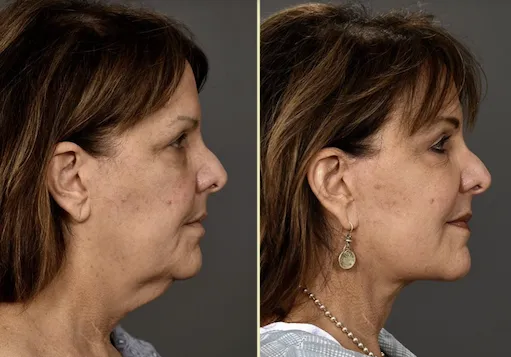
Seeing changes in your jawline or neck isn’t a reflection of your lifestyle. It’s more of your anatomy. Jowling and neck laxity result from natural, structural processes that occur beneath the surface. The fact is, it happens to everyone.
Jowls form when the SMAS layer weakens, and facial fat pads descend below the mandibular border. It isn’t simply loose skin. It’s a structural failure of the deep tissue support system that once held everything in place.
On the other hand, the platysma is a broad, thin sheet of muscle in your neck. As it weakens with age, the two sides separate along the midline, creating visible vertical bands. Meanwhile, submental fat accumulation under the chin blurs the cervicomental angle, softening the crisp profile that defines a youthful neckline.
Here’s what the progression typically looks like:
- SMAS weakening and facial fat pad descent create visible jowling
- Platysma muscle separation produces vertical neck banding
- Submental fat accumulates, blurring the chin-to-neck angle
- Skin loses elasticity and begins to sag
Contributing factors beyond age include genetics, weight fluctuations, sun exposure, and smoking. Because the root cause is structural, non-surgical skin tightening has limited effectiveness for moderate to significant changes. Surgical repositioning of these deeper layers produces the lasting correction.
What Surgical Techniques Are Used for Lower Face and Neck Rejuvenation?
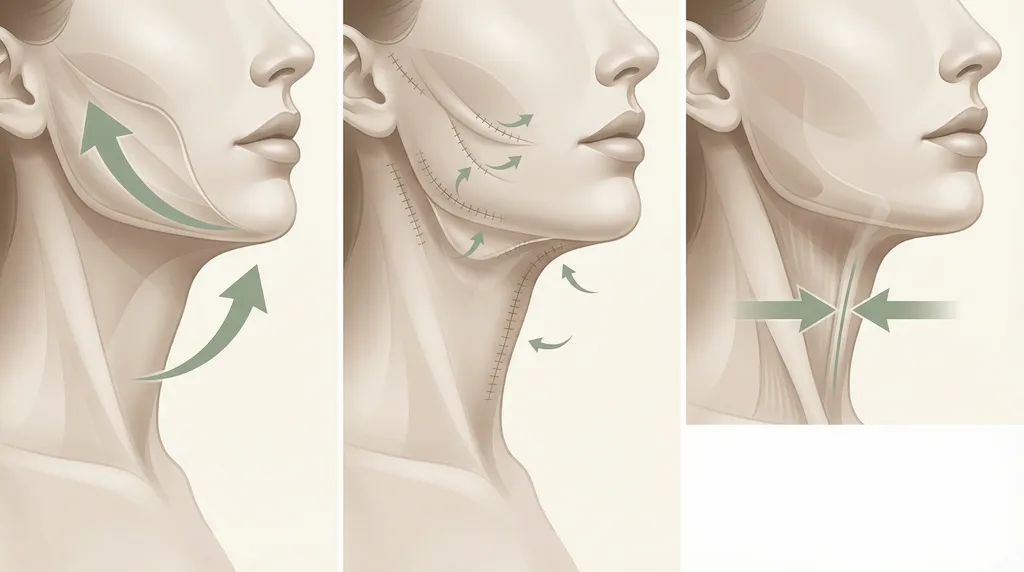
Achieving that ‘rested, not operated-on’ look requires a technique that respects your face’s underlying architecture. By exploring the different surgical pathways available, you can better understand how our surgeons customize every procedure to restore youthful contours while preserving your authentic look.
Deep Plane Facelift
This technique dissects beneath the SMAS layer, releasing retaining ligaments and lifting the entire structural support system as one composite unit. A systematic review and meta-analysis of 2,896 patients published in Aesthetic Plastic Surgery found a patient satisfaction rate of 94.4%. Results typically last 10 to 15+ years.
SMAS Plication and Imbrication
The skin is elevated in the subcutaneous plane, then the SMAS is folded, sutured, or advanced to firm anchors. The same meta-analysis reported 87.8% satisfaction with a lower overall complication rate of 10.3% compared to 17.2% for the deep plane. Longevity ranges from 5 to 10 years, making it an excellent choice for mild to moderate concerns.
Platysmaplasty and Cervicoplasty
Platysmaplasty involves midline approximation of the platysma muscle via a small submental incision, directly correcting banding and reshaping the cervicomental angle. Cervicoplasty removes excess neck skin for patients with significant laxity. Both are almost always combined with a facelift or neck lift.
| Technique | What It Addresses | Longevity | Best Candidate |
|---|---|---|---|
| Deep plane facelift | Jowls, midface, neck (comprehensive) | 10 to 15+ years | Moderate to severe aging |
| SMAS plication | Jawline, jowls, upper neck | 5 to 10 years | Mild to moderate, good skin elasticity |
| Platysmaplasty | Platysma bands, cervicomental angle | Several years (enhanced with a facelift) | Ages 40 to 60, bands without significant skin excess |
| Cervicoplasty | Excess neck skin, wrinkling | Varies | Significant skin laxity |
At Artisan Plastic Surgery, your surgeon selects techniques based on your unique anatomy, the degree of tissue descent, and the results you’re seeking. For deep plane procedures, the SMAS is trimmed, plicated, and re-draped for newly contoured tissues and a natural result. View before and after photos to see what’s possible.
Carol shared her experience with the results and recovery process:
“The results are amazing already. The whole process included pre op vitamins and post op included very helpful facials and products to make the recovery so easy and painless. Dr Alexander is a perfectionist and her work was flawless.”
Who Is a Good Candidate for a Lower Facelift and Neck Lift?
If you’re wondering whether your concerns are “enough” to justify surgery, know that there’s no threshold you need to meet. What matters is how the changes make you feel.
You may be a strong candidate if you meet the following criteria:
- Age 40 to 60+, though candidacy depends more on the degree of tissue descent than chronological age
- Good overall health with no uncontrolled medical conditions such as diabetes, hypertension, or clotting disorders
- Non-smoker, or willing to quit 4 to 6 weeks before and after surgery
- BMI ideally below 30, with stable weight for at least three to six months
- Visible jowling, neck banding, double chin, or loss of cervicomental angle without significant midface descent
- Moderate to significant skin laxity with some elasticity remaining
If you’re not sure about undergoing surgery, nonsurgical options are available. For changes that are early or mild, you might achieve meaningful improvement with FaceTite™ (a minimally invasive radiofrequency option), Morpheus8, or RF microneedling before committing to a surgical approach.
How Much Does a Lower Facelift and Neck Lift Cost in Atlanta?
We understand this is a significant investment, and you want to make sure every dollar is well spent. Let’s walk through what goes into the cost so you can feel confident in your decision.
A combined lower facelift and neck lift in Atlanta typically ranges from $12,000 to $20,000, depending on the technique selected. The ASPS national average surgeon fee range for a neck lift is $7,500–$13,000, though the total all-in cost, including anesthesia, facility fees, and post-operative care, is higher.
| Procedure | Atlanta Cost Range | Notes |
|---|---|---|
| Mini facelift | $7,500 to $12,000 | Earlier aging, limited downtime |
| SMAS lower facelift | $12,000 to $18,000 | Standard lower face/neck correction |
| Deep plane facelift | $15,000 to $24,000 | Advanced, longest-lasting |
| Neck lift alone | $6,000 to $13,000 | Isolated neck concerns |
| Combined lower facelift + neck lift | $12,000 to $20,000 | Most common combined approach |
| Anesthesia (add) | $600 to $1,200 | Per session |
| Facility fees (add) | $500 to $4,000 | A properly equipped surgical facility |
What’s not always included in a quoted price: anesthesia, facility fees, post-operative garments, medications, and follow-up visits. Always request an itemized quote so you know exactly what’s covered.
Surgery is a meaningful investment, and at Artisan Plastic Surgery, we believe cost should never be a barrier to feeling like yourself again. Our team walks you through every financing option available, including Alphaeon Credit, Cherry, and CareCredit, so you can move forward with confidence and a plan that works for your budget. Learn more about our financing options and find the right fit for you.
What Should You Expect During Recovery from a Lower Facelift and Neck Lift?
The thought of weeks in hiding can feel daunting. But recovery from a lower facelift and neck lift is more predictable and manageable than most patients expect.
- Days 1 to 3 (Head Wrap Phase): Surgical dressing and compression garment support the face and neck. Mild to moderate swelling with tightness and pressure. Rest with your head elevated and have drains removed if placed.
- Days 4 to 7 (Peak Swelling): Swelling and bruising peak around days three to five. Sutures begin removal at the end of week one. Continue head elevation, compression, soft foods, and limited neck movement.
- Week 2 (The Turning Point): Swelling and bruising visibly subside. Most patients can return to non-strenuous desk work. Early jawline and neck results become visible.
- Weeks 3 to 4 (Socially Presentable): Most swelling and bruising resolved. Light exercise, like walking, may resume per your surgeon’s guidance. Continued improvement in any numbness around the ears and chin.
- Months 2 to 3 (Final Results Emerge): Residual swelling resolves. Jawline and neck definition fully apparent. Numbness has mostly resolved.
- Months 3 to 12 (Continued Refinement): Internal scar tissue softens. Any remaining numbness typically resolves. Scars mature and fade to their final appearance.
Note that numbness around the ears, chin, and neck is normal and resolves over weeks to months. Final results continue improving for up to 12 months as tissues settle.
What Are the Risks of Lower Facelift and Neck Lift Surgery?
It’s completely natural to feel nervous about potential complications, especially when social media amplifies worst-case outcomes. Here’s an honest look at what the data shows.
All surgeries carry risk, and lower facelift and neck lift complications are well characterized. A review published in the Aesthetic Surgery Journal Open Forum identified the following complication rates:
- Hematoma: The reported rate ranges from 0.6% to 14.2% for neck lift procedures, which is the most common complication. Treated promptly if it occurs.
- Nerve injury: Temporary changes in under 1% of cases. Permanent nerve injury occurs in less than 1% when performed by experienced, board-certified surgeons. Most nerve-related issues resolve within 6 to 12 months.
- Skin necrosis: 1% to 3.%, with risk elevated in smokers.
- Visible scarring: Incisions are placed strategically around and behind the ears and under the chin. They typically fade over 12 months.
Overall patient satisfaction with facelift surgery is 92.4% according to a study published in the National Library of Medicine. Risk is minimized by choosing a board-certified surgeon, using a safe, quality surgical environment, providing complete pre-operative health disclosure, maintaining strict no-smoking compliance, and following all post-operative instructions carefully.
Can Non-Surgical Options Improve Jowls and Jawline Definition?
It’s totally understandable to feel nervous or move backwards when discussing surgery. That’s why nonsurgical and minimally invasive options are available. These options can meaningfully improve early or mild lower face and neck concerns.
FaceTite for jowl and lower face laxity uses radiofrequency-assisted liposuction through tiny one to two-millimeter incisions, delivering both fat reduction and skin tightening with shorter recovery than surgery. Morpheus8 treatment for tighter skin stimulates collagen and improves mild laxity with minimal downtime. Botox injections can relax visible platysma bands, providing temporary but effective correction for mild cases.
Dermal fillers can subtly define the jawline and camouflage early jowling, though the results are temporary and don’t address the underlying structural changes.
Here’s the honest framing: for moderate to significant jowling, neck banding, or substantial skin excess, surgical options deliver structural correction that non-surgical modalities can’t replicate. But for patients with early changes, these options can delay the need for surgery by years.
Artisan Plastic Surgery‘s three-level approach to facial rejuvenation means every patient finds their ideal entry point. Whether you start with noninvasive treatments or move directly to a surgical lower facelift and neck lift, your surgeon will help you understand which approach matches your goals without pressure to do more than you need.
Claudia described the impact on her confidence:
“Dr Alexander did a lower face and neck lift on me. I could not be more pleased! She and her entire staff a truly wonderful people! They all made my experience rewarding! My results are better than expected! Dr Alexander is a truly gifted surgeon. I HIGHLY recommend her and her staff. You will not be disappointed”
Conclusion
A lower facelift and neck lift isn’t about chasing a younger version of yourself. It’s about restoring the facial harmony that aging has quietly shifted, so the face looking back at you actually feels like yours. The jowling, the neck banding, the softened jawline, these aren’t character flaws. They’re structural changes, and they have structural solutions.
At Artisan Plastic Surgery in Atlanta, we’ve built our practice on one belief: that beautiful results come from listening first. We don’t offer one-size-fits-all answers or pressure you toward more than you need. What we offer is a real conversation, expert eyes, and a surgical plan built entirely around you.
Your next step is simply a conversation. Our team is here to answer your questions, walk you through what to expect, and help you decide if now is the right time. Schedule your consultation online to take the first step toward a more defined, refreshed you.
Frequently Asked Questions
What is the best technique for correcting jowls, deep plane, or SMAS?
Both deliver excellent results, but the best choice depends on your anatomy. Deep plane offers 94% satisfaction and longer-lasting results, while SMAS has a lower complication profile and may be ideal for mild to moderate concerns.
How long is the recovery from a lower facelift and neck lift?
Most patients return to desk work by week two and feel socially comfortable by weeks three to four. Full results, including resolution of subtle swelling and numbness, emerge over two to three months.
At what age should you consider a lower facelift and neck lift?
Most patients are between 40 and 60, but candidacy depends on the degree of tissue descent rather than age alone. Some patients in their late 30s with significant genetic sagging benefit, while others in their 70s with good skin quality are excellent candidates.
Am I a good candidate if I have loose neck skin but not many jowls?
Yes, a neck lift alone can address isolated neck concerns, including loose skin, platysma bands, and submental fullness. Your surgeon will evaluate whether adding a lower facelift would improve your overall result.
What non-surgical options exist for jowls if I’m not ready for surgery?
FaceTite™ offers minimally invasive fat reduction and skin tightening, while Morpheus8 and RF microneedling stimulate collagen for mild laxity. Dermal fillers can subtly camouflage early jowling as a temporary option.

