

Surgical Hair Restoration, Atlanta
FUE Hair Transplant in Atlanta
Follicular Unit Extraction is a minimally invasive hair transplantation technique in which individual follicular units are extracted from a donor area, usually the back and sides of the scalp, and transplanted into areas experiencing hair loss.
CONSULTATION
Required
PROCEDURE LENGTH
About 7 hours
RECOMMENDED SESSIONS
One for most patients
DOWNTIME
About 10 to 14 days
OFFERED AT
Northside
ANESTHESIA
Local Anesthesia with optional oral sedation

The Approach
Follicular Unit Extraction (FUE) is an advanced, minimally invasive hair restoration technique designed to restore hair in areas affected by thinning or hair loss
By individually harvesting healthy hair follicles from the back and sides of the scalp and carefully transplanting them into areas of concern, FUE creates natural-looking, long-lasting results without the need for a linear incision or stitches.
The procedure takes advantage of the fact that hair follicles in the donor region are typically more resistant to the hormonal changes responsible for pattern hair loss. Once transplanted, these follicles generally retain that resistance, allowing them to continue growing in their new location.
At Artisan Plastic Surgery in Atlanta, FUE hair restoration is performed by Chanel Gordon, PA-C, a hair restoration specialist with extensive experience in advanced transplantation techniques, under the supervision of Dr. Diane Alexander. Every treatment begins with a comprehensive evaluation of your hair loss, donor hair availability, and long-term restoration goals. From designing a natural hairline to strategically placing each follicular unit, our approach prioritizes precision, artistry, and results that complement your individual features.
Candidacy
Are You a Candidate for an FUE Hair Transplant?
During your consultation at Artisan Plastic Surgery, we carefully evaluate your scalp, hair density, donor area, and the progression of your hair loss to determine whether FUE is the right treatment for you. Successful results depend on several factors, including the quality and availability of donor hair, the pattern of hair loss, and your long-term restoration goals.
Not every patient requires surgical intervention. For individuals experiencing early-stage or actively progressing hair loss, nonsurgical treatments such as PRP therapy or prescription medications may be recommended before or alongside transplantation. Our goal is to create a personalized treatment plan that delivers natural-looking results while preserving your donor hair for the future.
You are likely a strong candidate if:
- You have localized hair loss, such as a receding hairline, thinning temples, or decreased density at the crown.
- You have sufficient healthy donor hair at the back and sides of your scalp.
- Your hair loss has slowed down
- You are in good overall health and able to undergo a procedure under local anesthesia.
- You understand the recovery and growth process, including that final results typically develop over 12–18 months.
- You are looking for a long-term solution to restore natural-looking hair density.
Scope
What an FUE Hair Transplant Treats
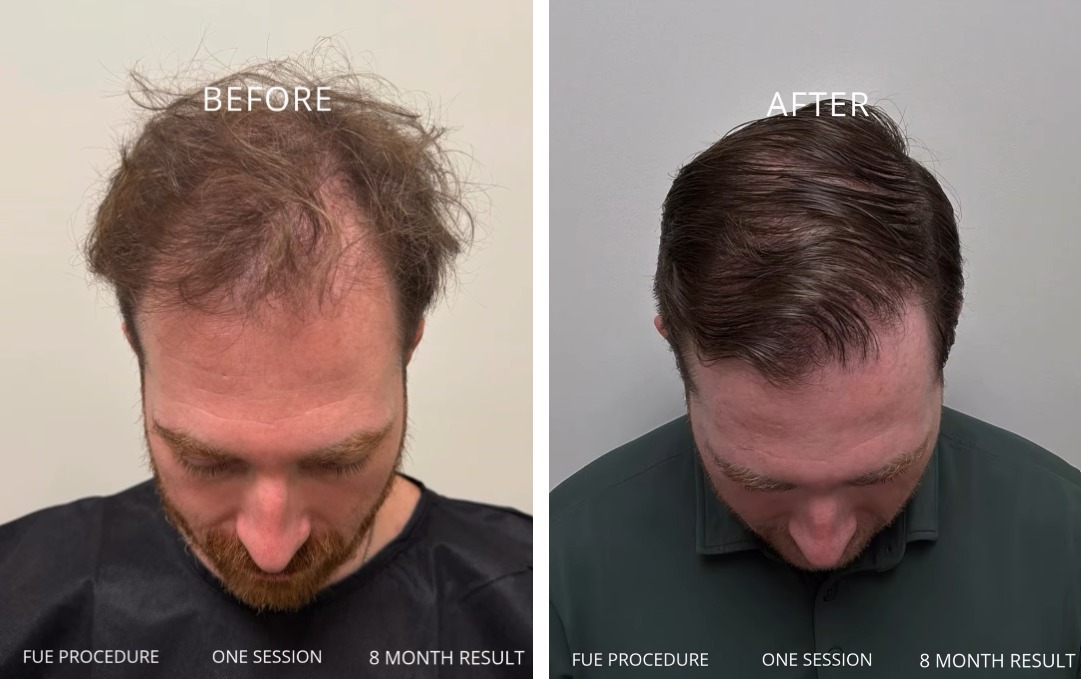
It treats
Common treatment areas include a receding hairline, thinning temples, decreased density through the mid-scalp, and hair loss at the crown. FUE can also be an effective option for certain patients experiencing traction alopecia or stable scarring-related hair loss, following a thorough medical evaluation. We also perform beard and eyebrow transplants.
It does not treat
FUE is not suitable for every type of hair loss. Patients with diffuse thinning that significantly affects the donor area, active inflammatory or scarring alopecia, or certain untreated medical conditions may not be ideal candidates.
Additionally, hair transplantation does not prevent future hair loss or reverse the underlying cause of thinning. For this reason, treatments such as PRP therapy or prescription medications may be recommended to help preserve existing hair and support long-term results.
The Procedure
How an FUE Hair Transplant Works
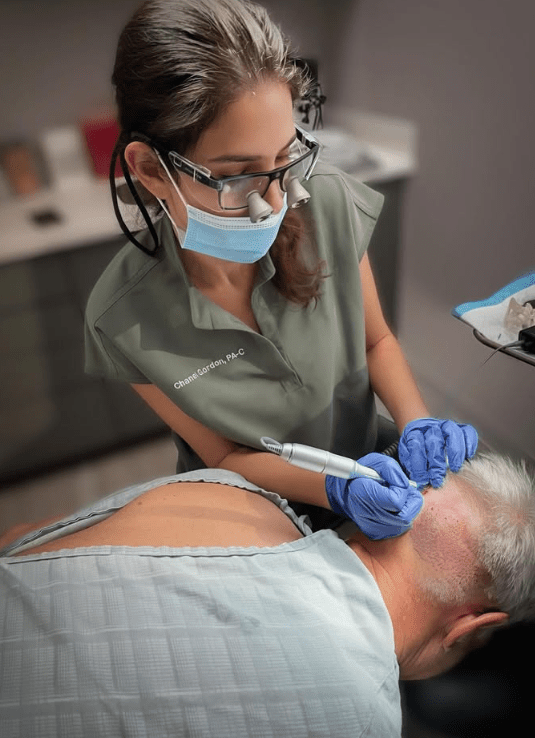
Harvesting- Individual follicular units, naturally occurring groups of one to four hairs, are carefully extracted from the donor area, typically the back and sides of the scalp. Using a specialized micro-punch instrument, each follicular unit is harvested individually, eliminating the need for a linear incision or stitches. The donor area is typically shaved for FUE procedures. However, a no-shave option may be available for select patients, depending on their hair characteristics and treatment needs.
Implantation- The procedure is performed under local anesthesia to maximize patient comfort and typically takes several hours, depending on the number of grafts required. Once harvested, the follicles are meticulously implanted into the areas of thinning or hair loss. Each graft is strategically positioned with careful attention to the natural angle, direction, and distribution of hair growth, creating a seamless, natural-looking result.
Because each follicle is removed individually, there is no long linear scar across the back of your head. The tiny extraction sites typically heal within several days, leaving small, scattered scars that are often difficult to detect once healed. Most patients can resume light daily activities within a few days, while transplanted follicles gradually establish themselves and begin producing new hair over the following months.
Choosing
FUE Hair Transplant vs. PRP: Which Do You Need?
FUE Hair Transplant
Surgical
- Transplants healthy follicles from the donor area to areas of thinning or hair loss.
- Receding hairlines, thinning temples, crown hair loss, and areas requiring additional density.
- Most scabs are gone within 10 to 14 days. Most patients resume light activities within a few days.
- New growth typically begins around 3–4 months, with final results developing over 12–18 months.
PRP Hair Restoration
Non-surgical
- Uses concentrated platelets from your own blood to deliver growth factors to the scalp.
- Early to moderate thinning, where hair is finer but the follicles are still active.
- Minimal downtime; temporary scalp tenderness or swelling may occur.
- A series of 3 sessions, with first changes in 6 to 8 weeks, then maintenance
FUE and PRP are not mutually exclusive treatments. While FUE restores hair by transplanting healthy follicles into areas of hair loss, PRP may help improve the health and density of existing hair. For some patients, combining both treatments offers a more comprehensive approach to hair restoration. During your consultation, we will determine which treatment, or combination of treatments, best suits your individual needs and goals.
Longevity
Is an FUE Hair Transplant Permanent?
FUE hair transplantation offers long-lasting, often permanent results. Hair follicles harvested from the donor area are typically genetically resistant to the hormone responsible for pattern hair loss (DHT). When transplanted, these follicles generally retain that resistance and continue growing naturally in their new location.
However, while transplanted hair is designed to last, your existing, non-transplanted hair may continue to thin over time. For this reason, we take a long-term approach to hair restoration, carefully planning each procedure with future hair loss in mind. Maintenance treatments, including medications or PRP therapy, may also be recommended to help preserve your existing hair and maintain a natural, balanced appearance.
Recovery
Recovery and Growth Timeline
Most patients look healed within 10 to 14 days. Full hair growth takes 12 to 18 months, because transplanted follicles go through a resting phase before they grow.
Day of Procedure
Return home the same day. Mild tenderness and swelling are normal. Rest and sleep with your head elevated. Your scalp is tender and the new grafts are fragile, so follow your aftercare instructions closely and sleep with your head raised.
Days 1 to 3
Mild swelling, redness, tenderness, and scabbing. Rest and keep your head elevated.
Days 4 to 7
Swelling subsides, and scabs begin to loosen.
Days 10 to 14
Most scabs are gone, grafts are secure, and the scalp looks significantly healed.
Weeks 3 to 8
Transplanted hairs typically shed. This is completely normal.
Months 3 to 4
New hair growth begins.
Months 6 to 9
Noticeable improvement in density and thickness.
Months 12 to 18
Final results, with crown growth sometimes taking longer.
Temporary shedding is a normal part of hair transplantation. Our team checks in with you by phone on day 4 and day 10, and we see you in the office at one year to review your final result.
Your FUE procedure is performed by a hair restoration specialist who has trained other providers in the technique.
Your Experience
Your Personalized Hair Restoration Experience
Consultation
You meet with Chanel to talk about your goals and hair history. She examines your scalp and checks the density of your donor area. If you are a candidate, you plan your new hairline together.
Procedure Day
Your scalp is numbed, and your follicles are removed one unit at a time from the donor area. Each graft is placed at the angle your hair naturally grows. You go home the same day.
Recovery
You follow a careful aftercare routine for about two weeks. Most scabs are gone in 10 to 14 days, and most people return to normal routines well before the new hair starts to grow.
Growth
The transplanted hair sheds in the first weeks and begins to regrow around months 3 to 4.
The Practice
Why Patients Choose Artisan
A dedicated FUE specialist
Chanel Gordon, PA-C, has more than 10 years in hair restoration. She served as Chief PA at Bosley and Advanced Hair Restoration and has trained other providers in FUE.
Surgical and non-surgical options under one roof
FUE, PRP, Exosome microneedling, and hormone optimization are all available here. Your plan is built around your hair loss and can combine treatments when that helps.
Clear guidance about timing
If your hair loss is still changing quickly or has a cause that should be treated first, we will tell you and help you start there. Donor hair is limited, so timing matters.
Part of an established Atlanta practice
Artisan was founded in 2000 as Atlanta’s first all-woman-physician plastic surgery practice. Its 360-degree approach looks at your overall health along with your appearance.
Results
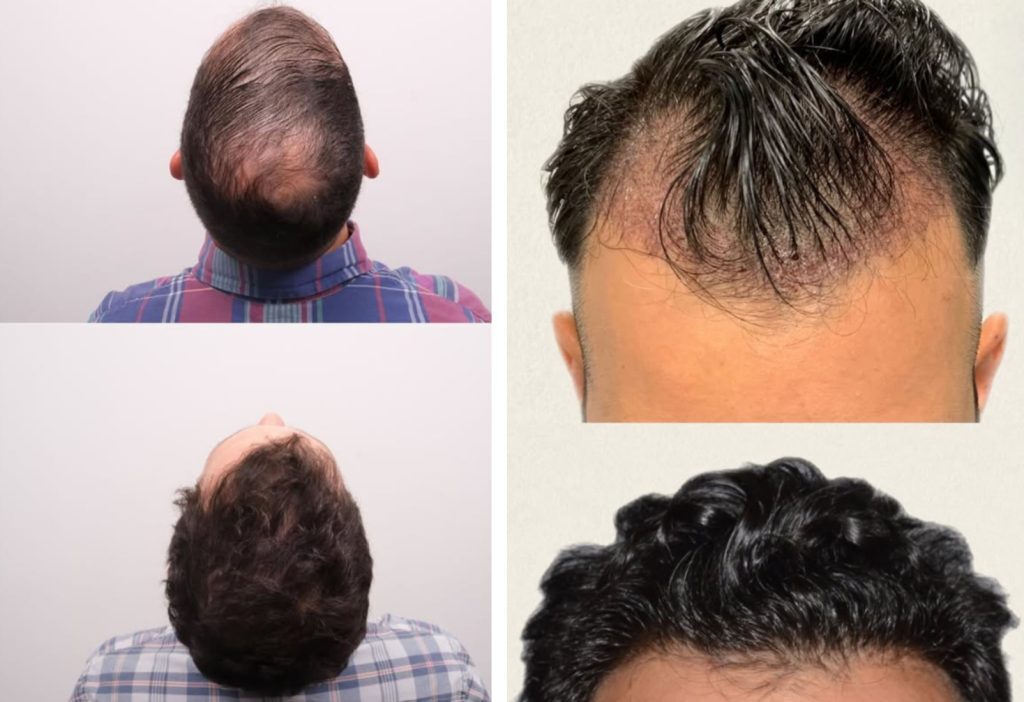
FAQ
FUE Hair Transplant FAQs
How much does an FUE hair transplant cost?
We price by treatment area rather than per graft because every patient’s hair restoration needs are different. This allows us to focus on achieving the best possible coverage and density for each area, rather than working toward a specific graft count. Our priority is a natural-looking result, not a number.
Is a hair transplant permanent?
Yes, transplanted hair is generally long-lasting. Donor follicles typically retain their resistance to pattern hair loss after transplantation. However, existing hair may continue to thin, which is why long-term planning and maintenance are important.
Does an FUE hair transplant hurt?
FUE is performed under local anesthesia to keep patients comfortable. The initial numbing injections may cause brief discomfort, but patients typically experience little to no pain during the procedure. Mild tenderness afterward is normal.
Can women get an FUE hair transplant?
Absolutely! FUE can be an excellent option for women experiencing hairline recession, localized thinning, or traction alopecia. Candidacy depends on the underlying cause of hair loss and the availability of healthy donor hair.
What is the difference between FUE and FUT?
Both techniques transplant healthy hair follicles to areas of hair loss. FUT involves removing a strip of scalp, leaving a linear scar using sutures, while FUE extracts individual follicular units, resulting in tiny, scattered scars without a linear incision. At Artisan Plastic Surgery we only perform FUE procedures.
Do you use manual FUE or a device like NeoGraft?
At Artisan Plastic Surgery, Chanel uses a specialized FUE extraction system chosen for its precision, control, and gentle handling of follicular units. Other technologies, including NeoGraft and robotic systems such as ARTAS, take different approaches. Chanel prefers a technique that allows meticulous graft harvesting, low transection rates, and minimal trauma and dehydration to the follicles, so more grafts survive and results look healthy and natural.
Will my transplanted hair fall out?
Yes, temporary shedding typically occurs within 3–8 weeks after transplantation. This is completely normal. The follicles remain intact beneath the scalp and typically begin producing new hair within 3–4 months.
When will I see results?
New growth usually starts around months 3 to 4. You see your full result at about 12 to 18 months
Will I need more than one procedure?
Many patients achieve their desired results with one procedure. However, additional sessions may be recommended to increase density or address future hair loss.
Can I have PRP after a hair transplant?
Many patients do. PRP is often used with a transplant to support the existing hair around the grafts. We will talk through timing at your consultation.
A consultation will show whether a transplant can give you the result you want.
We assess your donor hair and the pattern of your hair loss. Then we tell you whether FUE makes sense now or whether another treatment should come first.
Plan My Treatment Request a Consultation Call (404) 851-1998