




It usually starts with one browser tab, then another. By the fourth or fifth, saline, silicone, and gummy bear implants have run together in your head. Every source seems to contradict the one before it, and the choice starts to feel like a test you didn’t study for.
Here’s the reassuring part. Breast augmentation is one of plastic surgery’s most familiar procedures, with more than 1.6 million performed worldwide in 2023, according to ISAPS. The decision you’re weighing has been worked through, carefully and individually, more times than you can count.
At Artisan Plastic Surgery in Atlanta, the city’s first woman-led practice and a guide to what to expect from plastic surgery consultations, patients ask about implant types in nearly every visit. The honest answer is that no single type is best for everyone, only the one that’s best for you. This article covers what saline and silicone implants are, how they differ, and how to find the one that fits you.
Key takeaways
A few points are worth holding onto as you weigh your options.
- Saline and silicone are the two main implant types, with gummy bear being a form-stable silicone innovation.
- They differ most in feel, appearance, and how a rupture shows up, not in basic safety.
- Saline offers a smaller incision and an obvious rupture, but it feels firmer and ripples more easily.
- Silicone feels closest to natural tissue, and gummy bear — a highly cohesive form of silicone, adds form stability with a teardrop shape option.
- The right choice depends on your anatomy, goals, and lifestyle, so an in-person consultation matters more than any chart.
What should you know about saline breast implants?
Saline implants are the easiest of the three to picture. Each one is a silicone shell filled with sterile salt water, the same fluid used in an IV bag.
One feature sets them apart. Your surgeon places the shell empty and fills it once it’s positioned during a breast augmentation. That allows a smaller opening and some fine-tuning of volume during surgery.
The trade-off is in how they feel. Saline implants feel firmer, closer to a water balloon than to soft tissue. They can also show visible rippling along the edge when there’s less natural tissue coverage.
Here’s how the strengths and limits balance out:
- Volume can be fine-tuned during surgery, which helps with mild asymmetry.
- The incision can be smaller, since the shell goes in empty.
- A rupture is obvious, with no guesswork involved.
- The feel is firmer and reads less like natural tissue.
- Rippling is more likely, especially with less tissue coverage.
- The FDA approves saline for breast augmentation starting at age 18.
That point about rupture is worth slowing down on. If a saline shell tears, the implant deflates and the salt water is safely absorbed by your body, according to the FDA. You’d see the size change within a day or two, and a new implant can usually be placed at the same time.
So who does well with saline? Often it’s patients who value the certainty of an obvious rupture. It also suits those with enough natural tissue to soften the edges, or anyone who wants the smallest possible incision.
What are silicone breast implants, and how do they work?
If saline is about predictability, silicone is about feel. The shell is still silicone, but it comes pre-filled with a soft, cohesive gel. That gel moves much like breast tissue, which is why most patients consider silicone the closest match, according to the Mayo Clinic.
There’s one trade-off worth understanding. Because the gel is cohesive, a tear in the shell often stays contained inside the scar-tissue capsule, with nothing to signal it. The medical term for this is a silent rupture.
That’s why silicone implants come with a simple monitoring plan, an MRI or ultrasound around five years after surgery and then every few years after that. It’s a quiet background check, closer to a dental cleaning than a real worry. Silicone is FDA-approved for breast augmentation starting at age 22, and product innovation has produced a more form-stable version of silicone known as gummy bear, which we’ll cover next.
How are gummy bear implants different from standard silicone?
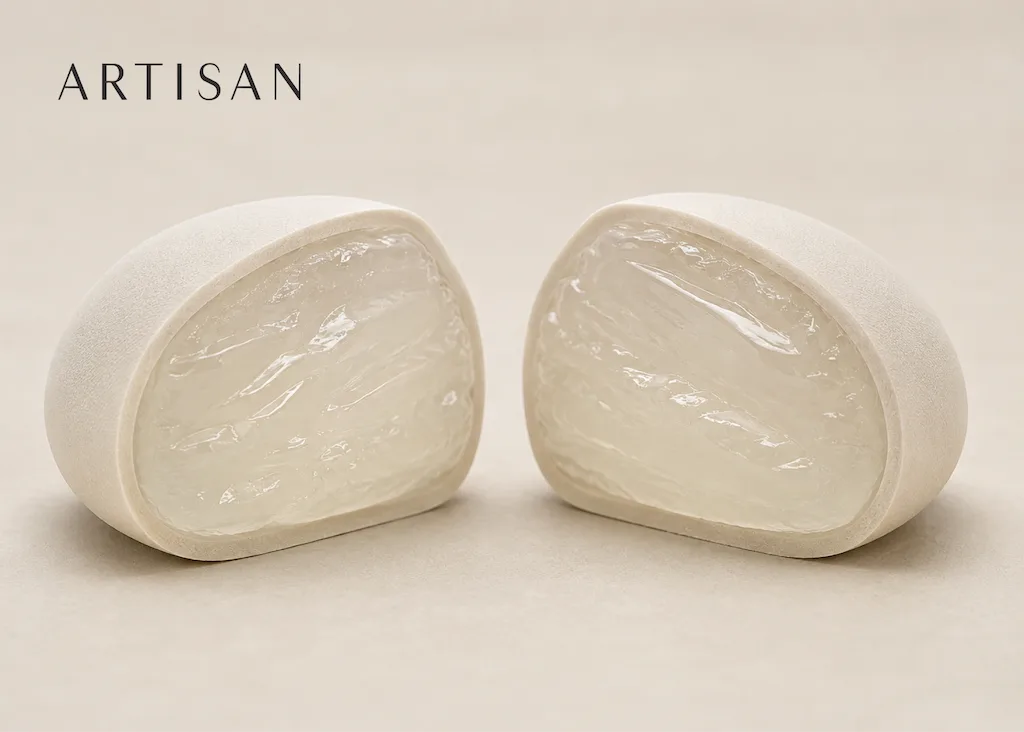
Gummy bear implants aren’t a separate category of implant — they’re silicone, the result of product innovation that turns the gel up a notch. The gel inside is more densely cross-linked. That makes it highly cohesive and form-stable, so it holds a defined shape on its own.
The nickname comes from a simple test. Cut one in half and the gel stays put, the way a gummy candy holds together instead of running. That stability means less rippling, steady upper fullness, and gel that won’t migrate even if the shell tears.
Artisan surgeons reach for this option in specific situations. Our team describes a gummy implant as a silicone implant with thicker, more cohesive gel. It’s often a good fit when there’s limited natural tissue to work with, or when an active lifestyle makes less movement a welcome quality.
Avery, a patient at our Northside office who was guided through her implant options, shared her experience:
“Had the BESTTTT!!! experience with DR.Val she was so knowledgeable in breast augmentation and helped me feel comfortable throughout the whole process. They turned out excellent!”
Gummy bear implants aren’t automatically the right pick, and ruling a type out is as useful as ruling one in. The firmness that holds their shape also makes them feel a little less soft than standard silicone. The teardrop versions can rotate out of position, and the pre-filled gel usually needs a slightly longer incision.
Gummy bear implants are often worth discussing if:
- You have less tissue coverage and want to minimize visible rippling.
- A natural teardrop slope appeals to you more than maximum upper fullness.
- You stay active and prefer an implant that moves less.
- A stable shape over the years is a priority for you.
The gel and the surgery around it can cost more than other implants, so it helps to know that flexible financing is available through Alphaeon Credit, Cherry, and CareCredit. With the options defined, the better question is how they stack up against each other.
How do these implant options compare side by side?
Both saline and silicone, including the form-stable gummy bear variation, lean toward a particular priority, and there’s no universal winner, only the option whose strengths match what matters most to you.
Feel is usually the first deciding factor. Silicone, both standard and the gummy bear variation, reads as more natural to the touch, while saline is firmer by nature. Rippling follows a similar pattern, most noticeable with saline and lowest with the form-stable gummy bear gel.
How each implant behaves if it ruptures is the next real difference. Saline announces itself by deflating, while silicone (both standard and gummy bear) tends toward quiet ruptures that imaging catches. Saline also needs the smallest incision, and gummy bear offers a teardrop shape standard silicone doesn’t.
| Feature | Saline | Silicone |
|---|---|---|
| Fill | Sterile salt water | Soft cohesive silicone gel |
| Feel | Firmer, water-balloon-like | Soft, close to natural tissue |
| Rippling | Most noticeable | Lower |
| If it ruptures | Deflates visibly, salt water absorbed | Often a quiet rupture, gel stays in the capsule |
| Incision size | Smallest | Moderate |
| Shape options | Round | Round |
| FDA age for augmentation | 18 and older | 22 and older |
At Artisan, our surgeons work with the full range of saline and silicone options rather than defaulting to one. A head-to-head chart only goes so far, though. The right choice depends on details a table can’t hold, your anatomy, your goals, and the life you’ll live with the result.
How do you choose the right implant type for you?

Choosing well, and choosing between silicone and saline implants specifically, comes down to matching the implant to three things: your anatomy, your goals, and your day-to-day life. None of that gets sorted from a webpage, which is what the consultation is for.
Your anatomy and tissue coverage
Your frame, skin quality, and natural breast tissue all shape which implant will sit and settle well. With less tissue to drape over the implant, silicone or gummy bear options help keep edges and rippling from showing. Saline can do beautifully when there’s more natural coverage to work with.
Surgeons call this tissue-based planning, using your actual measurements rather than a guess. It’s the more reliable way to match an implant to a body.
Your aesthetic goals
Then there’s the look you’re hoping for. Round implants add fullness across the upper breast, while teardrop gummy bear implants follow a more gradual, natural slope. Bringing reference photos to your consultation gives your surgeon something concrete to work from, the way you’d show an artist a composition you have in mind.
Your lifestyle and life stage
Your life outside the consultation room matters too. If you’re very active, your surgeon may place the implant under the muscle for stability, with a few weeks of easing back into hard workouts. If you’re curious how that placement actually happens, what really happens during breast augmentation surgery walks through it step by step. Age plays a role as well, since the FDA approves saline at 18 and silicone implants (including gummy bear) at 22.
Future pregnancies and routine screening are worth raising now. Pregnancy can change how your breasts look over time, and implants call for a few extra views during a mammogram, though they don’t prevent screening. None of these are dealbreakers, just part of an honest conversation.
The consultation itself
Here’s the part that ties it all together. A consultation isn’t a sales pitch. It’s a two-way evaluation, your chance to weigh our team’s approach as carefully as we weigh your anatomy and goals.
In person at our Northside or Johns Creek office in Atlanta, your surgeon examines your tissue firsthand and talks through the options that genuinely fit. From there, the team curates a treatment plan built around you rather than a template. Our co-founders built this practice on the idea that women deserve to be heard in these decisions.
You’re also welcome to bring a friend to your implant sizing session. A second set of eyes can make the choice feel clearer.
Alexandra, a Northside patient who weighed her options before deciding, described her experience:
“Had a breast augmentation done by Dr. Alexandra in October. It went perfectly, I am so happy with the results. All of the staff was kind and attentive, and I never felt any pressure during the consultation or payments process. They allowed me to split payments in increments that worked for me.”
If cost is on your mind, that’s normal. We’ll walk through financing options like Alphaeon Credit, Cherry, and CareCredit during the visit. When you’re ready, you can schedule a consultation with Artisan to talk through your options in person.
Whatever you choose, it helps to know what living with implants looks like over time.
What are the risks and long-term care of breast implants?

Implants are among the most studied medical devices in use, and the FDA tracks their risks closely. Most people who get them do well for years. Living well with them mostly means knowing what to watch for and keeping up light follow-up.
Common, usually manageable effects
Most of what can come up is minor and manageable. The one worth knowing by name is capsular contracture. That’s when the scar tissue your body naturally forms around the implant tightens and firms up, sometimes enough to change the breast’s shape or comfort.
It’s one of the more common reasons patients return for follow-up surgery, and it’s very treatable when it happens. A handful of other effects can show up too, and most are part of normal healing:
- Temporary changes in nipple or breast sensation that settle as nerves recover.
- Mild asymmetry, since no two breasts are identical to begin with.
- A small pocket of fluid that your body usually reabsorbs on its own.
- Infection or bleeding, which are uncommon and managed early when they occur.
Rare risks worth understanding
Two rare conditions get a lot of attention online, and they’re worth putting in perspective. BIA-ALCL is a rare cancer of the immune system, linked specifically to textured implant surfaces. Smooth implants carry no known risk, and when it’s caught, the outlook with treatment is generally excellent.
Naming these risks isn’t meant to alarm you. It’s so the words feel familiar if you come across them, rather than frightening.
Monitoring and follow-up care
Long-term care is mostly a matter of staying connected. Silicone implants (both standard and gummy bear) come with that imaging schedule, while saline tends to show a problem on its own. At Artisan, follow-up is built into the relationship, with check-ins after surgery and an open door whenever something feels different.
Revision surgery down the road
Sometimes a second surgery enters the picture, whether for capsular contracture, a rupture, or simply a wish to change size later. What to expect with breast implant removal or exchange is a well-traveled path, not a sign something went wrong, and your surgeon can walk you through what it involves.
It’s also worth knowing that implants aren’t lifetime devices. They don’t run on a fixed clock either, so there’s no need to replace them on a schedule when they’re comfortable and behaving well.
Conclusion
Remember those browser tabs. Saline, silicone, and gummy bear started to blur together not because the choice is impossible, but because no article can make it from the outside. The decision was always going to come into focus with a mirror, a conversation, and a surgeon’s hands, not a search bar.
A good next step costs you nothing. Time spent with real patient photos that match your starting point will tell you more than another comparison chart. When the options still feel close, an in-person visit fills in what photos can’t.
That’s the part we care about most at Artisan. Every patient in Atlanta deserves to feel heard, unhurried, and genuinely confident in their choice, because personalized beauty is a conversation, not a catalog. When you’re ready to start that conversation, reach out to our team or call (404) 851-1998.
Frequently asked questions
Are all breast implant types FDA approved?
Yes. Saline and silicone implants, including the form-stable gummy bear variation, are all FDA-approved for breast augmentation after extensive testing. Our board-certified surgeons use only FDA-approved implants, so any option you discuss has already cleared that bar.
Are gummy bear implants only available in a teardrop shape?
No. The teardrop, or anatomical, shape is popular for its natural slope, but gummy bear implants also come in a round version. Your surgeon can help you compare the two against the look you’re going for.
Are silicone implants safer than saline?
Neither is meaningfully safer than the other. They share a similar overall risk profile, and both are considered safe and well studied. The bigger differences are about feel, appearance, and how a rupture shows up.
Which breast implant type is most affordable?
Saline implants are generally the most economical, with silicone (including the gummy bear variation) costing more because of the materials involved. The total still varies with the surgical plan, so the most useful number comes from a consultation.
What happens if my breast implant ruptures?
It depends on the implant. A saline implant deflates noticeably as your body absorbs the salt water, so you’ll know quickly. Silicone ruptures (both standard and gummy bear) are often quiet, with the gel staying within the capsule, which is why imaging matters. Your surgeon can remove the implant and usually place a new one.
*Disclaimer: This content is for educational purposes only and does not constitute medical advice. A consultation with a qualified board-certified surgeon is required to determine the best treatment plan for your individual needs and any questions you may have about a medical condition or procedure.

