




There’s a question most people don’t say out loud when they start researching a breast lift: how do you know you’re picking the right surgeon? The credential pages blur, the galleries look polished, and phrases like “twenty years of experience” lose meaning after the tenth website.
The worry sits underneath the research. It’s not whether to have the procedure, but whether the person holding the instruments will listen and deliver what you actually want. It’s not whether to have the procedure, but whether the person holding the instruments will listen and deliver what you actually want. If that question is still open, it helps to know which non-surgical methods actually lift the breasts and which fall short before you start comparing surgeons.
The honest answer has less to do with intuition than with what you verify. According to ASPS, becoming a board-certified plastic surgeon takes at least six years of surgical training, including three years specifically in plastic surgery, plus written and oral board exams. Not every doctor performing cosmetic work has that training, which is why credentials are the first filter, not the last.
At Artisan Plastic Surgery in Atlanta, our board certified cosmetic surgeons in Atlanta know that choosing a breast lift surgeon feels personal long before it feels technical. “The Art of Personalized Beauty” is how we describe our approach, and as Atlanta’s first woman-led plastic surgery practice, we welcome the hard questions every patient brings to the first visit. This article covers the credentials that genuinely matter, the questions worth asking, and how to read a surgeon’s results beyond the highlight reel.
Key takeaways
A quick orientation before the full guide. These are the points most worth remembering as you narrow your list.
- Board certification by the American Board of Plastic Surgery is the gold-standard credential to verify, because it’s the only ABMS-recognized board specifically for plastic surgery.
- Experience matters most in specific ways: how many breast lifts the surgeon performs a year, how many incision patterns they use fluently, and how they handle uncommon cases.
- The consultation is a two-way evaluation. You’re there to be assessed, yes, but you’re also deciding whether the surgeon listens well, explains clearly, and aligns with your aesthetic.
- Surgical facility accreditation matters for safety. Look for accreditation from AAAHC, Quad A, or The Joint Commission, plus surgeon hospital privileges for breast surgery.
- Before-and-after photos and recent patient reviews tell you more than any marketing language can. Look specifically for patients with a starting point similar to yours.
What credentials prove a breast lift surgeon is qualified?
Credentials are the first thing to check because they filter out the people who shouldn’t be performing surgery at all. In the United States, “cosmetic surgeon” and “plastic surgeon” are not the same title, and a polished website doesn’t confirm formal training.
The gold standard for a surgical breast lift is certification by the American Board of Plastic Surgery, the only ABMS-recognized board specifically for plastic surgery. Membership in the American Society of Plastic Surgeons (ASPS) or The Aesthetic Society takes things a step further. Both organizations require ABPS certification plus annual continuing education, including patient safety training.
At Artisan Plastic Surgery, our board-certified plastic surgeons perform every breast lift in a setting that meets those standards. Here’s a plain-language view of what each credential actually confirms and how to verify it yourself.
| Credential | What it confirms | How to verify |
|---|---|---|
| ABPS board certification | Completed an accredited plastic surgery residency and passed comprehensive written and oral exams | Search the public verification tool at abplasticsurgery.org |
| ASPS or The Aesthetic Society membership | Annual continuing education, patient-safety training, ethical code of conduct | Search the society member directory |
| Hospital privileges for breast surgery | Peer-reviewed competency, plus emergency access in the rare case it’s needed | Ask the practice, or confirm with the local hospital |
| Accredited surgical facility | State-licensed, Medicare-certified, or accredited by AAAHC, Quad A, or The Joint Commission | Ask for the accrediting body by name |
One nuance worth knowing. A surgeon can be a “board-certified cosmetic surgeon” without being a board-certified plastic surgeon. If a surgeon lists a board you don’t recognize, look it up. The ABMS website is the definitive source.
Credentials are a floor, not a ceiling. A qualified surgeon will happily walk you through their training and show you the documents. If the answer sounds defensive or vague, trust that signal.
How much experience should your breast lift surgeon have?
Experience matters in specific, measurable ways. Raw years of practice are less telling than how often a surgeon performs a breast lift, how many techniques they use fluently, and how they respond when a case doesn’t follow the standard script.
Ask about volume. A surgeon who performs breast lifts every week is likely more fluent with the nuances of incision choice, nipple positioning, and scar placement than one who performs the procedure rarely. The Aesthetic Society, in its guide to selecting a surgeon, recommends asking how many of the specific procedures they perform.
Also ask whether they specialize in breast procedures. Some plastic surgeons focus on facial work, others on body contouring. A surgeon who performs mastopexy, breast reduction surgery, and augmentation-mastopexy regularly has seen a wider range of anatomy, which matters if you might combine procedures.
A few questions worth asking directly in the consultation:
- How many breast lifts have you performed in the last year, and over the course of your career?
- Do you specialize in breast procedures, or is breast lift part of a broader practice?
- Which incision patterns do you use, and how do you choose between them?
- How do you handle combination procedures like breast lift with augmentation?
- If a complication did happen, how is it managed, and who do I call?
At Artisan, our co-founders have specialized in breast surgery across their careers, and breast lift is among the procedures they perform most often. Every treatment plan is curated around your anatomy, goals, and lifestyle, not pulled from a template. If you want to meet a breast lift specialist in person, schedule a consultation to talk through your options.
What questions should you ask during a breast lift consultation?
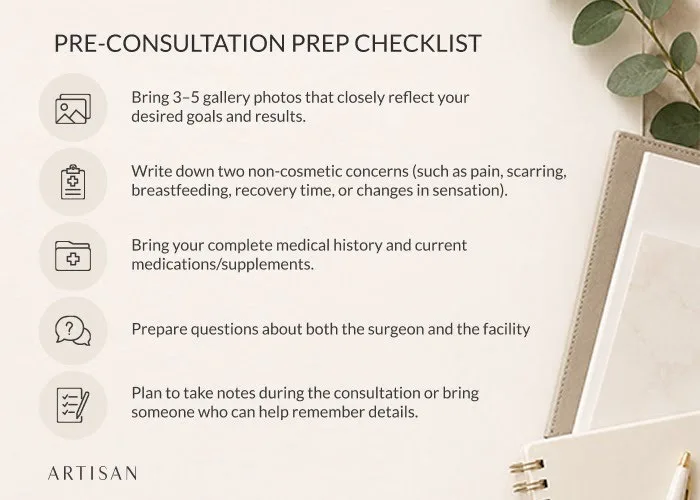
The consultation is where your research becomes a real conversation. A good surgeon will spend time on your goals and your anatomy before ever suggesting a technique, and they’ll welcome the questions below rather than rush past them.
Bring these with you, either on your phone or on paper:
- Am I a good candidate for a breast lift based on my anatomy and health history?
- Which technique do you recommend for me specifically, and why?
- What are the realistic risks, and how do you manage complications if they happen?
- What does recovery actually look like for someone with my lifestyle?
- Where will surgery take place, who administers the anesthesia, and what training do they have?
- How will my breasts look and feel in the months and years after the procedure?
- May I see before-and-after photos of patients with a starting point similar to mine?
- What does the total cost include, and what financing options does your practice offer?
Notice how each question invites a specific, personalized answer. Vague replies, or answers that feel rehearsed, are worth paying attention to.
Yarovinski, E., a patient at our Northside location, described the difference a question-friendly consultation made:
“She has excellent skills and knowledge. She took her time to answer all my questions and reviewed all options. I am thankful to use her as my plastic surgeon. She made my surgery easy, pleasant and comfortable.”
A surgeon who treats your questions as part of the visit is almost always a better fit than one who treats them as an interruption.
How do you evaluate a surgeon’s breast lift results?
Before-and-after photos are the most honest piece of evidence a surgeon can share, because they show the actual outcomes they deliver on real patients. That said, there’s a way to read a gallery, and a way to skim it and miss what matters.
Start by looking for patients with a starting point close to yours. Breast shape, tissue quality, and pregnancy or weight-loss history all shape what a breast lift can achieve. A stunning result on a patient with very different anatomy tells you less than a subtle, well-executed result on a patient who looks like you.
Pay attention to these details as you scroll:
- Do the results look natural in photos from multiple angles, not just a flattering front view?
- Are scars positioned carefully so they can be concealed by most swimsuits and bras?
- Is there a mix of subtle lifts and more significant reshaping, reflecting a range of goals?
- Do the after photos look like a refined version of the same person, not a different person?
- Are the photos from real patients clearly watermarked or attributed to the practice?
Recent reviews add the human layer that photos can’t show. Look at reviews from the last year or two, not just the greatest hits. Read what patients say about communication, recovery support, and how they felt between appointments.
Artisan publishes a gallery of breast lift results filtered by procedure, so you can see how a surgeon approaches different breast shapes, lift techniques, and combination procedures.
Is the surgical facility safe for your breast lift?
Where the surgery happens is almost as important as who performs it. Even a highly skilled surgeon needs the right environment, equipment, and support staff to keep a routine procedure routine.
Accreditation is the starting point. A reputable surgical facility is accredited by one of the following bodies:
- AAAHC (Accreditation Association for Ambulatory Health Care)
- Quad A (formerly AAAASF)
- The Joint Commission
- Medicare-certified or state-licensed for surgery
According to ASPS, accredited ambulatory facilities have serious complication rates below one half of one percent, with very low risk of any life-threatening event under anesthesia when protocols are followed.
Ask who administers the anesthesia. A board-certified anesthesiologist or a CRNA (certified registered nurse anesthetist) working under physician supervision is the standard for general anesthesia. Also ask whether the surgeon has hospital privileges for breast surgery. Those privileges allow a quick transfer to a hospital in the rare event of an emergency, which is a contingency you want in place even if you never need it.
The questions to verify in this section are simple: Who is accredited, by whom, and where does the care continue if something unusual happens? A confident surgical practice will have direct answers for each.
How do you know a surgeon is the right personal fit for you?

The technical filters get you to a shortlist. The final decision is about fit. Even an experienced surgeon with a beautiful gallery can be the wrong person if their communication style doesn’t match how you want to be cared for.
Pay attention to how you feel in the consultation. Do they look at you while you speak? Do they ask about your goals before suggesting a technique? Do they answer your questions in language you actually understand, or do they retreat into jargon?
Melissa R., a Northside patient who changed surgeons after a previous cosmetic procedure, shared what made the difference on her breast lift with implants:
“When I tell you Dr Val is the absolute best I truly mean it. I’ve had cosmetic surgery in the past (in 2016) and this time I decided to go with a different doctor and I’m so glad I did. Dr Val listened to me and understood what I wanted to look like and got the job done. I had a breast lift with implants.”
Think of the consultation as a two-way evaluation. The surgeon is assessing your anatomy, your health, and your goals. You are assessing their approach, their space, and their philosophy. Both parties are deciding whether the fit is right, and the best consultations feel collaborative rather than one-sided.
Artisan’s breast lift consultations are in person only, at our Northside or Johns Creek surgical office. That’s intentional. An in-person visit lets your surgeon do a hands-on assessment and gives you a real feel for the space and the team. It’s the way an artist might walk you through a composition before ever picking up a brush.
A few signals that usually point to a good personal fit:
- The team takes time with your history and your aesthetic goals before recommending a plan.
- You feel comfortable asking anything, including the questions you were worried would sound basic.
- The plan feels customized to you, not pulled from a template.
- The financing conversation happens openly, often with providers like Alphaeon Credit, Cherry, and CareCredit, so cost is part of the plan from the beginning.
If you want to see how that feels in practice, book your consultation with our team in Atlanta.
Conclusion
The quiet worry from the beginning of this article, the one you haven’t said out loud, deserves a clear answer. You find the right breast lift surgeon by verifying credentials, reading experience in specific ways, asking questions that invite real conversation, and paying attention to how the consultation feels.
Browsing real patient photos that match your starting point is one of the most useful next steps. When you’re ready, an in-person consultation fills in the details that photos can’t show. Every patient at Artisan in Atlanta is a unique canvas, and we’d be honored to walk you through a personalized breast lift plan. Reach out to our team or call (770) 872-6967 when you want to start that conversation.
Frequently asked questions
Is board certification required for breast lift surgeons?
Board certification is not legally required to perform cosmetic surgery in most states, but it’s the single most meaningful credential to check. The American Board of Plastic Surgery is the only ABMS-recognized board specifically for plastic surgery, which makes ABPS certification the standard to ask for by name.
How many breast lifts should a qualified surgeon have performed?
There’s no single threshold, but volume should be frequent rather than occasional. A surgeon who performs breast lifts weekly, and cosmetic breast reshaping procedures like augmentation-mastopexy routinely, tends to be more fluent with technique choice than one who performs the procedure a few times a year. Ask for their annual volume and their lifetime estimate.
What does American Board of Plastic Surgery (ABPS) certification actually mean?
ABPS certification means a surgeon completed an accredited plastic surgery residency of at least three years, plus prior general surgical training. They also passed comprehensive written and oral exams focused on plastic surgery. Certification is maintained through continuing education and periodic recertification.
Should I check a surgeon’s online reviews?
Yes, and read recent reviews, not just the featured ones. Look for patterns across many reviewers rather than any single glowing or critical account. Reviews from the last one to two years reflect the current team, schedule, and patient experience more accurately than older ones.
What if I am not happy with my breast lift results?
Speak with your surgeon first. Swelling, scar maturation, and final shape take many months to settle, and most concerns resolve as healing progresses. If the concern is persistent, most surgeons will discuss revision options during follow-up visits. Ask during your initial consultation how the practice handles revisions.
Is American Society of Plastic Surgeons (ASPS) membership important?
ASPS membership adds a meaningful layer on top of ABPS certification. It requires annual continuing education, patient-safety training, and adherence to an ethical code. Surgeons who pursue ASPS membership are typically investing actively in staying current with their field.
How do I verify a plastic surgeon’s credentials?
Search abplasticsurgery.org for ABPS certification and check the ASPS or The Aesthetic Society member directories for society memberships. Ask the practice directly which hospitals have extended privileges for breast surgery. If a surgeon resists any of these requests, treat that as useful information.
What red flags should I watch for when choosing a surgeon?
Pressure to book quickly, vague answers about training, reluctance to share recent before-and-after photos, unclear pricing structures, and uncertain facility accreditation are all worth pausing on. A confident surgical practice welcomes questions and answers them plainly.
Does surgeon experience affect breast lift scarring?
It often does. An experienced surgeon places incisions with the final scar pattern in mind, chooses among multiple incision patterns based on your anatomy, and closes tissue carefully to support fine scar healing. Scars will form either way, but placement and technique make a real difference in how visible they are later.
What questions should I ask about recovery?
Ask how long until you can drive, return to desk work, resume light exercise, and lift normally. Ask what follow-up visits are scheduled and how soon after surgery the team checks on you. Ask what to call the office about, and at what phone number, if something feels off at any stage.
Is the breast lift consultation free?
Many practices charge a consultation fee that’s applied toward surgery if you proceed, while others offer a complimentary first visit. Policies vary, so confirm fees when you call to book. During your consultation, we can talk through cost and financing options like Alphaeon Credit, Cherry, and CareCredit, plus what a personalized plan might look like.
How do I find plastic surgeons who specialize in breast lifts near me?
Start with the ASPS and The Aesthetic Society member directories filtered by ZIP code, then confirm each surgeon’s ABPS certification. Narrow your shortlist to practices that emphasize breast surgery and publish a current gallery. For patients in the Atlanta area, our team offers in-person consultations at our Northside and Johns Creek offices.
*Disclaimer: This content is for educational purposes only and does not constitute medical advice. A consultation with a qualified board-certified surgeon is required to determine the best treatment plan for your individual needs and any questions you may have about a medical condition or procedure.

