




It is a subtle realization that often starts in a fitting room mirror: the bra that once fit perfectly suddenly doesn’t, and the silhouette you’ve always known feels shifted. Whether pregnancy has changed your proportions, years of gravity have taken their toll, or significant weight loss has left behind more skin than shape, the feeling that follows isn’t about vanity. It’s a quiet question of whether your body still reflects who you are inside.
If you are longing to reclaim your natural contours and restore a youthful lift to your silhouette, a breast lift (mastopexy) offers an empowering solution. This procedure is designed to bridge the gap between the body you remember and the one you see today, repositioning tissue and removing excess skin to create a firmer, more rejuvenated appearance.
According to ISAPS, surgeons performed 141,355 breast lifts in the United States in 2024. It is also one of the Most Worth It procedures with 97% rating.
At Artisan Plastic Surgery in Atlanta, the city’s first woman-led plastic surgery practice known for plastic surgery results you can trust, we address every question about breast lifts in a welcoming, relaxed manner. This article explains who is a good candidate, what the procedure entails, and what recovery and long-term outcomes typically involve.
Key takeaways
A brief overview before the full guide.
- A breast lift reshapes and elevates breasts by removing excess skin and repositioning the nipple. It doesn’t add volume on its own.
- Good candidates are generally at a stable weight, in good overall health, non-smokers, and have finished pregnancy and breastfeeding. Age itself is rarely the deciding factor.
- The surgery takes about 2 to 3 hours under general anesthesia and is typically outpatient. Incision patterns correspond to the degree of sagging, ranging from a small crescent to an anchor shape.
- Most patients feel significantly better within 1 to 2 weeks and return to desk work around the 1-week mark. Exercise and heavy lifting wait 6 weeks.
- Aging, weight changes, and future pregnancies can soften the results over time. Most patients still enjoy a more elevated shape for many years.
Am I a good candidate for breast lift surgery?
The initial question most patients have is whether a breast lift is suitable for their reflection. Typically, it is if the concern is about shape and placement rather than size, and if your health and lifestyle support healing.
To determine your candidacy, surgeons evaluate more than appearance, using clinical measurements such as nipple position relative to the inframammary fold and overall breast volume distribution. The accurate anatomical term for this shift is ptosis, meaning sagging. Surgeons evaluate it using Regnault’s grading scale, as detailed in a study published in the National Library of Medicine, to categorize the nipple’s position relative to the breast fold.
Understanding the Regnault Ptosis Scale
| Grade | Severity | Anatomical Description | Typical Correction Goal |
|---|---|---|---|
| Grade I | Mild | The nipple is level with the inframammary fold (the breast crease). | Repositioning the nipple and subtle skin tightening. |
| Grade II | Moderate | The nipple has fallen below the fold but remains above the lowest part of the breast. | Significant tissue reshaping and skin removal. |
| Grade III | Advanced | The nipple points downward and is at the lowest point of the breast contour. | Extensive structural lift and more involved incision patterns. |
| Pseudoptosis | N/A | The breast tissue sags below the fold, but the nipple remains above the crease. | Focuses on tightening the “envelope” to restore shape. |
A breast lift can address any of these grades. Deeper ptosis usually calls for a more involved incision pattern. Your general health matters as much as the grade. Research on mastopexy candidacy consistently names these fit factors:
- You’re a non-smoker or willing to quit well before surgery, because smoking reduces blood flow and slows wound healing
- You’re at a stable weight and planning to maintain it, since swings of 10 to 20 pounds can undo your contour
- You have no medical conditions that impair healing, like uncontrolled diabetes or bleeding disorders
- You’re finished with pregnancy and breastfeeding, because future pregnancies stretch the tissue again
- Your expectations are specific and realistic. A lift elevates shape; it does not significantly change breast size
Age itself is not a gatekeeper. Healthy patients in their 60s and beyond have lifts every year. What your surgeon will look at is how your skin, tissue, and overall health are working together, not a number on a chart.
If you love your current size, a lift alone may be the whole answer, which is exactly what a breast lift without implants can do for small to medium breasts. If you want more fullness in the upper breast, your surgeon may suggest pairing the lift with an implant, one of the surgical breast lifting techniques known as an augmentation-mastopexy. Safety research is reassuring on the combination. Complication rates tick up modestly, from roughly 1.15% for a lift alone to 1.86% with implants.
What are the different types of breast lift techniques?
Different degrees of sagging call for different incision patterns. The shape of your incision is chosen to do the least work necessary for your degree of ptosis, keeping scars as subtle as possible while giving the soft tissue the support it needs.
Crescent lift
A crescent lift involves a small, half-moon incision along the upper edge of the areola. It raises the nipple by about one or two centimeters at most. According to the mastopexy reference, this technique is most effective for very mild ptosis, essentially a pseudo-lift, and is frequently combined with breast augmentation.
Donut (peri-areolar) lift
Also called a Benelli lift, the donut approach involves making two circular incisions around the areola and removing the ring of skin between them. It’s a good match for Grade I ptosis under about 2 centimeters of nipple descent. A synopsis review notes that the technique has a higher reported complication rate than other patterns, largely from areola widening, which is why surgeons are selective about when they use it.
Lollipop (vertical) lift
The lollipop incision circles the areola and then extends vertically to the breast crease, forming a shape that looks like, well, a lollipop. It addresses moderate sagging (Grade II, roughly 1 to 3 centimeters of descent) and allows your surgeon to reshape the underlying breast tissue, not just the skin. In the same synopsis review, the complication rate for vertical lifts is about 9.7 percent, mostly minor scar-related issues.
Anchor (inverted-T) lift
For severe ptosis or breasts with significant excess skin, your surgeon may recommend the anchor pattern, sometimes called the Wise pattern. It adds a horizontal incision along the breast crease to the lollipop, creating an inverted T. This approach is the most reshaping-intensive option and is most often used after massive weight loss.
Matching pattern to ptosis
A quick reference for how incision patterns pair with the degree of sagging. Your surgeon will fine-tune the exact choice during a hands-on evaluation.
| Technique | Incision | Best for |
|---|---|---|
| Crescent | Half-moon above the areola | Very mild sagging, often with implants |
| Donut | Ring around the areola | Grade I, under 2 cm of descent |
| Lollipop | Around the areola + vertical | Moderate Grade II, 1 to 3 cm |
| Anchor | Lollipop + horizontal crease | Severe Grade III, post-weight-loss |
The right pattern isn’t about picking the “smallest” scar. It’s about giving the tissue enough release to resettle into a natural silhouette.
What happens during breast lift surgery?
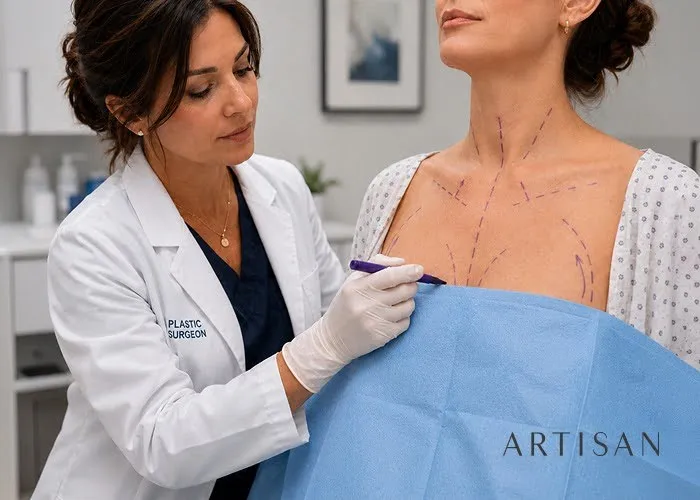
Knowing what happens from the moment you change into a gown to the moment you’re wheeled to recovery takes some of the uncertainty out of the day. Here’s the outline most breast lift operations follow, as described in the study’s chapter on mastopexy.
Step 1: Anesthesia
A breast lift is typically done under general anesthesia, so you’ll be completely asleep and not feel the procedure. Your anesthesiologist inserts an IV, monitors your breathing and heart rate, and manages medication as needed. For short procedures like mastopexy, a urinary catheter is usually not necessary.
Step 2: Markings and incisions
Your surgeon marks the incision pattern on your skin while you’re standing because gravity helps determine where the new nipple should be positioned. Once you’re asleep and positioned on the table, the chosen incisions (crescent, donut, lollipop, or anchor) are made along the pre-marked lines.
Step 3: Reshaping the breast tissue
Once the skin is opened, your surgeon lifts the underlying tissue attached to a pedicle, a flap that maintains the nipple’s blood supply and nerves. The breast contour is reconstructed from within, rather than merely being held up externally. Occasionally, a second internal stitch pattern is used to support the tissue and help minimize future sagging.
Step 4: Repositioning the nipple and areola
The nipple-areolar complex is elevated to a youthful height, and, if needed, the areola is gently resized. Because the nipple remains attached to its pedicle, sensation is usually preserved, though changes are possible and discussed before surgery.
Step 5: Closing and waking up
Excess skin is trimmed, the breast tissue pillars are sutured together, and the outer skin is closed with dissolving stitches. Most lifts take 2 to 3 hours. You’ll wake up in a surgical bra, still a little groggy, and a loved one will drive you home after a short stay in recovery.
What are the risks and complications of a breast lift?
Every surgery involves some risk, and it’s reasonable to want those risks clearly explained beforehand. The good news is that a breast lift, a form of cosmetic surgery to restore breast firmness, is among the safer aesthetic breast procedures when performed by a board-certified plastic surgeon.
A large safety analysis of more than 73,608 cases published in Plastic and Reconstructive Surgery found an overall complication rate of 1.2% for mastopexy alone. Hematoma, a small collection of blood under the skin, is the most common issue at 1.1%.
The risks worth understanding include:
- Permanent but fading scars around the areola that, depending on the pattern, may extend down to and along the crease
- Temporary or, more rarely, permanent changes in nipple or breast sensation
- Asymmetry, since no one is symmetric before surgery, and small differences can persist after
- Minor bruising (hematoma) or a small pocket of fluid (seroma) that your body reabsorbs naturally
- Slower-than-expected healing at an incision, especially for smokers or patients with diabetes
- Recurrent sagging over time from aging, pregnancy, breastfeeding, or weight changes
The vast majority of patients go through the process without any of these issues, and when they do arise, most respond to early, straightforward care. Your surgeon lowers these risks by carefully screening you, matching the technique to your anatomy, and maintaining close contact during the first six weeks of healing. What patients most often mention in reviews isn’t the absence of risk; it’s the sense of being held steady throughout the process.
Mya W., a patient who had a breast reduction and tummy tuck, shared what that felt like:
“I recently had a breast reduction and tummy tuck performed by Dr. Sybile Val, and I couldn’t be happier with my results. Dr. Val is not only an exceptionally skilled surgeon but also a genuinely kind and compassionate person. She went above and beyond to make sure I was comfortable and informed every step of the way—checking on me regularly after the procedure and even calling once I returned home. Her level of care and attention truly put me at ease throughout the entire process.”
If understanding what real patients look like afterward is more helpful than just percentages, our breast lift gallery offers a visual overview of outcomes for every incision pattern.
What is recovery like after breast lift surgery?
Recovery from a breast lift occurs gradually, with weekly improvements rather than sudden changes. Patients often report initial soreness and slow progress in the first days, a turning point in the second week, and by six weeks, they typically feel almost fully restored to their usual activities.
Our team at Artisan guides you through recovery with scheduled follow-ups at 1, 3, and 6 weeks and provides easy access to ask questions between visits. Pain is generally mild to moderate, controlled with prescribed medication, and usually decreases significantly within the first few days. Sleeping is more comfortable if your head is elevated during the first week.
Here’s what a typical mastopexy recovery looks like, drawn from our own aftercare guidance and ASPS recovery recommendations:
| Phase | Timeframe | What’s normal | Activity |
|---|---|---|---|
| Immediately after | Day 1 to 3 | Soreness, swelling, bruising, surgical bra on continuously | Rest, short walks, head elevated |
| Early recovery | Week 1 to 2 | Pain easing, swelling peaking, then settling | Light daily activities, desk work around week 1, arms not overhead for 7 days |
| Mid recovery | Week 3 to 6 | Most swelling gone, shape starting to settle | No lifting over 5 pounds through week 3, no gym |
| Full recovery | Week 6 onward | Scars beginning to mature, final shape emerging | Resume exercise, underwire bras OK |
A good support bra is a quiet but essential part of recovery. You will start with a soft surgical bra to wear continuously for the first week, except when showering, then switch to a supportive bra for approximately 6 weeks. There’s no need to rush into underwire bras.
It’s important to recognize warning signs, even if you might never need to. Contact the office immediately if you experience severe pain unrelieved by medication, rapidly expanding bruising on one side, or red, hot incisions. The same applies to fever, chills, or calf pain or swelling in one leg, which could indicate a blood clot, although rarely. Our aftercare line is (404) 851-1998.
What results can I expect from a breast lift?
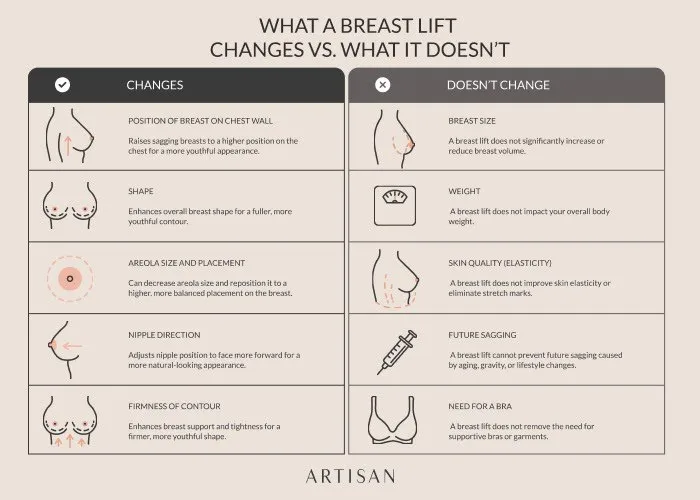
You’ll notice the changes on the day of surgery: the breasts will sit higher on the chest, the nipples will point forward again, and the overall shape will look more youthful even through bandages. However, during the first week, what you’re seeing is the swollen version of your final result, not the final outcome.
In the weeks and months that follow, swelling decreases, the shape stabilizes to its natural contour, and scars gradually soften. ASPS guidelines on breast lift outcomes indicate that scars typically continue to fade substantially over the first 1 to 2 years with appropriate sun protection and scar treatment. Ultimately, most scars become flat, thin, and well-concealed beneath clothing.
What shapes your long-term result:
- Weight stability, because gains and losses stretch or deflate the tissue your surgeon reshaped
- Bra support, which supports the skin envelope during the first 6 weeks and beyond
- Sun protection over the incisions, which fade better when they aren’t exposed to UV during the first year
- Future pregnancies and breastfeeding, which can change the shape again
- The natural timeline of aging and gravity, which nobody pauses entirely
A lift doesn’t promise an ageless breast. What it does is reset your starting position, so the natural passage of time begins from a higher, firmer baseline rather than a lower one. Patient-reported satisfaction in long-term outcome studies ranges from 85% to 94%, with corresponding gains in self-esteem and quality of life.
Taylea B., who had a breast lift with implant exchange in 2025, described what the long view felt like:
“Dr. Diane Alexander is my go to physician for plastic surgery. She performed my tummy tuck in 2020 and a breast lift with implant exchange in 2025. I trust her implicitly, and my outcomes have always exceeded my expectations.”
To see how different starting anatomies settle into their final shapes, the practice keeps a dedicated breast lift gallery of our own patients’ results.
What happens at a breast lift consultation?
A consultation is a two-way conversation in which your surgeon evaluates your anatomy and goals, while you evaluate the team’s approach, the space, and whether it’s right for you.
Your consultation at Artisan is conducted in person, either at our Northside office on Peachtree Dunwoody Road or at our Johns Creek location. An in-person visit allows your surgeon to perform a hands-on evaluation that cannot be done via a screen. During this visit, we assess breast position, evaluate skin elasticity, and examine symmetry and scar patterns.
Additionally, we’ll review your medical history, previous mammograms or biopsies, and your plans for pregnancy or breastfeeding, as well as your goals for the procedure. Then, your surgeon develops a personalized plan, similar to an artist discussing a composition: focusing on balance, proportion, and how each part contributes to the overall.
If a lift by itself is the best option, that’s what you’ll be told. If an implant could add fullness, or reducing cup size through surgery could improve proportion, those options are discussed frankly rather than aggressively pushed.
Conclusion
That quiet moment in front of the mirror is not just about looks, but also about reconnecting with your sense of self and envisioning how you want to feel every day. For many of our patients, the choice to pursue a breast lift is a thoughtful journey, often considered over months or years.
Taking the next step doesn’t have to be overwhelming. To begin with, you can explore our before-and-after gallery to see real results from people who started their journey just like you, whether after pregnancy, weight loss, or simply as time passes.
When you’re ready for answers beyond the photos, a personal consultation will provide expert insight and address your unique questions. To help make your decision easier, we also offer flexible financing options through Alphaeon Credit, Cherry, and CareCredit, so you can focus on yourself without worrying about the full cost.
Now is the time to invest in your confidence and well-being. Book your consultation at our Northside or Johns Creek location. You may also call us at (404) 851-1998 and take the first step toward a more empowered you.
Frequently asked questions
Does insurance cover breast lift surgery?
Most health insurance plans don’t cover a breast lift when it’s performed for cosmetic reasons. Coverage may be available in specific reconstructive contexts, such as after breast cancer treatment. Your insurer’s policy language will detail what qualifies.
Where will the scars be from a breast lift?
Scars typically follow the incision pattern selected by your surgeon. They may be located around the areola, extend vertically from the areola to the breast crease, or occasionally run horizontally along the crease. In nearly all cases, these scars stay within the area covered by a standard bra or swimsuit top.
Can I breastfeed after a breast lift?
Many women who’ve had a breast lift can still breastfeed, but not all, because surgery near the milk ducts and nipple can affect milk supply. If future breastfeeding is important to you, most surgeons recommend waiting until you’ve finished having children, since pregnancy can change breast shape again. This is a specific topic to raise at your consultation.
Will a breast lift make my breasts bigger?
A breast lift alone doesn’t add volume. It reshapes and elevates by removing excess skin and repositioning your existing tissue. If you want added fullness (particularly in the upper breast), your surgeon may pair the lift with an implant or a fat transfer, both of which are discussed and planned in advance.
What is the difference between a breast lift and a breast augmentation?
A breast lift alters the shape and position of the breasts, while a breast augmentation, using saline and silicone implant options, increases their size and projection. Lifts target sagging by removing surplus skin, whereas augmentations boost volume through implants or fat transfer. Many patients opt for both procedures, which can be combined into a single augmentation mastopexy.
Are there non-surgical breast lift options?
A handful of non-surgical techniques exist, including radiofrequency skin tightening, thread lifts, and targeted chest strengthening, but they are best suited for earlier, milder concerns than surgery. Non-surgical tools can firm skin or add subtle lift, while surgical procedures address moderate-to-severe structural sagging.
Who performs a breast lift?
Breast lifts should be performed by a board-certified plastic surgeon with specific training and ongoing experience in breast surgery. Our board-certified plastic surgeons have decades of collective experience in mastopexy, breast augmentation, breast reduction, and breast reconstruction, so every plan draws on depth in the same anatomic region.
How do I prepare for my breast lift consultation?
Bring your goals, medical history, current medications, prior surgeries, and any recent mammograms or biopsy reports. Think ahead about questions on recovery, photo expectations, and scar placement. Nothing is off limits during the visit.
*Disclaimer: This content is for educational purposes only and does not constitute medical advice. A consultation with a qualified board-certified surgeon is required to determine the best treatment plan for your individual needs and any questions you may have about a medical condition or procedure.

