




Rhinoplasty and otoplasty are two separate operations that surgeons frequently perform in a single session. One reshapes the nose. The other reshapes the cartilage of the outer ear so that prominent ears rest closer to the head.
The numbers put that pairing in perspective. In 2024, surgeons performed 1,083,631 rhinoplasties worldwide, making it the fifth most common cosmetic surgical procedure, according to ISAPS. Ear surgery is requested far less often, so a surgeon at ease with both is worth seeking out.
At Artisan Plastic Surgery in Atlanta, our team approaches the face as a single composition rather than a list of separate operations. If you have been weighing both procedures and wondering whether to do them together, that instinct deserves a careful look. This article covers the real benefits of combining the two, the risks that deserve honest attention, and what a shared recovery asks of you.
Key takeaways
- Rhinoplasty and otoplasty are routinely performed in one session, because both sit in the same surgical field and can be designed against each other for facial balance.
- Combining them means one anesthetic, one pre-operative workup, and one block of time away from work or school instead of two months apart.
- Combining two procedures roughly doubles the 30-day adverse-event rate compared with a single procedure, though both figures stay low. Much of the added risk is linked to longer time under anesthesia.
- Recovery is staggered rather than doubled. The ears settle within a few weeks, while the nose keeps refining quietly for months.
- Otoplasty is treated as cosmetic and is rarely covered by insurance. A rhinoplasty performed to correct obstructed breathing may be partially covered.
What are the benefits of getting rhinoplasty and otoplasty at the same time?
The nose and the ears are read together, not separately. Move the ears without touching the nose, and a face can still feel slightly out of balance. Your surgeon can shape both so they support each other, the way an artist adjusts two elements of one composition.
The practical reasons matter more than most people expect. Instead of clearing your calendar twice, you clear it once.
The advantages tend to fall into four groups:
- Facial balance. Both features get designed against each other in a single plan.
- A single anesthetic. You go under once, with one pre-operative workup.
- A shared recovery. Swelling, bruising, and time off overlap rather than repeat.
- One emotional arc. You get through the anxious part of surgery a single time.
That last point is not a small thing. A 2023 study of adults who had otoplasty found their social appearance anxiety scores dropped significantly six months later. Wanting to stop thinking about a feature you have thought about for years is a reasonable, human motive.
Our facial surgery team at Artisan hears that reason more often than any other. Whether you combine the two or stage them apart, asking the question this carefully is a good sign.
Unlike liquid rhinoplasty in Atlanta, which uses injectable fillers to make subtle changes to the nose, surgical rhinoplasty reshapes the underlying nasal structure.
What are the risks of combining nose and ear surgery?
Most people who combine these procedures come through without trouble. Still, joining any two operations raises the odds of a bump in the road, and you deserve that stated plainly. An analysis of more than 35,000 patients found a 30-day adverse-event rate of 8.7 percent when two procedures were combined, against 4.2 percent for one alone.
Both numbers are low in absolute terms. The increase is real, though, and the honest way to read it is as a reason to weigh your surgeon and your operating time carefully.
Time under anesthesia
Rhinoplasty generally runs one to three hours. Otoplasty adds another one to two. Together they usually land between three and five hours, which is the most important number in this conversation.
Once an operation passes about three hours, published anesthesia guidance urges extra caution with general anesthesia. Blood clots and postoperative nausea are the complications it flags most often. An unhurried surgeon who declines to rush both procedures into one morning is showing you good judgment.
Keeping the two fields separate
The inside of the nose naturally carries more bacteria than skin does. Surgeons call that a clean-contaminated field. The ears, by contrast, are clean, so they are almost always reshaped first, before the nose is opened.
Sterile drapes, fresh instruments, and a change of gloves between the two stages keep one from affecting the other. It is a quiet piece of choreography, and it is worth asking your surgeon to walk you through it.
Who should wait
Some people are asked to postpone, and it is rarely permanent. Active smoking is the most common reason. Most surgeons require complete abstention for several weeks on either side of surgery, because nicotine constricts the vessels that healing cartilage depends on.
An active ear or respiratory infection will also pause things, as will uncontrolled diabetes, high blood pressure, or a bleeding disorder. None of this is meant to frighten you. It is the checklist your surgeon runs so that when the answer comes, you can trust it.
How is a combined nose and ear surgery performed?
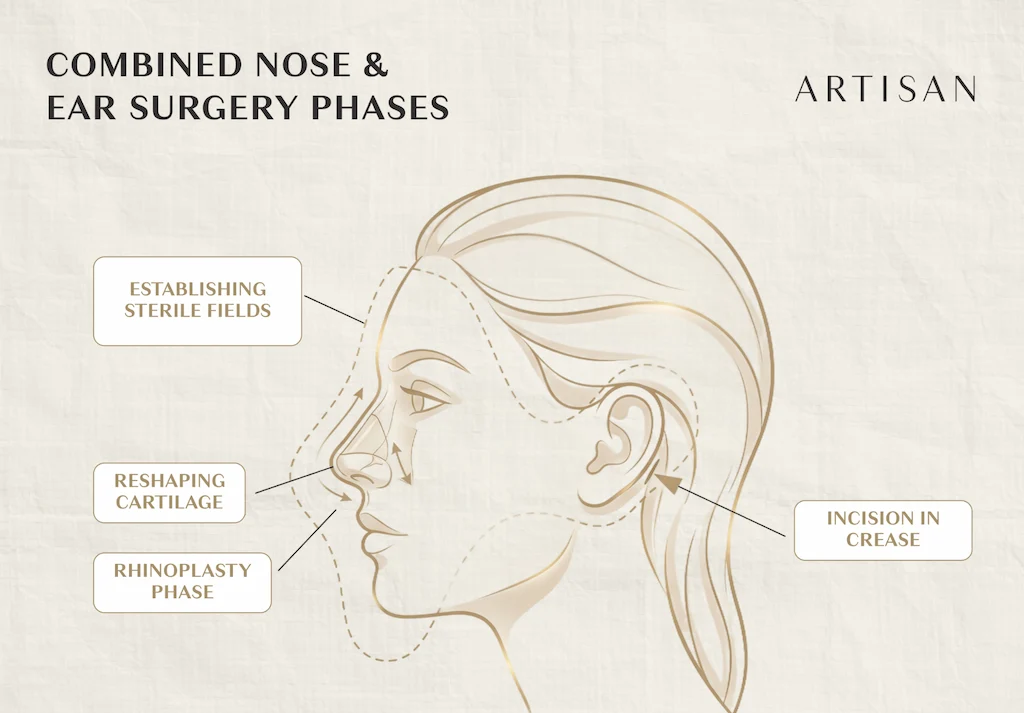
You are asleep for the whole thing, and the operation moves in a deliberate order. General anesthesia is used rather than sedation, because two surgical fields and several hours of work call for it.
Here is how the day usually unfolds:
- General anesthesia has started, so you are asleep and feel nothing.
- The ears are reshaped first, through a small opening tucked behind each ear.
- The nose is reshaped second, once the ear work is finished and re-draped.
- A splint is taped over the nose, and a soft wrap goes around the head.
The otoplasty phase
Your surgeon works through the crease behind the ear, where the resulting mark stays hidden. The cartilage is then either folded into the curve it never formed, or gently thinned so that it bends without resistance.
Two classic stitch techniques do most of the work. Mustardé sutures build the missing fold, and Furnas sutures draw a deep, cupped bowl back toward the head. Which one your surgeon reaches for varies with your own anatomy and goals, as a published surgical review notes.
The rhinoplasty phase
The nose is approached either from inside the nostrils, leaving no outside mark, or through a tiny opening across the skin between them. That second approach gives your surgeon direct sight of the framework underneath.
From there the work is structural. Bone and cartilage are refined, and grafts are sometimes borrowed to support the tip or straighten the bridge. Millimeters decide the outcome, which is why this stage is never hurried.
What does recovery look like for both your nose and your ears?
Recovery is staggered, not doubled. Both areas start healing on the same day, but they finish on different schedules. Knowing that in advance saves a lot of unnecessary worry.
| Phase | Timeframe | What to expect |
|---|---|---|
| Right after surgery | Day 1 to 3 | Ear wrap and nose splint stay on, sleep on your back |
| First follow-up | Day 3 to 5 | Wrap becomes a soft headband, bruising around the eyes peaks |
| Back to routine | Week 1 to 2 | Nose splint comes off, most people return to desk work |
| Settling in | Week 3 to 6 | Headband at night only, the ear shape reads clearly |
| Final refinement | Month 3 to 12 | Ears look settled, the nose keeps refining slowly |
The first week is the one people ask about most. A bulky wrap protects the ears for three to five days and must stay intact to hold the new shape. The nasal splint, meanwhile, simply needs to stay dry.
Sleep is the part nobody warns you about. You will rest on your back with your head elevated, and side sleeping is off the table while both sites are tender. Pretty manageable, once you have set the bed up for it.
Then the timelines separate. Your ears look close to their final shape within a few weeks. Nasal swelling keeps refining for months, particularly at the tip, so the mirror keeps rewarding you long after you have stopped thinking about surgery.
Susan, a patient at our Northside office who had a multi-part facial surgery and one overlapping recovery, described how it went:
“The level of care and communication has been excellent. I still have two more follow-up appointments and will post photos once I’m fully healed, but I’m already thrilled with my results and the overall experience.”
What determines the cost of combined nose and ear surgery?
Cost is one of the first questions patients ask, and it rarely has a tidy answer. A combined procedure is priced from its parts, and those parts differ for every face.
The variables that move the number most are:
- Surgical time. Two procedures mean a longer operation and a longer anesthesia bill.
- Anesthesia type. General anesthesia costs considerably more than a local approach.
- Technique and complexity. Cartilage grafting or a revision case takes longer than a primary one.
- Facility fees. Where the operation happens shapes a meaningful share of the total.
- Aftercare. Medications, headbands, and follow-up visits belong in your planning.
Insurance sits in an awkward middle. Otoplasty is treated as a cosmetic procedure and is rarely covered, even when prominent ears have caused a child real distress at school.
The nose can be different. Where a rhinoplasty is genuinely reconstructive, correcting documented breathing obstruction that has not responded to medical treatment, a policy may cover that portion. The cosmetic refinements done in the same operation would still be yours.
To keep the investment manageable, you can explore flexible financing through Alphaeon Credit, Cherry, and CareCredit. Your surgeon gives you a precise figure once your plan is set, because a quote written before anyone has examined you is a guess.
How do you choose the right surgeon for a combined facial procedure?
Board certification is the floor, not the ceiling. It tells you a surgeon completed accredited training and passed rigorous examinations. That is the baseline you want before anyone works on two structures at once.
From there, ask about volume. A surgeon who performs both operations regularly, and who has combined them before, brings judgment that no credential captures on paper. Ask how many combined cases they have done.
Before-and-after photos are the other place to look, and they need to be read rather than admired. ASPS submission standards bar collages and require that the surgical area not be distorted by lighting, hair, or positioning. A gallery where the “after” is warmer or better lit is telling you something.
At Artisan Plastic Surgery, our surgeons are certified by the American Board of Plastic Surgery. Each brings more than 20 years of experience to that assessment. Part of that experience is knowing when to say no, or not yet.
Ansley, a patient at our Northside office who valued being able to speak openly before surgery, put it this way:
“I had surgery under Dr. Santosa and am so pleased with how the process went. Dr. Santosa is so kind and genuine. I never felt rushed during pre-op appointments and always felt comfortable to bring up concerns with her or her staff.”
What happens at your consultation?
The consultation is not only your surgeon’s chance to evaluate you. It is equally your chance to evaluate them, their approach, and how they answer a question they have heard a hundred times.
Yours begins with a hands-on examination of your nasal structure, your ear cartilage, and your overall health. A screen simply cannot replicate that. Then comes a candid discussion of whether combining the two serves your goal or complicates it. Some faces are better served by staging them.
As Atlanta’s first woman-led plastic surgery practice, we tend to spend longer on that conversation than most. Your surgeon walks through the approach the way an artist might discuss a composition, weighing balance and proportion. The plan you leave with is curated around your anatomy, never pulled from a template.
Conclusion
You arrived with a straightforward question about whether the nose and the ears can be addressed at once. They can, and for many people that one decision spares a second anesthetic and a second season of thinking about it. Rhinoplasty and otoplasty are not the same operation, yet planned together they become one thoughtful design.
An evening spent with a before-and-after gallery is one of the most useful next steps you can take. A personal consultation then fills in the parts a photograph will never show.
Every face that walks into Artisan Plastic Surgery in Atlanta arrives with its own proportions and its own reasons. Both deserve to be heard before anything is planned, and that is what the Art of Personalized Beauty means in practice.
When you are ready, reach out to our team or call (404) 851-1998.
Frequently asked questions
How long does a combined nose and ear surgery take?
Most combined procedures run about three to five hours. Rhinoplasty accounts for roughly one to three hours of that, and otoplasty for another one to two. Complex or revision cases take longer.
What kind of anesthesia is used when combining rhinoplasty and otoplasty?
General anesthesia is almost always used. Otoplasty alone can sometimes be done under local anesthesia with sedation. Two surgical sites and several hours of operating time make general anesthesia the safer choice here.
Will I need to wear bandages on both my nose and my ears at the same time?
Yes, and they work differently. A bulky wrap circles your head for three to five days, holding the ears in position. A lightweight splint sits over the bridge of the nose for about a week.
Is the recovery time longer if I get both surgeries done at the same time?
Not meaningfully. The two recoveries overlap rather than add together, and the nose sets the pace because it heals more slowly. Most people take one to two weeks away from work.
How should I sleep after undergoing simultaneous nose and ear surgeries?
On your back, with your head elevated on several pillows or in a recliner. Side sleeping presses on the healing ears and the nasal splint, so it waits until your surgeon clears it.
Can children combine rhinoplasty and otoplasty surgeries?
Usually not in one operation. Otoplasty is commonly performed from around age five to seven, once the ear has nearly finished growing. Rhinoplasty waits until the nose completes its growth in the mid-to-late teens. In the newborn period, our team can often reshape ear deformities without surgery, using molding devices while the cartilage is still soft.
Are the risks of complications higher when combining otoplasty with a rhinoplasty?
Yes, roughly double the 30-day adverse-event rate of a single procedure, though both rates stay low in absolute terms. The added risk is linked mostly to longer time under anesthesia rather than to the procedures interfering with each other. Choosing a board-certified surgeon who performs both operations regularly is the most effective way to keep that risk where it belongs.
*Disclaimer: This content is for educational purposes only and does not constitute medical advice. A consultation with a qualified board-certified surgeon is required to determine the best treatment plan for your individual needs and any questions you may have about a medical condition or procedure.

