




Loose breast skin is a skin problem, not a size problem. After weight loss or pregnancy, the breast loses internal volume faster than the skin around it can contract. What remains sits lower and feels emptier, even when the scale finally reads what you wanted.
Here is what the research actually shows. Surgeons performed 772,138 breast lifts worldwide in 2024, according to ISAPS, making it the eighth most common surgical aesthetic procedure that year. Skin stretched past its elastic limit rarely recoils on its own, and that is tissue biology rather than discipline.
Artisan Plastic Surgery in Atlanta is the city’s first woman-led plastic surgery practice, and this is a conversation we have every week. Wanting your body to reflect the work you have put into it is not vanity, it is self-respect. This article covers why breast skin loosens, what non-surgical treatment can realistically deliver, and which surgical options genuinely restore shape.
Key takeaways
- Loose breast skin comes from a stretched skin envelope and depleted elastic fibers, not from lost volume alone. That distinction determines which treatments can help you.
- No home method lifts skin that has already stretched. Exercise, supplements, and creams can improve how your chest looks and slow further loosening, but they cannot reverse structural change.
- Breastfeeding does not independently cause sagging. Age, body mass index, significant weight loss, and smoking are the factors research points to.
- Non-surgical radiofrequency microneedling produces a subtle lift for mild laxity. Surgery is the only option that removes skin, which is what moderate to severe looseness requires.
- Timing protects the result. Stable weight, a finished breastfeeding period, and no active nicotine use make a lasting outcome far more likely.
Why does breast skin become loose and saggy after weight loss or pregnancy?
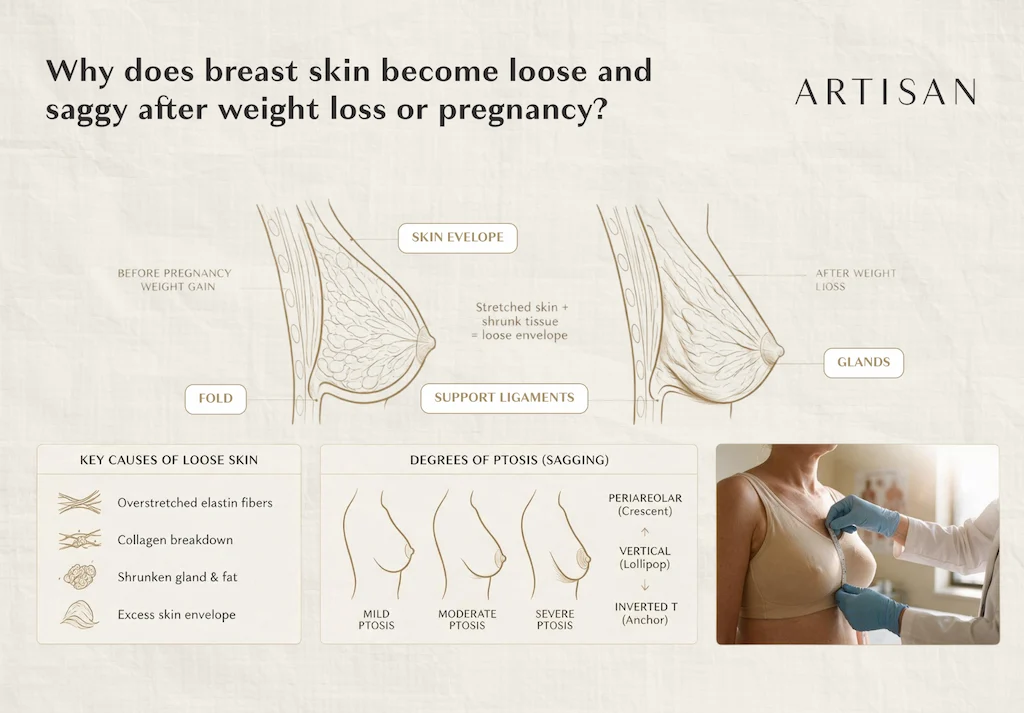
Breast skin loosens because its internal scaffolding stretches and its elastic fibers break down, and neither repairs itself the way you might hope. Volume leaves, but the envelope stays.
Rapid weight loss and skin elasticity
Significant weight loss weakens the dermis, the deeper layer of skin that gives it strength and snap. Research on patients after major weight loss documents measurable changes in the skin’s collagen and elastin content, the two proteins responsible for recoil. Once those fibers break down, skin behaves less like a rubber band and more like a stretched-out sleeve.
If you have lost a large amount of weight, this is the part nobody warns you about. You did everything right, and your skin simply could not keep pace.
Pregnancy, breastfeeding, and glandular change
During pregnancy, rising estrogen and progesterone drive rapid growth of the milk-producing glands. The breast expands quickly. After weaning that tissue shrinks back, leaving skin to hold a space no longer filled.
Here is the part that surprises most patients. A study of 132 plastic surgery patients found that age, body mass index, significant weight loss, and smoking predicted sagging, while breastfeeding itself did not. If you have been carrying guilt about nursing your children, you can set it down.
Cooper’s ligaments and the breast’s internal scaffolding
Inside every breast runs a web of thin connective bands called Cooper’s ligaments. They run from the chest wall to the skin, holding everything in position, like the internal framing of a tent. They stretch under load, and unlike muscle, they do not tighten back up with training.
Age, genetics, and skin recoil
Skin elasticity declines with age, and genetics set the ceiling on how much recoil you had to begin with. Two people can lose the same weight and end up with visibly different amounts of loose skin.
That is not a character flaw, it is inherited tissue quality. Knowing which force shaped your result is the first step toward a treatment that can address it.
Can you tighten loose breast skin naturally at home?
The honest answer is no, at least not in any meaningful way. Home methods can improve how your chest looks and how you carry yourself, and several genuinely help slow further loosening. None of them lift skin that has already stretched.
Chest exercises are the most common suggestion and the most misunderstood. Breasts contain fat, glandular tissue, and connective bands, but no muscle of their own. Training the pectoral muscles underneath improves posture and shoulder stability, as Harvard explains, which is a firmer foundation rather than a lift.
Collagen supplements come up next. A systematic review of 61 studies found that ingestible collagen improves skin hydration and reduces wrinkles. None of that evidence shows it lifts breast skin.
Here is a realistic accounting of what each approach does:
- Chest exercises strengthen the muscles beneath the breast and improve posture, which changes how your chest reads in clothing. They do not lift breast tissue.
- Collagen and good hydration support general skin health, but elastic fibers that have already broken down do not regrow because you drank a powder.
- A well-fitted, supportive bra reduces the daily gravitational load on Cooper’s ligaments, limiting further stretching.
- Firming creams act on the stratum corneum, the outermost layer of dead skin cells. Elasticity lives far deeper, down in the dermis.
- Massage, ice baths, and cold showers briefly constrict surface blood vessels, and the tightening fades within minutes.
What non-surgical treatments help tighten loose breast skin?
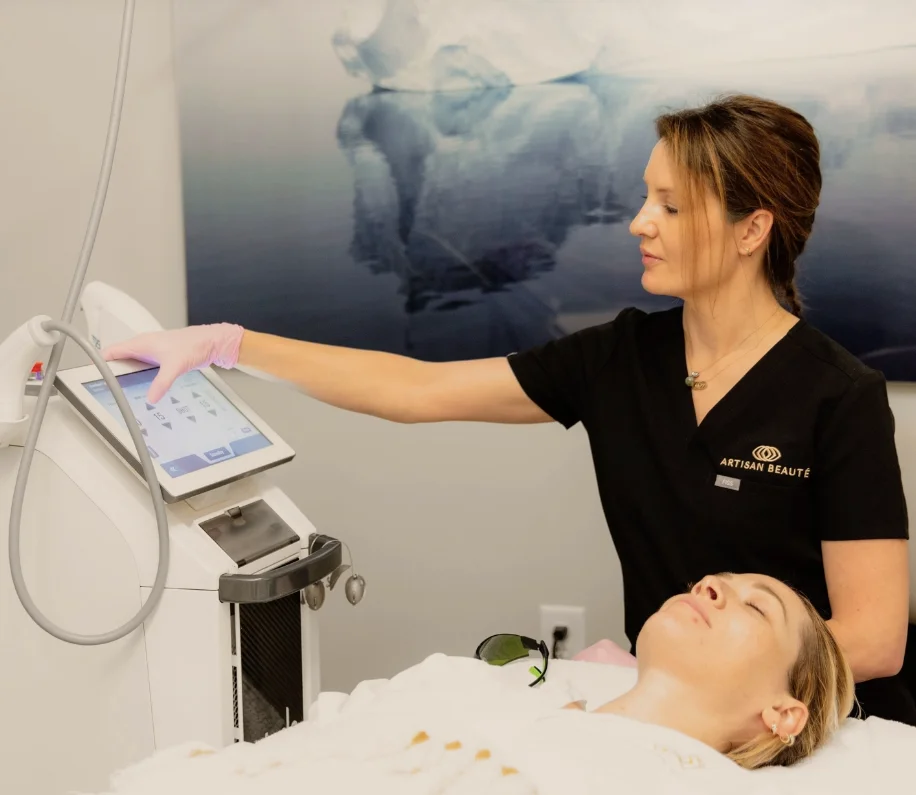
Non-surgical skin tightening can improve mild laxity. It works by injuring the deeper skin on purpose, so the body rebuilds collagen there. The most established tool for the chest is radiofrequency microneedling.
Artisan Beaute, our medical aesthetics practice, offers Morpheus8™, a radiofrequency microneedling device with handpieces built for the neck and body. Tiny insulated needles deliver heat beneath the surface of the skin, and that controlled injury triggers a wound-healing response. New collagen forms over the months that follow, which is why the change appears gradually rather than on the drive home.
Radiofrequency microneedling remodels skin, as MDedge describes, rather than removing it. Our team recommends three or more sessions spaced three to four weeks apart, and a pre-treatment consultation always comes first. For some patients that is enough, and for others it is the moment they realize the loosening runs deeper than any device can reach.
Michelle, a patient at our Johns Creek office who came to us after significant weight loss, shared her experience:
“I was extremely nervous as I had never considered Plastic surgery, however due to extreme weight loss it became necessary. this practice was recommended to me by a Dr and a friend and I have to say from start to finish they have all been wonderful.”
So what can you realistically expect? Non-surgical options like Morpheus8 work well for early, mild laxity, while surgical procedures like a breast lift address more advanced structural changes. The lift these devices produce is subtle, measured in millimeters rather than cup sizes.
You benefit most if your nipple still sits at or above the crease beneath the breast. A clinical evaluation in Plastic and Reconstructive Surgery tested radiofrequency on the breast only in patients with mild to moderate sagging. Effective non-invasive correction of significant sagging, in the authors’ words, is virtually nonexistent in the literature.
What surgical options provide the best results for tightening breast skin?
Surgery is the only approach that removes skin, and removing skin is the only way to resize an envelope that no longer fits. Which operation suits you depends on where your nipple sits and whether you also want volume back.
| Approach | Best suited for | What it involves |
|---|---|---|
| Breast lift (mastopexy) | Enough natural volume, breast sits low | Removes excess skin, repositions the nipple |
| Augmentation alone | Nipple still at or above the crease | Restores upper fullness with an implant |
| Lift with implants | Loose skin plus lost volume | Reshapes the envelope and refills it |
| Lift with fat transfer | Loose skin, prefers no implant | Reshapes and refills using your own fat |
| Mommy makeover | Breast and abdominal laxity together | Combines breast and body contouring |
The breast lift (mastopexy)
A breast lift, known medically as a mastopexy, removes excess skin, reshapes the tissue underneath, and repositions the nipple higher on the chest. Surgical literature describes it as tightening the skin envelope without adding volume.
Volume is a separate question, which is why some patients after major weight loss feel a lift alone leaves them flatter than they pictured. Name that before surgery, not after.
At Artisan, a breast lift takes two to three hours and is performed at Northside as an outpatient procedure. Our team never treats it as a one-size-fits-all operation, and the incision pattern is chosen around your anatomy.
Adding implants or fat transfer
If you have lost both skin tension and volume, a lift on its own may not deliver the upper fullness you are picturing. Adding an implant, or transferring your own fat, restores what the lift cannot.
Patients after major weight loss often need this combination, since they present with severe sagging and loss of upper-pole volume together. A clinical primer on breast lift planning advises adding implants when a patient’s remaining volume is insufficient. Our team offers augmentation combined with a lift, so shape, size, and nipple position are addressed in one operation.
Augmentation is the third most common aesthetic surgery for women worldwide, with ISAPS recording 1,611,758 procedures in 2024. Choosing it alongside a lift is common, not unusual.
Choosing the incision pattern
Scars are the trade you make for shape, and how much scar depends on how much skin has to go. Surgeons choose from several patterns. A small incision around the areola suits mild sagging, a vertical “lollipop” handles moderate cases, and an anchor pattern removes the most skin.
Your surgeon walks you through that choice at your consultation. Scars fade over time and can usually be concealed by a swimsuit top.
Combining with body contouring
Pregnancy and weight loss rarely limit themselves to one area. A mommy makeover addresses breast and abdominal laxity in a single operation, which appeals to patients who would rather recover once than twice.
Whether that suits you depends on your health and how much surgical time is safe in one sitting. Every plan our team builds is curated around your anatomy and your goals, never assembled from a menu.
While belly fat reduction, Atlanta treatments can address stubborn abdominal fat, loose breast skin requires a treatment plan tailored to the breasts.
When is the right time to undergo breast tightening surgery?
Timing matters more here than for almost any other operation, because the skin your surgeon removes is the skin you keep. Operate too early, and the body changes again underneath the result.
ASPS advises seeking a breast lift only after you have reached and sustained your target weight. Losing more weight afterward can loosen the envelope you just had tightened, and regaining it stretches the new one.
Mayo Clinic suggests waiting about six months to a year after you stop breastfeeding, which lets the breasts return to a stable shape and size. Milk production keeps breast volume shifting, and no surgeon can design an envelope around a moving target.
Taylor, a patient at our Northside office who came to us after four pregnancies and nearly a decade of breastfeeding, shared her experience:
“My experience with Dr. Ashraf, Dr. Alexander, and Jordan Beasley has been nothing short of life-changing. I’m 45 years old, and I had 4 children via c-section (not the plan) and nursed all 4 for a combined total of 9 1/2 years. I wanted a mommy makeover (breast implants and tummy tuck).”
Smoking carries more weight here than most patients expect. Nicotine narrows the small vessels feeding the nipple and the skin around it. ASPS tells breast lift patients to stop smoking well in advance of surgery, and quitting restores much of that blood flow.
Should you delay if more children might be in your future? Many patients wait, and many decide that feeling comfortable in their body now is worth a possible revision later. Neither choice is wrong, and a surgeon worth trusting will lay out both honestly.
What should you expect at your breast tightening consultation?
A consultation is not an audition. It is equally your chance to evaluate a surgeon, their approach and their space. That only happens in person, at one of our Atlanta offices.
Your surgeon examines your skin quality and where the nipple sits relative to the crease beneath the breast, because both decide which technique will work. A clinical synopsis of breast lift planning describes poor skin elasticity as one of the factors shaping which technique is appropriate. From there your plan is composed around your anatomy, the way a portrait is composed rather than copied.
Our co-founders built this practice around the way women actually experience their bodies. Nothing has to be decided in a single visit, and there is no pressure to commit.
Bring a written list of questions. The ones worth asking include:
- Are you certified by the American Board of Plastic Surgery?
- Am I a good candidate for this procedure, and why?
- Which incision pattern do you recommend, and what will the scar look like?
- How many of these procedures do you perform each year?
Cost belongs in this conversation too, not after it. You can explore flexible financing through Alphaeon Credit, Cherry, and CareCredit, then choose a payment plan that fits your life.
When you are ready, schedule a consultation with Artisan at our Northside or Johns Creek office, or call (404) 851-1998 to get started.
Conclusion
The loosening you noticed was never a sign that you did something wrong. It happened because the skin envelope outlasted the volume it held, and a breast lift is the one intervention that resizes that envelope.
Looking at real patient photos from women whose starting point resembles yours is one of the most clarifying things you can do next. You can view before-and-after results any time, and an in-person conversation later fills in what photographs cannot show. Photos set expectations, and a consultation sets a plan.
Every patient at Artisan Plastic Surgery in Atlanta deserves to feel heard, respected, and confident in a decision this personal. That is what the Art of Personalized Beauty means to us, and it is why no two plans leave our offices looking alike. Call (404) 851-1998 when the time feels right for you.
Frequently Asked Questions
Does exercise help with loose skin on the breasts?
Exercise helps the foundation, not the skin. Breasts contain no muscle of their own, so chest presses strengthen the pectoral muscles beneath rather than lifting the tissue itself. Many patients notice a firmer-looking chest and better posture, which is a real change, just not a lift.
Can creams or firming lotions tighten loose breast skin?
Topical creams work only on the stratum corneum, the outermost layer of dead skin cells. They hydrate the surface and temporarily improve texture. They cannot reach the dermis, where the fibers that determine firmness actually live.
Can cold showers or ice therapy help lift saggy breasts?
Cold makes surface blood vessels constrict, so skin feels briefly tighter. That effect fades within minutes and has no influence on the connective tissue underneath. No evidence supports it as a way to lift sagging breasts.
Is a breast lift or breast implants better for loose skin after weight loss?
It depends on what you lost. A lift removes excess skin and repositions the nipple, while an implant restores volume without addressing loose skin. Many post-weight-loss patients do best with both, and some prefer fat transfer instead of an implant.
How long should I wait after breastfeeding to get breast surgery?
Most surgeons recommend waiting about six months to a year after you stop breastfeeding completely. Your breasts keep changing size during that window as milk production ends. Operating before things stabilize risks a result that no longer fits a few months later.
Can I get pregnant again after having surgery to tighten my breast skin?
Yes, pregnancy after a breast lift is safe. The concern is cosmetic rather than medical, because pregnancy stretches the skin envelope again and can undo some of the shape you gained. Standard techniques that keep the nipple attached to the milk ducts generally preserve breastfeeding, though nothing can be promised.
Does smoking affect the elasticity of breast skin?
Smoking harms breast skin twice over. Nicotine narrows the small blood vessels feeding the skin and nipple, and tobacco chemicals accelerate the breakdown of collagen and elastic fibers. It is also why surgeons ask you to stop well before a breast lift, since reduced blood flow raises the risk of poor healing.
What is the average cost of a breast lift to tighten loose skin?
Cost varies with the technique used, your surgeon’s experience, and whether you combine the lift with implants, fat transfer, or body contouring. Because every plan is built around individual anatomy, a meaningful number only exists after an in-person consultation. Financing through Alphaeon Credit, Cherry, and CareCredit can spread that investment across a payment plan that fits your budget.
*Disclaimer: This content is for educational purposes only and does not constitute medical advice. A consultation with a qualified board-certified surgeon is required to determine the best treatment plan for your individual needs and any questions you may have about a medical condition or procedure.

