



Titles like aesthetic physician, body sculpting specialist, and cosmetic surgery expert can appear above a liposuction page without telling you anything about the training behind them. The credential that maps directly to liposuction is certification by the American Board of Plastic Surgery.
Here is what that credential actually takes. According to ASPS, certification by the American Board of Plastic Surgery requires at least six years of surgical training after medical school, including a minimum of three years in a plastic surgery residency. Written and oral examinations follow. A title takes an afternoon to write.
At Artisan Plastic Surgery in Atlanta, our plastic surgeons are board certified by the American Board of Plastic Surgery, and we would rather you verify that than take our word for it. Researching this carefully, before you fall in love with a photo gallery, is exactly the right instinct. This guide covers the credentials worth verifying, the questions worth asking at your consultation, and the warning signs worth walking away from.
Key takeaways
- Board certification by the American Board of Plastic Surgery is the credential that maps to liposuction training. Titles like “cosmetic surgeon” carry no defined training requirement.
- You can verify certification yourself in a few minutes. ABMS Certification Matters is free, and it draws on all 24 recognized member boards.
- Ask about experience in two parts: how many liposuction procedures a surgeon has performed, and how often they perform them now. Their photos should also show patients who start where you start.
- Where your procedure happens matters as much as who performs it. Ask for the facility’s license, its accrediting organization, and who administers your anesthesia, then check all three independently.
- A markedly low quote usually means something was left out of it. Compare itemized written estimates, not headline numbers.
What qualifications should a liposuction doctor have?
Start with board certification in plastic surgery, then look at what that surgeon actually does week to week. Certification tells you the training was completed and examined by an independent board. Recent, procedure-specific experience tells you the training is still in active use.
| Credential | What it tells you | Where to check it |
|---|---|---|
| Board certification in plastic surgery | Training was completed and independently examined | ABMS Certification Matters, by surgeon name |
| Plastic surgery residency | Formal training in surgical technique and safety | Ask for the training history at your consultation |
| Hospital privileges for liposuction | A hospital reviewed the surgeon for these procedures | Ask which hospital, then confirm with that hospital |
| Professional society membership | Ongoing education and accredited operating settings | The society’s own member directory |
Board certification in plastic surgery
The American Board of Plastic Surgery is a member board of the American Board of Medical Specialties, which is the umbrella body that recognizes legitimate medical specialty boards. That distinction matters because the phrase “board certified” on its own is not regulated. A surgeon can hold certification from a board nobody recognizes and use the same two words.
ASPS guidance for liposuction patients points to certification by the American Board of Plastic Surgery. Another board recognized by the American Board of Medical Specialties can also qualify, provided its training genuinely includes body contouring. A self-created cosmetic surgery board does not.
At Artisan, every provider’s credentials are published on our team page, including the FACS designation our plastic surgeons hold. That is deliberate. Credentials you have to ask for are credentials worth asking about.
Independent verification
You do not need permission to check, and you do not need to tell anyone you are checking. ABMS Certification Matters draws from all 24 recognized member boards and lets you look up a physician by name.
It is worth knowing what that certificate includes. The American Board of Plastic Surgery’s own FAQ explains that its examinations span the whole of plastic surgery, cosmetic and reconstructive, and that surgeons stay current through its Continuous Certification program.
Two minutes settles a question that a beautifully designed website cannot. If a name does not appear where you expect it, that is your first real question for the consultation rather than a reason to panic. Sometimes the answer is a middle name or a maiden name.
Experience with liposuction specifically
Certification is the floor, not the ceiling. A board-certified plastic surgeon who mostly does facial work and one who does body contouring every week are both properly trained, and they are not interchangeable for your procedure.
The Aesthetic Society puts it plainly in its checklist for selecting a liposuction surgeon. Does this surgeon have extensive experience with liposuction and body contouring surgery, and how many of these procedures have they performed?
No published threshold turns that number into a qualification on its own, so treat the answer as context rather than a score. ISAPS recommends a plastic surgeon who has actively practiced for at least three years after finishing training.
Then ask the follow-up that the number cannot answer. How often do they perform liposuction now, and how often do they treat the areas you care about?
Hospital privileges are worth one more question. They are not a substitute for certification. They do mean a hospital independently reviewed that surgeon for these procedures, and that there is somewhere to take you if something needs more than an office can offer.
How should you compare liposuction surgeons near you?

Build a shortlist from things you can verify, then consult more than one. Comparing two qualified surgeons is not disloyalty. It is the only way to learn what a plan for your body actually looks like when two trained people describe it.
Photos are where most people start, and they are useful as long as you read them properly. ASPS advises treating a gallery as evidence to scrutinize rather than proof of a guaranteed result. Consistent lighting, angles, poses, and camera setup are what make two images comparable.
For anyone comparing Liposuction in Atlanta, GA, those photos can offer useful context when they show consistent views and patients with comparable starting points.
Here is what to look for as you work through a gallery and a review page:
- Patients whose starting point resembles yours in body shape, skin quality, and the specific area being treated
- The same pose, background, and lighting in the before image and the after image
- A stated time point after surgery, since a photo at six weeks and a photo at six months show different things
- Whether the surgeon’s aesthetic style matches what you actually want, which is a preference, not a quality judgment
- Independent reviews across more than one platform, read for patterns rather than for the single best or worst story
Our own archive is organized by treatment category, and liposuction is one of them, so body contouring results sit apart from unrelated procedures. Whichever practice you are considering, ask to see cases that resemble yours rather than the highlight reel.
Reviews deserve a similar filter. They tell you about communication, waiting rooms, and whether someone answered the phone at week two, which genuinely matters. They cannot tell you whether a facility is accredited or who administered the anesthesia, so treat them as one input rather than the verdict.
What should you ask during a liposuction consultation?
A consultation should end with a plan, not a price. And it works both ways.
A surgeon is assessing whether liposuction suits you. You are assessing how they think, how they explain, and whether they tell you plainly what the procedure cannot do.
Candidacy and what could limit your result
Ask directly whether you are a good candidate and what might hold your result back. ASPS describes typical candidates as people with localized fat that resists diet and exercise, generally within about 30 percent of their ideal weight. Firm elastic skin, good overall health, and not smoking or vaping round out the picture.
Then ask about the limits. Skin laxity, cellulite, natural asymmetry, bone structure, prior surgery, and future weight changes can all shape what a contour can become. A surgeon who names those out loud before you book is doing you a favor, even when it is not the answer you hoped for.
Technique, areas, and anesthesia
Ask which technique they recommend and why it fits your anatomy, rather than which technique is newest. Suction-assisted liposuction remains the standard approach, and the evidence does not support replacing it with ultrasound-assisted or laser-assisted methods in every case.
Get specific about the plan. Which exact areas will be treated, whether treatment should be staged across more than one operation, and what total volume they expect to remove. Ask what type of anesthesia you will receive, who will administer it, and who monitors you while you are under.
Recovery, follow-up, and revision
Ask what your recovery actually looks like on a calendar. ISAPS reports that patients usually return to work around 5 to 14 days after liposuction, and to more strenuous activity at about 2 to 4 weeks. Swelling and bruising can take one to six months to settle fully, depending on how much was removed.
Then ask who you will actually see afterwards. How many follow-up visits are routine, who is reachable at night and on weekends, and which symptoms mean call us now rather than wait until Monday. Ask too what happens if you are unhappy once the swelling settles, including whether a revision carries additional fees and what the written policy says.
At Artisan, liposuction consultations happen in person at our Northside or Johns Creek offices, and the plan is built around your anatomy and goals rather than a standard package. As Atlanta’s first woman-led plastic surgery practice, we bring a particular sensitivity to how women experience their bodies, and that shapes how these conversations go. An in-person assessment also lets your surgeon evaluate skin quality and tissue by hand, which a screen simply cannot replicate.
You can book a consultation to talk it through with no expectation of committing on the day. Bringing a written list of questions is not overthinking it. It is how you make sure the visit answers what you came to ask.
Sloane, a patient at our Northside office who described what the consultation itself felt like, shared their experience:
“If you’re on the fence about injectables or surgery, go have a consult with the incredible team at Artisans. I truly can’t say enough about how good they make me feel about myself. They never push anything on you, they ask what YOU want and help you achieve that.”
How can you tell whether the facility and anesthesia plan are safe?
Judge the operating room the way you judged the surgeon, by what you can verify rather than by how the lobby looks. Ask for the exact address where your procedure will happen, the facility’s state license number, the name of its accrediting organization, and the certificate’s expiry date. Then check the accreditor’s public directory and your state health department’s licensing database yourself.
Accreditation is not a decorative logo. ISAPS describes an accredited facility as one that has met standards for equipment, operating room safety, personnel, and surgeon credentials. In the United States the names you will see are QUAD A, AAAHC, and The Joint Commission.
The setting also has to match the size of the operation. ASPS defines large-volume liposuction as at least 5,000 cc of total aspirate, which is fat plus the fluid infiltrated during surgery. Risk rises as both the volume and the number of treated areas go up.
| Planned scope | Appropriate setting | What to verify |
|---|---|---|
| Single small area | Accredited, state-licensed operating suite | License, accreditation certificate, expiry date |
| Multiple areas | Accredited surgical facility with full monitoring | Emergency equipment and hospital transfer plan |
| Large volume, 5,000 cc or more | A facility equipped for major surgery | Whether staging into serial procedures is safer |
Anesthesia deserves its own set of questions. Ask who administers it and who watches you continuously, since the surgeon operating on you cannot also be the person monitoring your anesthesia. The American Society of Anesthesiologists states that the anesthesiologist should be physically present during the operation and available until you are discharged from anesthesia care.
Finally, ask what happens if something goes wrong in that room. A safe facility has continuous monitoring, resuscitation equipment and medications on hand, staff trained in advanced resuscitation immediately available, written emergency protocols, and an agreed plan for transferring a patient to hospital. None of that is a difficult question for a well-run practice, and a straight answer to it tells you a great deal.
How do you compare cost and spot warning signs before booking?
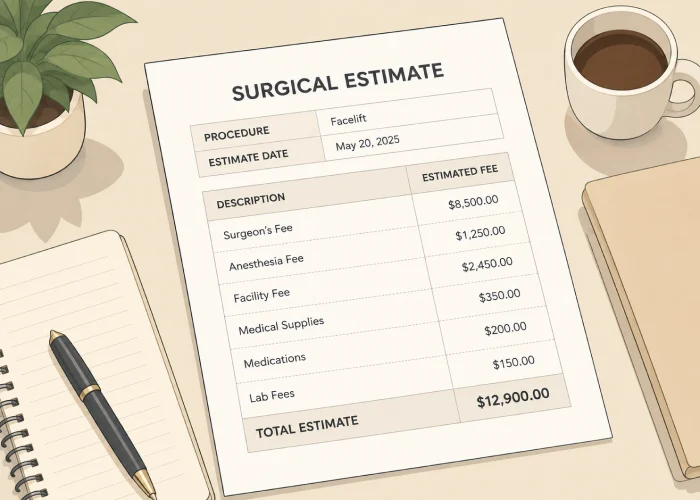
Compare total value, not the headline number. Ask every practice for a dated, itemized written estimate covering the exact areas and technique proposed, then read the two documents side by side rather than the two figures.
A complete written quote should account for all of this:
- The surgeon’s fee for the specific areas being treated
- Anesthesia or sedation, and the anesthesia provider’s fee
- The surgical facility
- Any pre-operative medical tests
- Compression garments, prescriptions, and aftercare supplies
- Routine follow-up visits, and what happens financially if a revision or a complication needs treating
Once you have that, an unusually low number stops looking like a bargain and starts looking like a question. ASPS identifies anesthesia, facility costs, medical tests, garments, and prescriptions as charges that may be additional, so a low quote may simply be a shorter list. Ask what is included, what is excluded, and what is refundable.
Pressure is the other signal worth naming. A limited-time discount, a deposit requested before you have a written estimate, or vague answers about anesthesia and accreditation are warning signs rather than value. A surgeon’s fee is only one part of the total, and ISAPS frames safe aesthetic surgery as resting on four pillars together: the patient, the surgeon, the procedure, and the facility.
Your own comfort belongs on the list too. Being able to ask a question without feeling like an inconvenience is a legitimate selection criterion, not a soft one, and it usually predicts what aftercare will feel like.
Cost is real, and planning for it is part of the decision. At Artisan, your consultation includes a personalized breakdown rather than a number pulled from a webpage. You can also explore flexible financing through Alphaeon Credit, Cherry, and CareCredit, so the investment spreads across a plan that suits your budget.
Melissa, a patient at our Northside office who chose a different surgeon for a second procedure, described what made the difference:
“I’ve had cosmetic surgery in the past (in 2016) and this time I decided to go with a different doctor and I’m so glad I did. Dr Val listened to me and understood what I wanted to look like and got the job done. I had a breast lift with implants and a thigh lift with liposuction.”
Conclusion
The title above a surgeon’s name told you almost nothing, and that was the honest starting point. What you have now is a shorter, harder list. A certification you can look up, experience you can ask about, a facility you can verify, and a written estimate you can compare. Liposuction is a sculpting procedure, and the hands that perform it are the variable that matters most.
Going back to browse real patient results is a good next step, particularly cases that start where you start. After that, a conversation fills in what images cannot show you.
Every patient deserves to walk out of a consultation feeling heard rather than sold to. That is the standard we hold ourselves to at Artisan in Atlanta.
When you are ready, get in touch with our team or call (404) 851-1998, and we will take it from wherever you are.
Frequently asked questions
How do I find the best liposuction surgeon near me in Atlanta?
Start with a credential search rather than a search engine. Use ABMS Certification Matters to build a shortlist of board-certified plastic surgeons near you, then confirm that each one performs liposuction regularly and operates in an accredited, state-licensed facility. Book consultations with at least two of them before deciding.
What board certification should a liposuction surgeon have?
Certification by the American Board of Plastic Surgery is the credential that matches liposuction training most directly. Another board recognized by the American Board of Medical Specialties can also be appropriate if its training genuinely covers body contouring. A certificate from a board that is not ABMS-recognized does not carry the same meaning, even when the phrasing sounds identical.
How can I verify that a surgeon is certified by the American Board of Plastic Surgery?
Search the surgeon’s name on ABMS Certification Matters, which draws from all 24 recognized member boards. It is free and takes a couple of minutes. The American Board of Plastic Surgery also publishes an FAQ explaining what its certification covers and how its Continuous Certification program works.
How many liposuction procedures should a surgeon have performed?
The Aesthetic Society lists it as a fair consultation question, but no published threshold turns a number into a qualification by itself. Pair it with how often the surgeon performs liposuction now, how recently they treated your specific areas, and whether they can show you cases with a similar starting point. ISAPS suggests looking for a plastic surgeon who has been in active practice for at least three years after training.
Should I choose a surgeon who only does liposuction?
Not necessarily, and exclusivity is not a credential. A board-certified plastic surgeon who performs liposuction frequently alongside other body contouring work is generally a stronger choice than someone marketing a single procedure. What matters is current, relevant experience with your areas and the ability to explain the limits of what the procedure can do.
Can I see before-and-after photos of patients with a body type similar to mine?
You should be able to, and it is a fair thing to insist on. Ask specifically for cases with a comparable starting contour, skin quality, and treatment area, photographed with consistent lighting, angles, and poses. Photos taken at different time points after surgery show different stages of healing, so ask when each image was captured.
How do I know whether a liposuction surgery center is accredited?
Ask for the accrediting organization’s name, the certificate number, and its expiry date, then confirm it directly in that accreditor’s public directory. In the United States the recognized bodies are QUAD A, AAAHC, and The Joint Commission. Check the state health department’s licensing database as well, since license and accreditation are two separate things.
Who should administer anesthesia during liposuction?
A qualified anesthesia professional, such as an anesthesiologist or a certified registered nurse anesthetist, and not the surgeon performing your procedure. Ask who will be in the room, what monitoring is used throughout, and where you recover once the anesthesia wears off. The person operating on you should not be the person watching your vital signs.
Should my liposuction surgeon have hospital privileges?
It is a useful question, because privileges mean a hospital has independently reviewed that surgeon’s qualifications for those procedures. They also mean there is a clear route to hospital care if a complication needs more than an office setting can provide. Privileges are a supporting signal rather than a replacement for board certification.
What are red flags when choosing a liposuction surgeon?
Watch for an unrecognized certifying board, surgery planned in an unaccredited or non-medical setting, and vague answers about anesthesia or emergency arrangements. Pressure to book quickly, discounts that expire, and reluctance to hand over a complete written estimate belong on the same list. A surgeon who promises an outcome without discussing limits is a warning too, since realistic informed consent includes what can go wrong.
What should I ask about follow-up care and revision surgery?
Ask how many post-operative visits are routine, who provides them, and who is reachable outside office hours. Find out which symptoms warrant an urgent call and how long you should wait before judging your result, since swelling can take months to resolve fully. Ask what happens if you are dissatisfied, including who pays for a revision and what the written policy actually says.
What affects the cost of liposuction, and how can I plan for it?
The number of areas treated, the technique used, operating time, anesthesia, and the facility all shape the total, which is why two honest quotes can differ. Our surgeons build a personalized breakdown at your consultation rather than quoting from a price list. We also work with three financing providers, so the investment can be spread across a plan that fits your budget.
*Disclaimer: This content is for educational purposes only and does not constitute medical advice. A consultation with a qualified board-certified surgeon is required to determine the best treatment plan for your individual needs and any questions you may have about a medical condition or procedure.

