



A breast lift quote is not one number. It’s a stack of them: the surgeon’s fee, anesthesia, the operating facility, pre-operative lab work, and the garments you’ll need afterward. Two practices can quote the same operation and mean different things by it.
Here’s what the data says about who’s asking. Roughly 26 percent of breast lifts performed in the United States in 2024 were done for patients in their 30s, according to ASPS. That’s the decade when mortgages, childcare, and student loans compete for the same dollar, which is why a vague answer about cost helps nobody.
At Artisan Plastic Surgery in Atlanta, we’d rather talk about money early than let it ambush you at the end of a consultation. Wanting to feel at home in your own body isn’t vanity, and budgeting carefully for it isn’t unromantic. This article covers what sits inside a breast lift quote, why two surgeons price the same operation differently, and how patients pay for it.
Key takeaways
- A surgeon’s fee is not the price of your surgery. Anesthesia, facility time, pre-operative clearance, and recovery supplies are often quoted separately.
- Incision pattern drives cost more than almost anything else. It decides how much tissue is reshaped and how long you spend in the operating room.
- The lowest quote is rarely the best value. It usually excludes anesthesia and facility fees.
- Insurance almost never covers a cosmetic lift, and HSA and FSA funds generally can’t be used. That changes for a medically necessary reduction, or reconstruction after mastectomy.
- Non-surgical tightening treats mild skin laxity, not sagging that has already moved the breast. Repeating those treatments can cost more over time than one operation.
What goes into the total cost of a breast lift?
The surgeon’s fee is only the first line of your bill. It pays for your surgeon’s time and skill, and according to ASPS it does not include anesthesia, operating room facilities, or related expenses. Most quotes you’ll find online are surgeon’s-fee-only, so the numbers you’ve been comparing may not be comparable.
Anesthesia and facility fees come next, and both are calculated against time. A breast lift takes two to three hours of operating room time, so a longer technique costs more to support.
Then there’s the money that lands before and after the operation. Pre-operative clearance, bloodwork, and imaging are often billed by outside labs. Compression garments and prescriptions are easy to forget when you’re focused on the surgical number.
| Line item | What it pays for | Usually in the base quote? |
|---|---|---|
| Surgeon’s fee | Your surgeon’s time and expertise | Yes |
| Anesthesia | Keeping you comfortable and asleep | Often billed separately |
| Facility fee | Accredited operating room and staff | Often billed separately |
| Pre-operative workup | Clearance, bloodwork, imaging | Rarely, often an outside lab |
| Garments and prescriptions | Support and pain management at home | Rarely |
| Follow-up visits | Post-operative checks and healing review | Usually, but ask |
Asking for that breakdown in writing is not rude. It’s the most useful thing you can do at a first consultation.
How does your breast lift technique change the cost?
Your incision pattern is the biggest single lever on price, because it determines how much skin comes out and how long the operation takes. A crescent or donut lift uses the smallest openings and the least time. An anchor lift reshapes the most tissue and keeps you in the operating room longest, pulling anesthesia and facility charges up with it.
Your surgeon isn’t choosing a price tier. They’re choosing the pattern that lets your tissue hold a new shape, settled by measurement rather than budget.
| Technique | Degree of sagging it addresses | Why the cost shifts |
|---|---|---|
| Crescent or donut lift | Mild | Smallest incisions, shortest operating time |
| Vertical (lollipop) lift | Moderate | More reshaping, more time under anesthesia |
| Anchor (inverted-T) lift | Advanced | The most reshaping and the longest operating time |
| Lift with implants or fat transfer | Varies with volume goals | Adds materials and grafting time to one operation |
Combining a lift with implants or fat transfer costs more than a lift alone. Doing both in one operation means one anesthetic, one facility booking, and one recovery.
Here’s the part that costs people real money. Choosing a smaller incision than your anatomy calls for is a false saving, because a pattern that can’t release enough tissue trades a shorter scar for a shape that doesn’t hold.
The surgical literature is explicit that a donut lift suits a narrow range of anatomy, and that pushing it past those limits risks flattening, areolar spreading, and wide scars. Correcting that is a second surgery, with a second set of every fee on the list above.
Why do breast lift quotes vary so much between surgeons?

Geography, credentials, and where the operation happens explain most of the spread. Practices in expensive metropolitan markets carry higher rent, payroll, and insurance, and those costs sit inside the quote whether or not anyone names them.
Facility setting matters more than most patients expect. Research on same-day plastic surgery has found freestanding ambulatory surgery centers to be less costly than hospital outpatient departments for the same procedure. Where your surgeon operates is a line item, not a detail.
Credentials move the number too. A board-certified plastic surgeon has completed years of dedicated surgical training, and experience with your technique is priced accordingly. Paying less for a surgeon who performs your operation occasionally is a different kind of expense.
Della, a patient at our Johns Creek location who had several procedures in a single operation, described what she got for what she paid:
“66 years old, had a Blepharoplasty, face lift, breast augmentation, and tummy tuck all at one time. priced fairly, surgeons excellent, after care superb. Not one problem after surgery, results are amazing.”
Travelling out of state or overseas for a lower quote deserves the same arithmetic. The savings are real on the day of surgery. It stops being real the moment you need a follow-up or a revision, because those costs fall back on you at home.
What payment and financing options make a breast lift affordable?
Almost nobody writes one check. Most patients use a medical credit card or a point-of-sale installment plan, and the difference is worth understanding before you sign.
Medical credit cards work like a store card reserved for healthcare. The lender pays your surgeon directly, and you repay the lender, often with a promotional window where no interest is charged. Installment lenders instead split one treatment into fixed monthly payments over a set term.
If you’re weighing plans, you can explore financing at Artisan through Alphaeon Credit, Cherry, and CareCredit, which gives you three structures to compare rather than one to accept.
The trap worth naming is deferred interest. Interest on a medical credit card is often deferred rather than waived, so clearing the balance inside the promotional window costs you nothing extra. Miss a payment or carry a balance past that window, and the CFPB warns you can end up with significant interest and fees on top of your medical bills.
So what should you ask a lender?
- Is this deferred interest, or is the promotional rate a true zero percent?
- What’s the standard rate if I miss the promotional window?
- Does pre-qualification use a soft credit check, and when does a hard inquiry happen?
- Is there a penalty for paying off early?
- What’s the full term, and what’s the monthly payment?
One more thing patients often assume incorrectly. Health savings and flexible spending accounts generally can’t cover a cosmetic lift, because IRS Publication 502 lists cosmetic surgery among the expenses that don’t count as medical care. If a lift is reconstructive, that answer can change, which is a conversation for your surgeon and your plan administrator.
Does health insurance cover any part of a breast lift?
Almost never, when the lift is cosmetic. A mastopexy reshapes the breast and repositions the nipple, and because it treats appearance rather than a medical condition, insurers class it as elective. Most plans also decline to cover complications arising from cosmetic surgery, which is a quiet risk worth knowing in advance.
Coverage genuinely changes in two situations. The first is breast reduction. When a reduction is medically necessary, the lift is an inseparable part of that operation, and insurers assess the whole procedure against their own medical-necessity criteria. Most ask for documented physical symptoms, such as chronic back, neck, or shoulder pain, and many also require photographs and a minimum weight of tissue removed.
Approval isn’t always straightforward. A 2023 analysis in Plastic and Reconstructive Surgery Global Open found wide inconsistency between insurers in how preauthorization criteria are applied. If your claim is denied and you believe you meet the criteria, appeal it.
The second situation is reconstruction after breast cancer. Under the federal Women’s Health and Cancer Rights Act, health plans that cover mastectomies must also offer post-mastectomy reconstruction benefits, and restoring symmetry can involve a lift on the opposite breast. Levels of coverage still vary by plan, so check yours.
At Artisan, reconstruction is its own practice area, and the coverage question there looks nothing like a cosmetic lift.
Is a non-surgical breast lift a cheaper alternative?

Only if it’s treating the concern you actually have. Radiofrequency and laser treatments use controlled heat to stimulate the skin’s natural production of collagen and elastin, according to ASPS. Unlike a surgical lift, which removes and tightens loose skin, they rebuild the support structures underneath it.
That improves the quality of a skin envelope. It does not remove skin, and it does not move the nipple.
Non-surgical tightening works on early, mild laxity. Surgery addresses moderate to advanced structural sagging, where the breast has already changed position on the chest wall. They aren’t two routes to one destination, they’re treatments for two different stages.
The other options in this category share that ceiling:
- A liquid lift using dermal fillers, or fat transfer, adds volume and can improve upper-pole fullness. Neither lifts a breast that has descended.
- PDO thread lifts place dissolvable sutures to reposition tissue slightly. The effect is subtle and temporary, and threads remove no excess skin.
- Radiofrequency and laser tightening change skin quality, not breast position.
Here’s what that means for your budget. Every treatment here is repeatable by design, and repeatable means recurring. A single surgical correction can cost less over several years than a maintenance schedule that never quite gets there.
If your sagging is mild and you want firmer skin, non-surgical is a reasonable, honest choice. If it isn’t, paying twice is the likeliest outcome.
How do you get an accurate quote for your body?
No formula turns your measurements into a number from a distance. An in-person consultation is where a quote stops being a range and becomes yours. Your surgeon assesses your skin quality, your degree of sagging, and your nipple position by hand before recommending a technique.
That visit runs both ways. Your surgeon is evaluating your anatomy and your health, and you are evaluating them, their operating facility, and whether they answer the awkward questions without flinching. As Atlanta’s first woman-led plastic surgery practice, our surgeons build every plan around the person in front of them rather than a standard package.
Bring the cost questions with you and ask for the total in writing. A complete quote names the surgeon’s fee, anesthesia, the facility, pre-operative testing, garments, and follow-up visits.
Alexandra, a patient at our Northside office who worked out a payment schedule she was comfortable with, described how that conversation went:
“All of the staff was kind and attentive, and I never felt any pressure during the consultation or payments process. They allowed me to split payments in increments that worked for me as well.”
Conclusion
You came here for a number, and the honest answer is that a breast lift has a price rather than a list price. What you can control is whether you’re comparing complete quotes, whether the technique matches your anatomy, and whether the payment structure serves you instead of the lender.
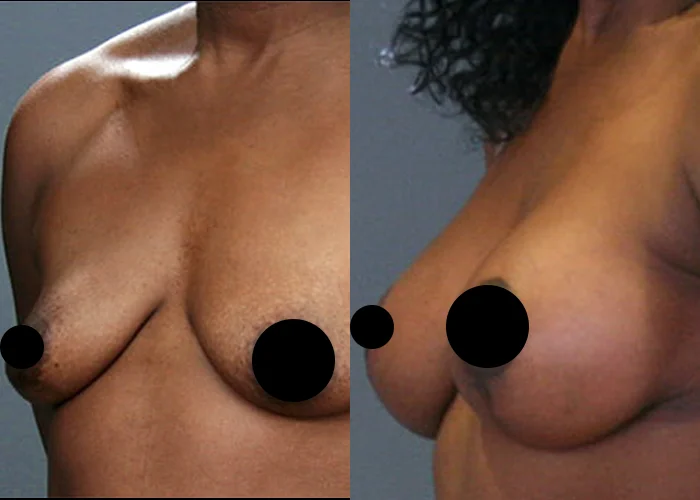
Looking at real patient photos from women whose starting point resembles yours grounds the conversation in shape rather than in numbers. The quote follows the plan, and the plan follows your body.
At Artisan in Atlanta, we think a patient who understands exactly what she’s paying for makes a better decision than one who was simply reassured.
Every patient arrives with a different silhouette, a different history, and a different set of constraints, and all three belong in the conversation. When you’re ready, reach out to our team or call (404) 851-1998.
Frequently asked questions
How much does a breast lift cost?
There’s no single figure. The total depends on your incision pattern, your time in the operating room, anesthesia, and the facility. Any number quoted without those details is a surgeon’s fee rather than a price, which is why our surgeons give you an itemized breakdown at your in-person consultation.
Will my health insurance cover a breast lift?
A cosmetic lift is elective, so insurers almost never cover it, and many plans also exclude treatment of complications from cosmetic surgery. Coverage can apply when a lift forms part of a medically necessary breast reduction, or of reconstruction after a mastectomy. Those claims are assessed under entirely different criteria.
Can I use my HSA or FSA to pay for a breast lift?
Generally no. These accounts are restricted to medical care that treats a condition, and a purely cosmetic procedure doesn’t qualify. If your surgery is reconstructive or medically necessary, ask your surgeon and your plan administrator before assuming either way.
Does adding implants to a breast lift increase the cost?
Yes. Implants or fat transfer add materials and operating time, so the combined total exceeds a lift alone. Doing both in one operation usually costs less than staging them, because you pay for one anesthetic, one facility booking, and one recovery.
Is the lowest-priced breast lift the best value?
Rarely. A low quote often reflects a surgeon’s fee with anesthesia and facility charges still to come, or a smaller technique applied to anatomy that needs more correction. A revision carries a second set of every fee, which is the most expensive way to save money.
Is anesthesia included in a breast lift quote?
Often not. Anesthesia is commonly billed separately, and it’s charged against operating room time, so a longer technique costs more to support. Ask whether your figure includes both anesthesia and the facility fee.
Can I pay for a breast lift in monthly installments?
Yes. Medical credit cards and installment lenders both offer monthly structures, and our practice works with Alphaeon Credit, Cherry, and CareCredit so you can compare three approaches. Read the promotional terms closely before choosing.
Does an anchor lift cost more than a lollipop lift?
Typically yes. An anchor lift reshapes more tissue and runs longer, which raises anesthesia and facility charges alongside the surgeon’s fee. The better question isn’t which costs less, but which pattern your degree of sagging requires.
How can I pre-qualify for financing without hurting my credit?
Most healthcare lenders let you check likely approval with a soft credit inquiry, which doesn’t affect your score. The hard inquiry comes later, when you submit a full application. Confirm which stage you’re at before you click through.
What is deferred interest on a medical credit card?
Interest accrues quietly during the promotional period and is forgiven only if you clear the whole balance before that window closes. If any amount remains, or a payment is late, you can be billed the interest that built up along the way. Not every plan works this way, so ask the lender directly.
Are compression garments and prescriptions included in my surgical quote?
Usually not. Garments, pain medication, and other recovery supplies are out-of-pocket costs on top of the surgical fee. Ask our team to list them explicitly in your breakdown, so nothing lands unexpectedly during recovery.
*Disclaimer: This content is for educational purposes only and does not constitute medical advice. A consultation with a qualified board-certified surgeon is required to determine the best treatment plan for your individual needs and any questions you may have about a medical condition or procedure.

