




You’ve seen the before-and-after photos and learned that recovery takes weeks. But what happens in the hours between those two points? For most people considering a tummy tuck, that middle part is the foggiest and often produces the most anxiety. It doesn’t have to be.
Data from the International Society of Aesthetic Plastic Surgery (ISAPS) indicate that more than 1 million abdominoplasty procedures were performed worldwide in 2024. Behind each of these cases is a sequence of steps that is far simpler than most patients expect.
At Artisan Plastic Surgery, a practice focused on preparing for your plastic surgery appointment in Atlanta, we take the time to guide each patient through every step of the process before their surgery. As a women-owned and operated practice, we understand that knowing what to expect can be the difference between feeling anxious and feeling confident in the operating room. This article explains how the surgery begins, what happens during the main steps, and what you can expect when you wake up.
Key takeaways
Before diving into the details, here is an overview of a tummy tuck procedure, from your arrival at the clinic to the first hour after waking up.
- General anesthesia is the standard for full tummy tucks, with pre-op markings, surface prep, and patient positioning completed before the first incision.
- Your surgeon places a horizontal incision low in the bikini line so the scar is hidden by swimwear, with the length adjusted to the amount of skin to be removed.
- Separated abdominal muscles (diastasis recti) are stitched back together, narrowing the waistline and improving posture and core strength.
- Excess skin and fat are trimmed after the flap is redraped, and liposuction is often used to refine the flanks or upper abdomen.
- Drains, dressings, and a compression binder are placed before you wake up. Most patients spend 30 to 90 minutes in the recovery area, then move to extended monitoring or an overnight room.
How does tummy tuck surgery start with anesthesia and preparation?
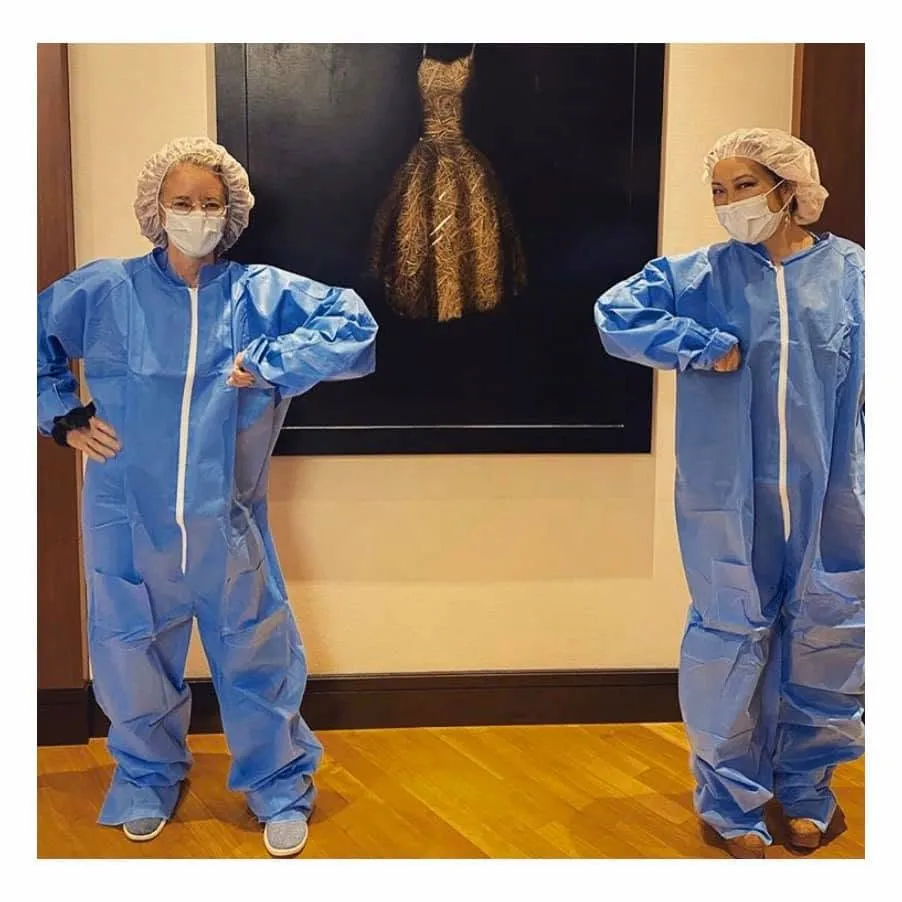
Before your surgeon makes a single mark, a full abdominoplasty begins with a checklist. The anesthesiologist’s team confirms your medical history, your surgeon reviews the plan, and safety steps are completed before any incision is made. The lights are positioned, the medical equipment is properly laid out, and the whole team will be with you throughout the procedure.
Pre-op marking while you stand
The first technical step happens while you are standing. Your surgeon marks the incision lines and key landmarks while gravity shapes your skin. Markings are made while standing, so the natural drape and folds are captured accurately.
For a typical full tummy tuck, the planned low transverse incision runs from hip bone to hip bone. The exact length is tuned to how much skin needs to be removed and where your bikini line naturally sits.
Anesthesia options and what they feel like
General anesthesia is the standard for full tummy tucks. You will be fully asleep and will not feel or remember any part of the surgery. A pooled analysis of 48,379 patients found a low blood-clot rate of about 0.06% with modern protocols.
At Artisan, major surgeries take place at Northside Hospital. The anesthesiologist administers your general anesthetic in the operating room. Mini tummy tucks may use a regional and local-only approach if the planned area is small.
Mya, a patient at our Northside office, described how the early steps felt:
“I recently had a breast reduction and tummy tuck performed by Dr. Sybile Val, and I couldn’t be happier with my results. Dr. Val is not only an exceptionally skilled surgeon but also a genuinely kind and compassionate person. She went above and beyond to make sure I was comfortable and informed every step of the way.”
Liposuction prep and local infiltration
For patients with excess fat in the flanks or upper abdomen, a tumescent solution (a mixture of saline, lidocaine, and epinephrine) is infiltrated first. The solution numbs the tissue and reduces bleeding. Liposuction is then performed before the main incision in many lipoabdominoplasty plans.
A long-acting local anesthetic like Exparel may also be infiltrated beneath the fascia and along the planned incision line. The goal is to reduce narcotic use in the early days and provide steadier comfort during recovery.
Positioning on the table
You are positioned supine, lying on your back, with the bed slightly flexed at the hips. This position allows your surgeon to redrape your skin downward later. Once positioned, the surgical site is cleaned and draped, and the team begins.
How and where does the surgeon make incisions for a tummy tuck?
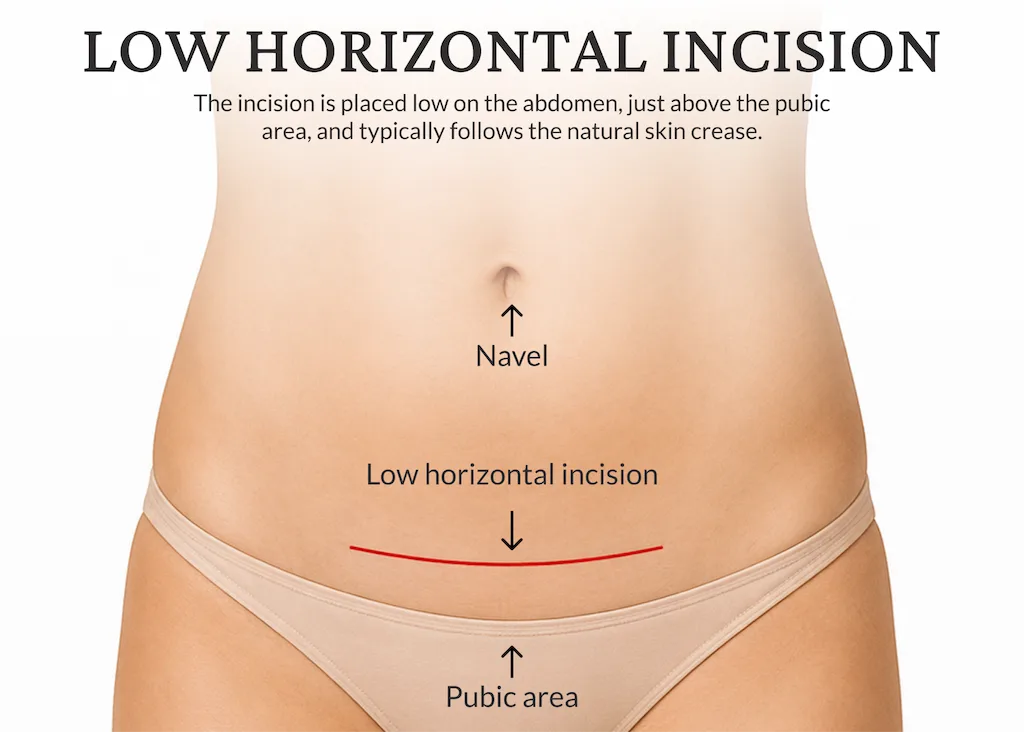
After preparation, the first cut is the one most patients ask about. Questions about where it goes, how long it runs, and how visible the scar will be afterward are usually the first questions in the consultation.
The main horizontal incision
For a full abdominoplasty, the main incision is horizontal and sits low. It typically runs from one hip bone to the other, just above the pubic area. Length scales with the amount of loose skin to be removed. An extended tuck after major weight loss may carry the incision around to the flanks.
Second incision around the belly button
If the upper abdomen also has excess skin, a second incision is made around the belly button. Removing that skin requires detaching the navel from the surface and reattaching everything once the new outline is set. This second incision is standard for full procedures.
Hidden under swimwear by design
A bikini-line placement is not an accident. The horizontal scar is intentionally low enough to sit beneath a typical swimsuit, underwear, or workout shorts. Over six to twelve months, the line gradually softens as the scar matures.
Techniques that minimize visible scarring
Several closure techniques reduce visible scarring and complications simultaneously. Progressive tension sutures anchor the skin flap more deeply to the underlying fascia, dramatically lowering seroma rates in large series. Many surgeons also recommend silicone gel sheets or scar-softening lasers around the two- to three-week mark.
To see how scars actually fade across real patients, browse the before-and-after gallery and review the one-year photos.
How are abdominal muscles repaired during a tummy tuck?
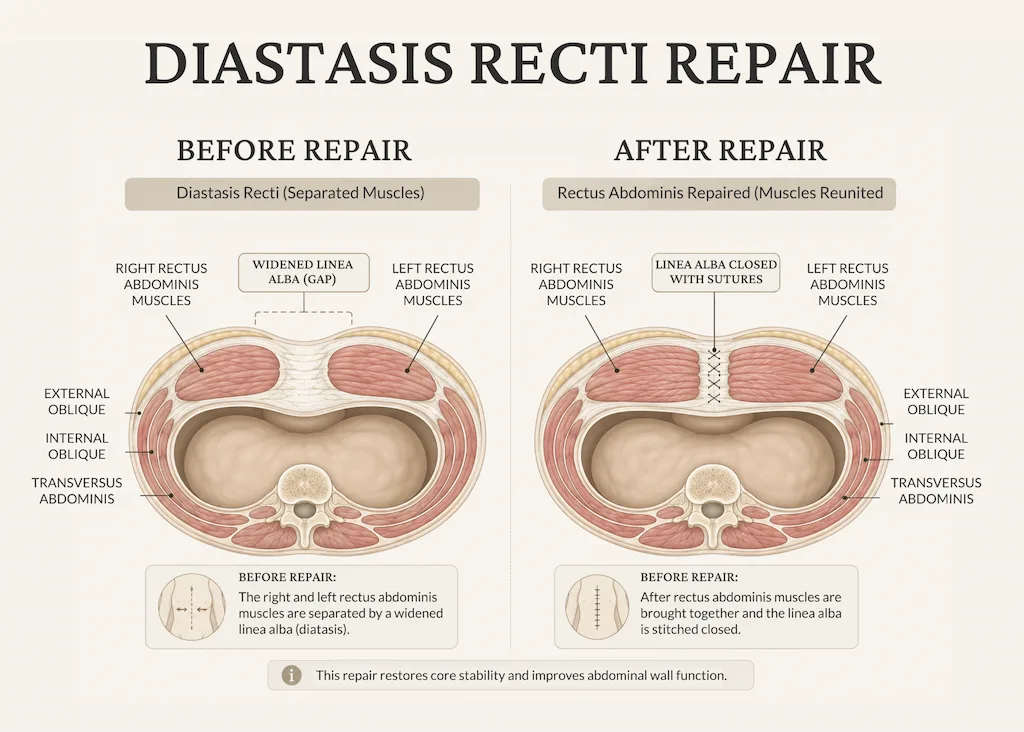
For many patients, the muscle-repair step is the one that makes the most difference to their final shape. The skin tightening matters, but the structural change underneath is what creates a flatter front.
The reason the muscles separated
Diastasis recti, the medical term for a gap between the two halves of the rectus abdominis, affects roughly 6 in 10 women after childbirth. The linea alba stretches to accommodate the growing uterus, and in 30% to 60% of cases, the gap persists six months postpartum.
Many post-childbearing patients exploring diastasis recti repair options at Artisan arrive having tried exercise for years before realizing the gap is structural, not a matter of stamina.
Reaching the muscles
Once the lower incision is made, the skin flap is lifted off the fascia up to the rib cage. The belly button is freed circumferentially but kept attached to its underlying stalk to preserve its blood supply.
Amanda, an Artisan patient at our Northside office, described the team’s approach to this kind of structural work:
“Highest level of expertise and care. Dr Diane Alexander and her team go above and beyond for beautiful, natural results with an emphasis on wellbeing. She takes time to listen to your concerns and does her magic. The recovery process is very easy with her knowledgeable team to support you on your way back to your best self.”
Tightening the fascia
The two halves of the rectus muscle are pulled toward the midline. The fascia between them is stitched together in a running line, top to bottom. Long-acting absorbable sutures, such as PDS, or permanent monofilament sutures, such as Prolene, are most common.
The technical term is plication. It is essentially a corset sewn into your own anatomy, and the waistline narrows visibly even before the skin is closed.
Functional changes from muscle repair
The benefits are not just cosmetic. A 3-year follow-up found that surgical plication significantly improved core, back, and abdominal strength compared with pre-op measurements. For post-childbearing patients, this functional change is often the part they did not expect.
How is excess skin and fat removed in a tummy tuck?
Once the muscles are tightened, the next thing is the visible reshaping. The skin that was once stretched too far has nowhere to retract on its own, so it has to be addressed directly.
Trimming the lower skin
After repairing the fascia, the lifted flap is moved downward toward the new incision. The exact amount of skin to be removed isn’t fixed beforehand. Your surgeon marks it while the skin is under the right amount of tension, then removes it in a single piece.
Liposuction for contour, not bulk
Liposuction, a way of improving your body shape through cosmetic surgery, is often combined with abdominoplasty to sculpt and enhance the contours of the flanks, hips, or the area beneath the rib cage. According to a 16-year clinical analysis by the American Society of Plastic Surgeons (ASPS), this combined approach has become the modern standard. The integration of liposuction during a tummy tuck has steadily increased from 18% to 25% of all cases in recent years.
At Artisan Plastic Surgery, our approach is to sculpt rather than reshape, treating each abdomen as a unique canvas. Liposuction is added only where the contour benefits from it.
Adjusting the upper skin
The skin on the upper belly is pulled down during the procedure. If there’s a lot of loose skin above the belly button, a second cut around the navel allows extra skin to be pulled down to the new closure line. For less looseness or skin laxity, a small tube is used instead.
Stretch marks during a tummy tuck
What actually happens to stretch marks during a tummy tuck? It’s one of the most common questions we get, and the short answer: it’s all about location.
Because a tummy tuck involves removing excess skin, any stretch marks below your belly button are usually removed for good. As for the ones above your belly button, they will likely stick around, but as the surgeon pulls the remaining skin down and taut, those stretch marks shift much lower on your abdomen, making them a lot less noticeable and much easier to hide under a swimsuit!
During your consultation, your surgeon can outline which parts of your anatomy would be removed and which would stay.
What happens to the belly button during tummy tuck surgery?
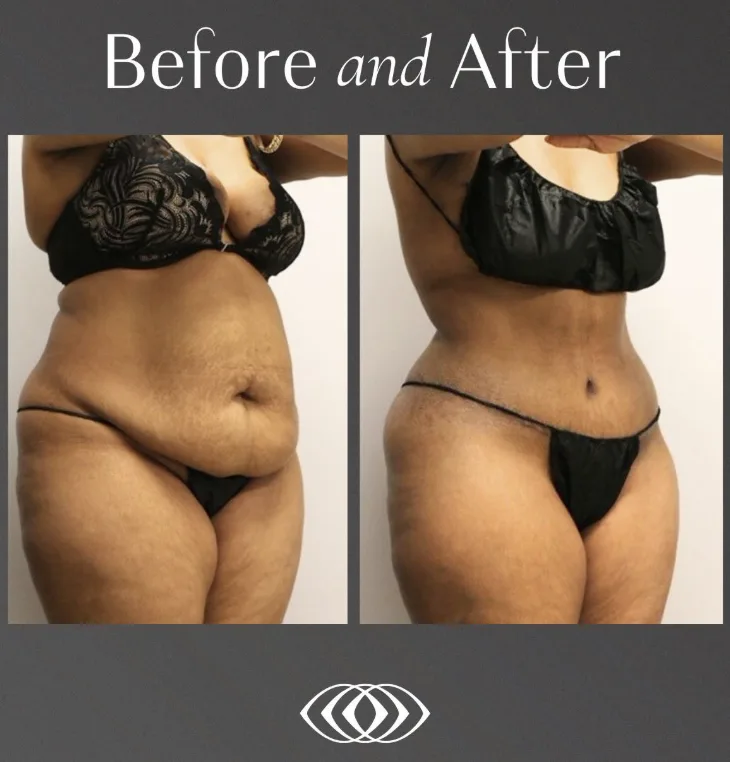
This step often catches many patients off guard. Your belly button does not move with the skin. It stays where it has always been, and a new opening is made for it on the redraped surface.
The navel is detached from the surrounding skin with a circumferential incision, but it remains attached to its underlying stalk. That stalk preserves the blood supply. This is why surgeons leave a generous cuff of fat around the umbilical stalk.
After the upper skin is brought down, a new opening is created in the flap. About 90% of techniques start with a round, oval, or vertical ellipse incision on the new skin. The native belly button is then pulled through this opening and sutured to the surrounding flap and underlying fascia.
When it comes to a beautiful tummy tuck, the surgeon’s technique is much more important than the size of the incision. A small but crucial detail is the placement of the navel: it is usually positioned about 10 centimeters above the final scar, helping to create a natural and balanced look between the waist and hips. Instead of a flat appearance, shaping the navel with a gentle inward slope makes the results look more authentic.
If you are having a mini tummy tuck limited to the area below the navel, this step is usually skipped. Because a mini tummy tuck only tightens the loose skin below the navel, the upper skin is not shifted, and your belly button remains untouched.
How are the incisions closed, and what happens immediately after surgery?
The final minutes seem calmer than the middle, and they greatly influence your actual recovery experience.
Layered closure
Once the skin is trimmed and the belly button is brought through, the incisions are closed in multiple layers. Deeper absorbable sutures hold the tissue together. The skin surface is sealed with fine sutures, surgical adhesive, or skin tape, depending on the tension.
Drains and what they do
In most full tummy tucks, small Jackson-Pratt drains are placed beneath the skin before closure. These soft, flexible tubes collect fluid from the space where the flap was lifted, helping prevent seroma, a buildup of fluid that is one of the more common post-operative complications.
You will empty and record the drain output at home a few times a day. Once your daily output drops below the threshold your surgeon sets, the drains are removed at a follow-up visit. For most patients, that happens within the first one to two weeks.
Dressings, garments, and silicone
A light dressing covers the incision. A compression binder is placed around your abdomen before you leave the operating room. The binder supports the new contour, reduces swelling, and stabilises the muscle repair.
About two to three weeks in, your surgeon may apply silicone sheets or gels to the scar. These help soften and fade the line over the following months.
Waking from anesthesia
You wake up in the post-anesthesia care unit, usually within 30 to 90 minutes after the procedure ends. The team monitors vitals, manages nausea, and keeps you comfortable while the anesthesia clears. Most patients describe the wake-up as foggy rather than painful.
For major surgery, our team plans for overnight observation rather than same-day discharge. Lighter procedures may go home the same day after one to two hours of monitoring.
Your first look in the mirror
The honest answer is that you won’t see your final contour straight away. Swelling and bruising peak between 48 and 72 hours after surgery and then gradually subside, the beginning of what tummy tuck recovery is really like over the following weeks.
What is visible immediately is a flatter, tighter front than you started with, even under all the swelling.
Taylor, a patient at our Northside location, captured that first look:
“My experience with Dr. Ashraf, Dr. Alexander, and Jordan Beasley has been nothing short of life-changing. I’m 45 years old, and I had 4 children via c-section (not the plan) and nursed all 4 for a combined total of 9 1/2 years. I wanted a mommy makeover (breast implants and tummy tuck). I couldn’t even imagine what I am seeing in the mirror today.”
What should you expect during your consultation?
A consultation is where the steps in this article stop being theoretical. It is also a two-way evaluation. Your surgeon is assessing your anatomy, and you are equally assessing their anatomy, their space, and their philosophy.
The visit usually begins with a careful look at your medical history and a focused examination of your abdomen, skin elasticity, and any diastasis. Your surgeon then walks you through which technique best fits your starting point, what realistic outcomes to expect, and what recovery will mean over the next several weeks.
Every plan is built around the patient, not pulled from a one-size-fits-all template. This reflects our practice philosophy of personalized beauty.
Consultations are exclusively in-person at either our Northside or Johns Creek surgical centers in the Atlanta area. A screen cannot evaluate skin elasticity or how fat is distributed across your abdomen. This hands-on assessment is essential to accurately assess these factors.
When you’re ready, schedule a consultation at Northside or Johns Creek, or call (404) 851-1998 to talk through whether a tummy tuck fits your goals. There is no expectation that you commit during the visit.
Conclusion
The journey from stepping into the operating room to regaining consciousness takes just a few hours, yet it encompasses many stages. Anesthesia, marking, incision planning, muscle repair, skin removal, belly-button repositioning, and closure all occur between closing and opening your eyes. These steps are carefully practiced, organized, and designed to streamline the process, so you don’t need to be aware of the precise choreography as it happens.
If you want to see the actual results of those steps, explore real before-and-after examples that reflect your initial situation. But always remember that only in-person visits provide details that photos cannot capture.
At Artisan in Atlanta, our approach is to treat each abdomen as a unique canvas and each patient as a partner in the plan.
Frequently asked questions
How long does tummy tuck surgery take?
A full tummy tuck typically takes two to three hours, from the first incision to the final dressing. Mini procedures are shorter, often taking one to two hours. Combination surgeries that include liposuction or a breast procedure can take four hours or longer.
Is a tummy tuck done under general anesthesia?
For complete and extended tummy tuck procedures, general anesthesia is typically used, ensuring you are completely asleep and do not experience or remember the surgery. In some cases, a mini abdominoplasty may be performed under regional anesthesia combined with sedation.
Will I have visible scars from a tummy tuck?
Every tummy tuck leaves a scar, but the main horizontal scar is placed low enough to be hidden by typical swimwear and underwear. A full procedure also leaves a small circular scar around the belly button. Scars soften and fade over six to twelve months.
Is liposuction always part of a tummy tuck?
Not always, but it is commonly added to refine the flanks, hips, or upper abdomen so the contour blends naturally. Combined procedures, sometimes called lipoabdominoplasty, have become more common over the past decade. Whether liposuction is recommended for you depends on your anatomy and goals.
Can I get pregnant after a tummy tuck?
Pregnancy after a tummy tuck is possible, but most surgeons recommend completing your family first. Pregnancy can stretch the abdominal skin and re-separate the repaired muscles. Your surgeon can talk through timing during your consultation.
*Disclaimer: This content is for educational purposes only and does not constitute medical advice. A consultation with a qualified board-certified surgeon is required to determine the best treatment plan for your individual needs and any questions you may have about a medical condition or procedure.

