




Ear pinning surgery reshapes the cartilage of the outer ear so that ears sitting away from the head rest closer to it. Your surgeon works through a small opening tucked behind the ear, folding and anchoring cartilage that never developed its natural curve. The ear itself is never moved or relocated, only reshaped.
Here is what the numbers show. In 2024, ear surgery ranked as the 16th most popular cosmetic surgical procedure worldwide, accounting for 2.1 percent of all global surgical procedures, according to ISAPS. That puts it firmly in routine, well-studied territory.
At Artisan Plastic Surgery in Atlanta, we bring decades of experience to procedures where a few millimeters decide the result. If you are reading this for a child, that precision is probably the part you want to understand first. This article walks through the techniques surgeons choose between, what happens at each stage of the operation, and how healing actually unfolds.
Key takeaways
- Ear pinning is one specific type of otoplasty. It reshapes cartilage through an opening behind the ear rather than moving the ear itself.
- Surgeons either fold intact cartilage with permanent stitches or thin it so it bends. Many now combine both in a single operation.
- The procedure runs about two hours as an outpatient visit. Children are usually asleep under general anesthesia, adults often awake and relaxed under sedation.
- The dressing stays on for three to five days, most people return to work or school within a week, and a night headband continues for several weeks after.
- Serious problems are uncommon. Bleeding beneath the dressing and wound infection each occur in well under 2 percent of cases.
What is otoplasty, and why do patients choose to pin their ears back?
Otoplasty is the umbrella term for any surgery that changes the shape, size, or position of the outer ear. Ear pinning is one specific kind, the kind that brings protruding ears closer to the head. The words get used interchangeably online, but only one describes what most people are searching for.
Ears stick out for structural reasons, never because of anything a parent did or failed to do. Ear deformities, protruding ears among them, affect roughly 5 to 10 percent of people worldwide, per a 2026 clinical review. Protruding ears, known clinically as prominauris, trace to three features, a flat antihelical fold, a deep conchal bowl, or an ear meeting the skull at more than a 30-degree angle.
Timing depends on the ear, not the calendar. Cartilage becomes stable enough around age five, and there is no upper age limit at all. Most surgeons look for the same handful of things:
- Ears that are fully or nearly grown, generally from about age five onward
- Good general health, with no chronic or active ear infections
- Non-smoking status in adult patients, since smoking slows healing
- Realistic goals, and in a child, a genuine wish of their own to have it done
Children usually arrive wanting to fit in with their peers, while adults more often want to stop standing out, a difference research draws directly. For many families the trigger is teasing at school. Plenty of adults carry an older version of that same feeling, one they have quietly styled their hair around for decades.
Neither reason is more legitimate than the other. There is also one window where surgery is not the answer at all. Caught within the first weeks of life, many ear shapes can be guided into place with non-surgical ear molding, while a newborn’s cartilage is still soft.
How are ears pinned back, and which surgical techniques do surgeons use?
Surgeons pin ears back in one of two ways, or with a blend of both. They either fold the cartilage into a new curve and hold it with permanent stitches, leaving it uncut, or they thin it until it gives up its old shape. Nearly every named otoplasty technique is a variation on those two ideas.
You may also see the operation called pinnaplasty, particularly in the UK. The pinnaplasty technique is the same setback procedure under another name, reserved for ears that protrude.
| Approach | How it works | Trade-offs |
|---|---|---|
| Cartilage-sparing | Permanent stitches fold the cartilage into a curve, nothing is cut | Gentler on tissue, though firmer adult cartilage can pull back over time |
| Cartilage-cutting or scoring | The front surface is thinned so the cartilage bends away from the scored side | Holds strongly, and is often favored when cartilage is firm |
| Hybrid | Scoring softens the cartilage first, then stitches shape it | Lower recurrence and less suture extrusion than stitches alone |
The Mustardé technique
Mustardé otoplasty is the classic cartilage-sparing approach, and it is elegantly simple. Through the incision behind the ear, your surgeon places two to four permanent horizontal mattress sutures across the cartilage, drawing it into the fold that never formed on its own.
Nothing is cut away. The surgeon is sculpting a fold, not removing a feature, and your ear keeps its own structure.
Scoring, cutting, and the hybrid approach
Cartilage has a memory. Left intact, it wants to spring back toward the shape it has always held, which is why some surgeons weaken it first. Scoring the front surface makes cartilage warp gently away from the scored side, a behavior described long ago by Gibson and Davis.
The trade-off is real. Stitches alone are gentler, but in older patients with firmer cartilage recurrence is more common, as the sutures cut through or the cartilage simply remembers its old shape. A light scoring pass combined with suture fixation lowers both recurrence and the chance of a stitch working its way loose.
Pinning a protruding earlobe
The earlobe holds no cartilage, so stitches placed in cartilage cannot move it. A lobe that still flares after the upper ear is pinned needs its own correction, usually a small skin excision behind the lobe with the soft tissue drawn back and secured.
It is a small step that changes everything. A pinned ear above an unpinned lobe reads as unfinished, which is why surgeons treat the lobe as a separate stage.
Which of these suits you is not something you can settle from a screen. At Artisan, our board-certified surgeons match the technique to how firm your cartilage is and where the fold needs to sit.
No two ears take the same stitch pattern, and no plan here is a template. If you want that assessment in person, book your consultation and bring every question you have been saving.
What are the step-by-step stages of ear pinning surgery?
Ear pinning surgery is an outpatient procedure that takes about two hours, and you go home the same day. So what actually happens during those two hours?
| Stage | What happens | Why it matters |
|---|---|---|
| Preparation | Medical check, then anesthesia | Sets safety and comfort for the operation |
| Incision | A hidden opening behind the ear | Keeps the eventual scar out of view |
| Exposure and shaping | Skin lifted, cartilage folded and anchored | This is where the new ear shape is made |
| Symmetry and closure | Distances measured, skin stitched | Ensures the two ears match before you wake |
Preparation and anesthesia
Beforehand you will have lab work or a medical evaluation. You will also be asked to stop smoking and to avoid aspirin, anti-inflammatory drugs, and herbal supplements that thin the blood.
Anesthesia is usually the first thing parents ask about. Young children are typically placed under general anesthesia so they sleep through it. Older children and adults often receive local anesthesia with sedation, awake but deeply relaxed and feeling nothing.
The hidden incision
The incision goes on the back surface of the ear, in the natural crease where it meets the head. Clinically, that means removing a narrow strip of skin roughly 15 to 20 millimeters wide, positioned midway between the ear’s rim and that crease.
Every surgery leaves a mark, and it would be dishonest to say otherwise. This one sits where the ear folds against your head, which is why most people never see their own scar without a mirror and some effort.
Lifting the skin and shaping the cartilage
Your surgeon lifts the skin off the cartilage in a clean plane, exposing the framework underneath. A small muscle behind the ear is divided so the ear can move back toward the skull. That is why most patients who could wiggle their ears beforehand quietly lose the trick.
Then the shaping begins. Mustardé sutures create the antihelical fold, and where the bowl of the ear runs too deep, conchomastoid sutures draw it closer to the bone behind it.
Symmetry check and closure
This is the part that separates a good result from a merely adequate one. Your surgeon measures from the bone behind the ear to the outer rim, tightens, measures again, then compares one ear against the other before closing.
The numbers here are strikingly consistent. A 2026 systematic review of 1,590 patients found that otoplasty brought average projection down from 27.1 millimeters to a symmetrical 15.4 millimeters.
The internal stitches holding the cartilage are permanent and stay in place for life. The skin is then closed with fine stitches you will never have to think about again.
The surgeons at Artisan perform ear surgery as part of the face surgery care offered in Atlanta. Your surgeon walks you through this entire sequence long before the day arrives.
Susan, a patient at our Northside office who came through facial surgery with our team, described the experience:
“I had a facelift with upper and lower eye surgery with Dr. Diane Alexander at Artisan, and I’m so pleased with my experience so far. Dr. Alexander and her entire medical staff have been wonderful — attentive, caring, and professional every step of the way.”
What should you expect during otoplasty recovery and healing?
You wake in the recovery room wearing a bulky protective dressing that shields the ears and holds their new position. Most patients go home the same day, once they are steady on their feet and comfortable.
| Phase | Timeframe | What to expect |
|---|---|---|
| Right after surgery | Day 0 | Protective dressing in place, home the same day |
| Dressing period | Days 3 to 5 | Wrap stays dry and intact until your follow-up |
| Back to routine | Days 5 to 7 | Most people return to desk work or school |
| Headband phase | Weeks 4 to 6 | Soft headband at night, sleeping on your back |
| Full activity | 1 to 2 months | Contact sports and heavy lifting resume |
That timeline follows ISAPS guidance, and the dressing line matters more than the rest. The dressing has to stay dry and untouched until your surgeon removes it, because taking it off early can undo the correction.
Discomfort in the first days is real but manageable. Most patients move from prescription pain medication to over-the-counter options within three to five days, and the aching gives way to an itch you must not scratch.
Sleep on your back, head raised on a couple of pillows. The headband then takes over at night, keeping the ears from folding forward when you roll.
Your follow-up visits happen in person at one of the four Atlanta-area offices Artisan keeps. That first visit, when the dressing comes off, is the one nearly everyone remembers.
Seeing how a real ear looked at three weeks versus three months helps more than any written timeline. Browse the before-and-after gallery when you want a reference point that is honest about swelling.
What are the potential risks, complications, and side effects?
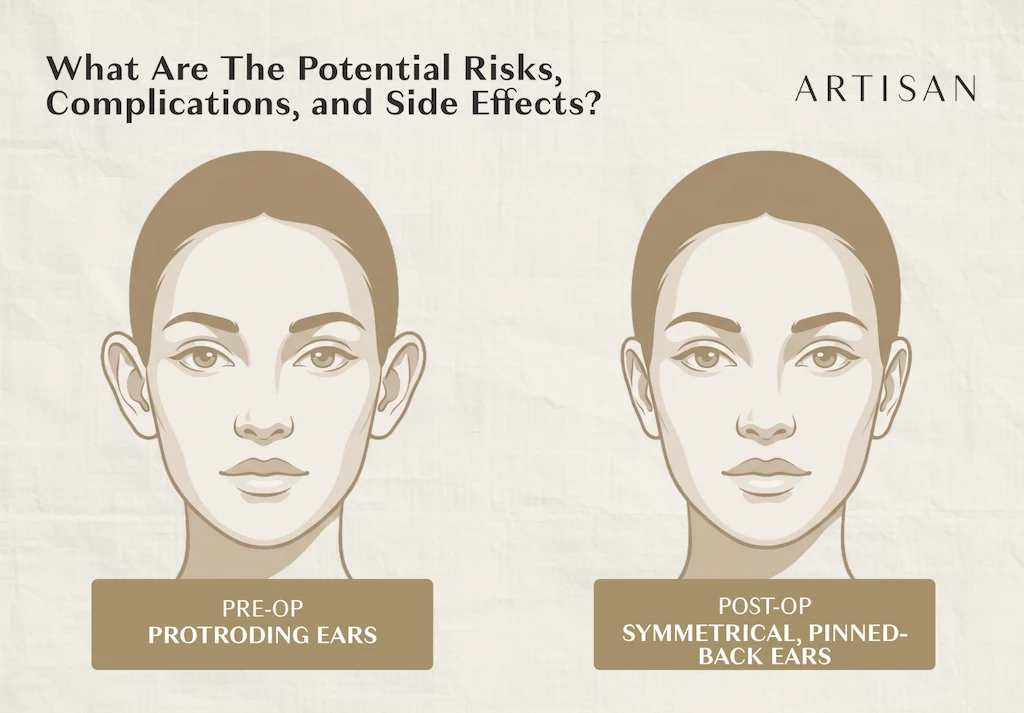
Here is the good news. Swelling, bruising, mild throbbing, redness, and patches of temporary numbness are normal parts of healing, not complications, and they settle over the first week or two.
Genuinely serious problems are uncommon. A 2024 meta-analysis in the Journal of Craniofacial Surgery found bleeding beneath the dressing in about 1.3 percent of ears, and wound infection in under 1 percent. Both are treatable, and both are easier to manage when caught early.
That makes the following list worth knowing rather than worth fearing. Call your surgeon the same day if you notice:
- Pain that suddenly worsens on one side, particularly under the dressing
- A fever, or any drainage with an unpleasant smell
- Skin behind the ear that looks dusky or darker than on the other side
- A dressing that slips or loosens before your follow-up appointment
Uneven ears are the outcome patients worry about most, and surgeons take that worry seriously. Careful measurement during the operation is the main defense, and the choice of technique matters too.
A 2025 study of 365 patients found that pairing Mustardé sutures with a supporting tissue flap lowered asymmetry to 1.6 percent, compared with 8.5 percent for the sutures alone. The permanent stitches can also break, in roughly 1.3 percent of cases, and an ear that loses its stitch drifts back toward where it started. That is fixable with a revision procedure rather than a lost cause.
Reading a list like this and feeling a flicker of doubt does not mean you are having second thoughts. It means you are doing exactly what a careful person should do before an elective operation, which is to understand it honestly before agreeing to it.
What should you expect at your consultation?
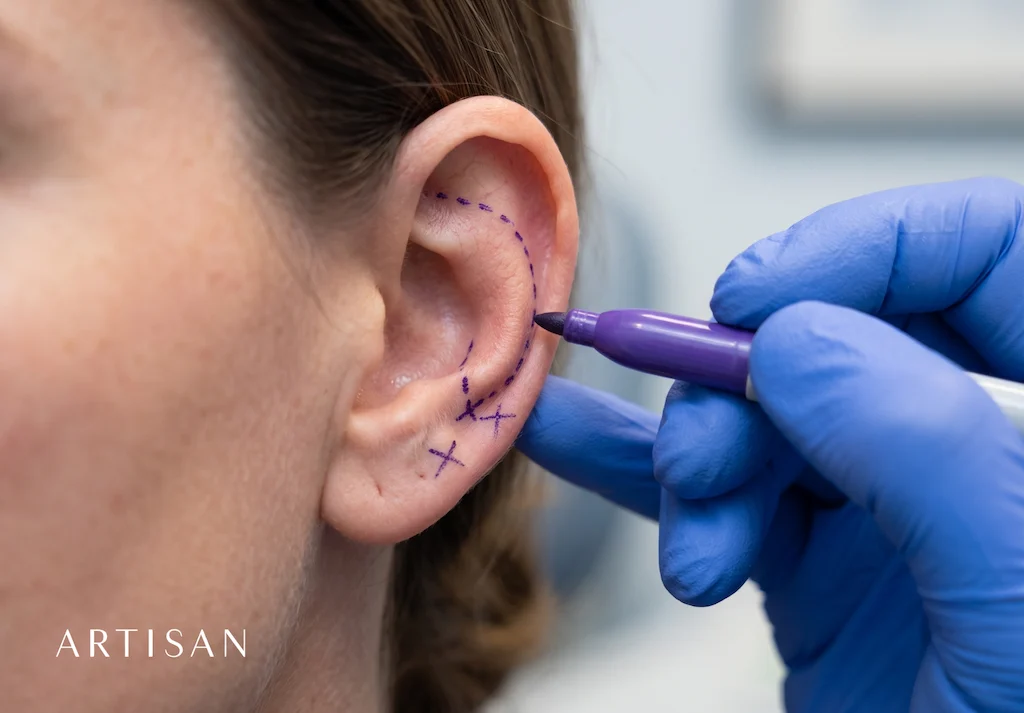
A consultation is not an audition. You are evaluating the surgeon just as closely as they are evaluating your ears. Their approach, their space, and the way they answer a question they have surely heard a thousand times all tell you something.
As Atlanta’s first woman-led plastic surgery practice, Artisan Plastic Surgery brings a particular sensitivity to that conversation. Your surgeon examines the cartilage by hand, listens to what you want changed, and curates a plan around your ear rather than reaching for a template. Consultations happen in person at our Northside and Johns Creek offices, because cartilage firmness is not something a screen can show.
Cost varies with the technique, the complexity of the reshaping, and whether one ear or both are treated. To keep that manageable, we offer flexible financing through Alphaeon Credit, Cherry, and CareCredit.
Nothing about the visit obligates you to book surgery. When you are ready, schedule a consultation or call (404) 851-1998.
Fay, a patient at our Northside office who weighed both the surgery and the cost, described how the conversation went:
“Their professionalism brings any angst to rest regarding the surgery and the financial numbers … everything is explained in detail with questions welcomed and answered.”
Conclusion
You came here to find out what actually happens during ear pinning surgery, and now you know. A fold is created where one never formed, cartilage is held with stitches you will never see, and the whole thing happens through an opening behind the ear. Otoplasty is precise work, but it was never mysterious work.
Looking at real patient photos is the most useful next step, because a healed ear says more than any description of a stitch. When you are ready, an in-person exam fills in what photographs cannot.
Every ear has its own architecture, and at Artisan Plastic Surgery in Atlanta we would rather map yours than reach for a standard correction. That is what the Art of Personalized Beauty means in a room this small.
Reach out to our team or call (404) 851-1998 whenever your questions outgrow the reading.
Frequently asked questions
What is the best age for a child to have their ears pinned back?
Most surgeons operate between the ages of five and eight, once the cartilage has developed enough to hold a new shape. A child who wants the surgery for themselves tends to have an easier recovery, so there is no need to rush the decision.
Can adults get otoplasty, or is it only for children?
Adults are welcome candidates at any age. Adult cartilage is firmer, so your surgeon may lean toward scoring or a hybrid technique rather than relying on stitches alone. Plenty of patients come in decades after first wishing they had.
Will I be awake during my ear pinning surgery?
That depends on your age and your surgeon’s judgment. Young children are almost always fully asleep under general anesthesia. Older children and adults often receive local anesthesia with sedation, which leaves you technically awake but relaxed and feeling nothing.
How long does an otoplasty procedure usually take?
About two hours from start to finish, on an outpatient basis. A straightforward single-ear correction can run shorter, while combining cartilage scoring with suture work adds time. You go home the same day either way.
Where will the scars be located after an otoplasty?
Behind the ear, tucked into the natural crease where it meets your head. If a small incision is needed on the front, our board-certified surgeons place it inside an existing contour so it disappears into the ear’s own shape. The marks fade considerably over the first year.
Are the stitches used in ear pinning temporary or permanent?
Both, and they do different jobs. The internal stitches holding the cartilage in its new fold are permanent and stay in place for life. The stitches closing the skin behind your ear either dissolve or come out at an early follow-up.
How long do I need to wear a headband after otoplasty?
Expect a soft headband at night for roughly four to six weeks after the dressing is removed, and some surgeons ask for longer. It exists to stop your ears folding forward while you sleep. Your follow-up visits at our Atlanta offices are where that schedule gets tailored to how you are healing.
Is ear pinning surgery permanent, or can ears pop back out?
Results are built to last, and most patients never look back. Cartilage does have a memory and can pull against its stitches, which is why permanent internal sutures are used and why the headband is not optional. A small number of patients see some protrusion return and choose a revision. An in-person consultation, with flexible financing through Alphaeon Credit, Cherry, and CareCredit, is where that conversation starts.
*Disclaimer: This content is for educational purposes only and does not constitute medical advice. A consultation with a qualified board-certified surgeon is required to determine the best treatment plan for your individual needs and any questions you may have about a medical condition or procedure.

