



Otoplasty is one of the safest operations in facial plastic surgery. It is not a procedure without risk, though, and any source that tells you otherwise is not being straight with you. Ear pinning surgery carries a small, well-documented set of things that can go wrong, from bleeding beneath the skin to a stitch that surfaces months later.
That fear deserves a real number, not a reassurance. A 2026 review pooling 18 studies and 1,590 patients put the overall complication rate at 14.4 percent, and nearly all of it was minor. The single most common issue was a stitch working its way to the surface, at 5.4 percent.
At Artisan Plastic Surgery in Atlanta, our board-certified plastic surgeons walk through the full risk picture before anyone books a date. Nobody should consent to an operation they only half understand. This article covers what can go wrong and how often, what your scars will actually look like, and how much of the risk sits in your own hands.
Key takeaways
- Serious problems after ear pinning are uncommon. Most of what gets counted as a complication is minor and fixable in the office, not in an operating room.
- The scar hides in the crease behind your ear. Thickened or keloid scars affect a small minority of patients, and your own scarring history matters as much as the technique.
- Aesthetic disappointments are usually judgment errors rather than accidents. Telephone ear, hidden helix, and an over-pinned look all trace back to how the sutures were balanced.
- Pain peaks in the first three days and feels like soreness. Pain that grows after 48 hours deserves a phone call.
- Two things sit within your control. The surgeon you pick, and how faithfully you wear the headband.
What are the real risks of otoplasty?
Low, but not zero. The 14.4 percent figure above sounds high until you look at what sits inside it, and then it stops sounding frightening. Most of that number is a stitch surfacing or a scar thickening, not an emergency.
Worrying about this is not overthinking. It is what careful people do before they let someone operate on a child, or on themselves.
It helps to sort the risks by when they show up. Early problems arrive within days and are usually about blood or bacteria. Late problems arrive over months and are usually about shape, stitches, and scars.
| When it shows up | What can happen | How often |
|---|---|---|
| First 1 to 3 days | Bleeding beneath the skin | 1.3 to 2.5 percent |
| First week or so | Wound infection | 0.8 to 2.6 percent |
| Months later | A stitch surfaces through the skin | About 5.4 percent |
| Months to years | Ears drift back toward their old position | About 3 percent |
Age changes the picture too. Children’s cartilage is soft and forgiving, while adult cartilage is stiffer and pulls harder against the stitches holding it, which is why adults see slightly more drift and slightly more revisions.
So where does that leave the one variable you actually choose? At Artisan, every surgeon who operates on an ear is board certified by the American Board of Plastic Surgery and a member of the American Society of Plastic Surgeons. Volume and judgment are what separate a clean result from a revision.
What can go wrong in the first days after surgery?
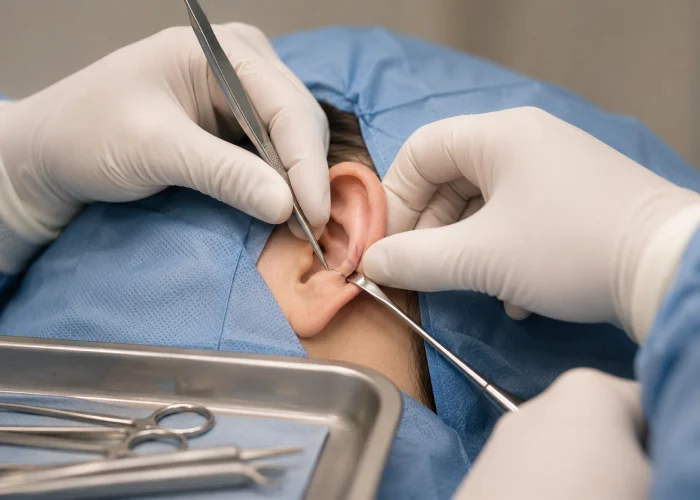
The early risks are the ones your surgical team watches for most closely, and they are the reason you have a follow-up appointment within a few days. Almost all of them are caught and handled quickly. Knowing their names helps you describe what you feel instead of guessing.
Bleeding beneath the skin
A hematoma is a pocket of blood collecting under the skin of the ear. It usually announces itself in the first one to three days, and the giveaway is pain that keeps building rather than settling.
This one is treated urgently, because trapped blood presses on cartilage that has no blood supply of its own. Your surgeon drains it, and the ear typically heals normally afterward.
Wound infection
Infections tend to appear five or more days out, not on day one. The ear looks red, feels tender and warm, and sometimes drains fluid that smells wrong.
Antibiotics resolve the great majority of these. The reason your surgeon wants to hear about it early is that ear cartilage is unforgiving of delay.
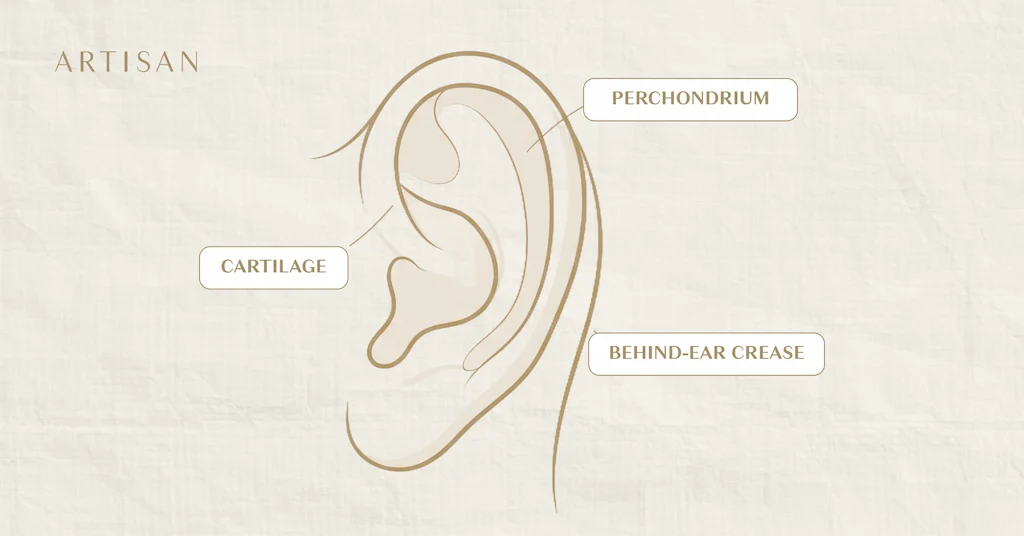
Perichondritis
The perichondrium is the thin membrane wrapped around the cartilage, and it is the cartilage’s only source of blood. An infection that reaches it is treated seriously, because separating the membrane from the cartilage can starve the cartilage entirely.
It is uncommon. It is also the clearest argument for calling your surgeon on the day something feels wrong rather than waiting for a weekday appointment.
A dressing wrapped too tightly
The head dressing is meant to be snug, not punishing. A dressing compressing the ear too hard restricts blood flow, and it announces itself as deep, throbbing pain, an intense headache, or a change in skin color.
Do not loosen it yourself and do not tough it out. There is no prize for enduring pain you were never supposed to feel, and one phone call is all it takes to sort out.
Will you have permanent ear pinning scars?
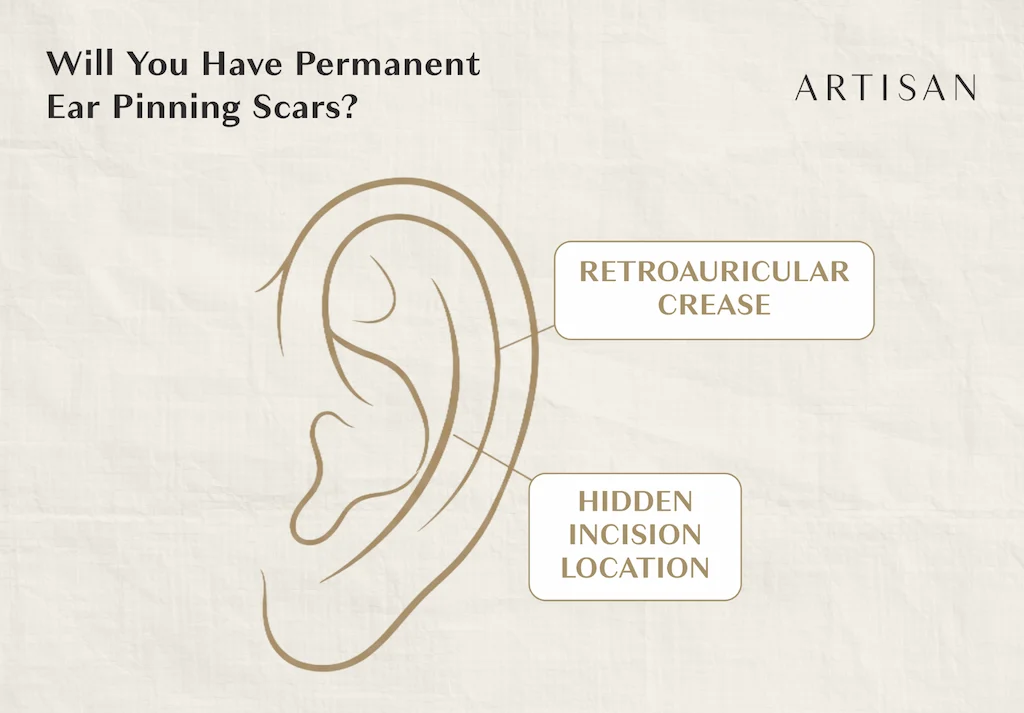
Yes. Ear pinning scars are permanent, and they are also, for most patients, genuinely hard to find.
Almost everyone asks about scars first, so let’s be precise about where they sit. The incision goes into the postauricular sulcus, the natural crease where the back of the ear meets the head. Once healed, that line is tucked behind the ear itself, in a place you cannot see straight on and a place other people never look.
Healing follows a predictable arc. The scar is pink and slightly raised for the first months, then flattens and fades toward a thin pale line over the rest of the first year. A surgeon’s job here is to refine the ear’s own architecture rather than redraw it, and the incision placement is the first expression of that.
Our surgeons hide that line in the crease for exactly this reason. Where the incision goes is a decision made before the first cut, and it is not one you can revisit later.
The harder question is what happens when a body scars badly on its own. Hypertrophic scars stay inside the original line, while true keloids grow beyond it. A 2026 systematic review found keloid or hypertrophic scarring in 1.7 to 2.2 percent of patients, with the rate shifting by technique and no cases at all in some approaches.
Your own scarring history carries real weight there, and the skin behind the ear does not help itself. It is poorly ventilated, it sits under tension, and it takes constant friction from glasses, hair ties, and the elastic loops of masks. A 2023 case report tied bilateral keloids after otoplasty to exactly that kind of repeated mechanical irritation.
Which means some of this is yours to influence:
- Sleep on your back for the first few weeks rather than grinding an ear into a pillow
- Trade ear-looped masks for behind-the-head straps while the incision matures
- Ask your surgeon when to start a silicone scar gel, and then use it consistently
- Keep glasses, headphones, and hair ties off the healing crease
If you have keloided before, anywhere on your body, say so at the consultation. That single sentence changes how a surgeon plans your incision, your closure, and your follow-up.
Jessica, a patient at our Buckhead office who came to our practice for scar revision after keloids formed from an earlier surgery elsewhere, shared her experience:
“Dr. Alexander performed a scar revision from a previous surgery I had with another surgeon that resulted in painful keloids. What stood out and almost brought me to tears was her compassion and understanding of my situation.”
What aesthetic complications can otoplasty cause?
These are the ones patients actually regret, and they are worth understanding because almost none of them are bad luck. An ear that looks wrong after otoplasty usually looks wrong because the sutures were balanced wrong.
Ears are not meant to lie flat. A natural ear sits at a modest angle to the head, and the goal is a harmonious, refined ear that still reads as an ear, not a flattened one. Otoplasty overcorrection, meaning ears pinned too far back, is the single failure a stranger notices from across a room.
| What it’s called | What causes it | How it is addressed |
|---|---|---|
| Telephone ear | Middle pinned tighter than the top and bottom | Revision that rebalances the sutures |
| Reverse telephone ear | Top and bottom pinned tighter than the middle | Revision that releases the poles |
| Hidden helix | Outer rim disappears from a front-on view | Releasing the over-tightened sutures |
| Overcorrection | Ears set too flat against the head | Suture release early, cartilage grafting later |
Timing matters enormously with all of these. Caught early, an overcorrected ear can often be released with a small procedure. Once scar tissue has matured and the cartilage has settled into its new shape, correction becomes a harder, grafting-level operation.
Then there is the correction that quietly undoes itself. Cartilage has memory, and the sutures bear that load for years. Ears drift back toward their original position in about 3 percent of cases, rising toward 5 percent with one surgical approach.
Noticing at week two that your ears do not match is normal, and nearly every patient does. Swelling is rarely symmetrical, especially if you have favored one side in your sleep, and the two ears finish healing on slightly different schedules.
At Artisan Plastic Surgery, our surgeons treat every ear as its own canvas rather than a standard setback measured off a chart. Two ears on the same head often need two different plans.
Is otoplasty painful, and how long does the discomfort last?
Most patients describe soreness rather than pain. The first three days are the worst of it, prescription medication usually covers that window, and most people step down to over-the-counter options after that.
Here is what that means for your week. Most patients are back at a desk or in a classroom within five to seven days, with the discomfort by then closer to an ache than anything sharp.
Numbness is the side effect nobody warns you about. The skin of the ear often feels muffled for weeks to months while the small sensory nerves recover. That is a normal part of healing rather than a sign of damage, and lasting nerve injury is uncommon.
Cold sensitivity can linger longer than either. Some patients notice their ears ache in cold weather well past the point the scars have faded, and for most it settles with time.
Then there is the itching, which patients report as more maddening than the soreness. It is a normal histamine response to healing, and the one rule is absolute: never lift the dressing to scratch, because that can undo the shape the sutures are holding.
- Take the pain medication on schedule for the first few days rather than chasing pain after it starts
- Ask your surgeon before taking an antihistamine for the itch
- Tap gently over the dressing instead of working a finger underneath it
- Never put ice directly against the ears
Sleeping is the other half of the pain equation. Rolling onto a fresh ear hurts, so back-sleeping with your head elevated is not a suggestion for the first weeks.
How can you lower your risk and recover safely?
More of this is in your hands than you would think. The two levers that matter most are the surgeon you choose and how honestly you wear the headband, and you control both.
Start with the red flags, because knowing them removes most of the low-grade anxiety of a first recovery. The symptoms that warrant contacting your surgeon promptly are a fever, worsening pain after the first 48 hours, foul-smelling drainage, and sudden swelling on one side.
| What you notice | Normal, or a red flag? | What to do |
|---|---|---|
| Swelling that eases a little each day | Normal | Keep the headband on |
| A fever above 101 degrees Fahrenheit | Red flag | Call your surgeon that day |
| Pain that grows after 48 hours | Red flag | Call before it worsens |
| Drainage with a bad smell | Red flag | Call your surgeon that day |
| One ear suddenly larger than the other | Red flag | Call without waiting |
The headband is doing more work than it looks like. It compresses the tissue to limit swelling and shields the ears from a stray elbow or a pillow at 3 a.m. It also holds the cartilage where the sutures put it, while scar tissue locks in the new shape.
Wear it around the clock for the first week or two, then at night for another four to six weeks. Patients who abandon it early are the patients whose ears drift. Revision surgery is uncommon, and it is not spread evenly between those who followed instructions and those who did not.
Friction is the other quiet enemy. Over-ear headphones, side sleeping, and swimming all press or expose an ear that is still remodeling, so they wait several weeks. ISAPS advises avoiding strenuous activity and contact sports for one to two months, since a spike in blood pressure or a stray elbow undoes what the sutures hold.
Sound like a lot to track? Every one of those instructions exists to protect a result you have already paid for, and your surgical team will walk you through them in writing before you leave.
Ansley, a patient at our Northside office who ran into a healing problem after her own surgery, described what happened next:
“I never felt rushed during pre-op appointments and always felt comfortable to bring up concerns with her or her staff. I unfortunately had complications with healing after surgery and Dr. Santosa’s response and availability gave me so much reassurance.”
What should you ask at your otoplasty consultation?
The consultation is not only your surgeon evaluating you. It is equally your chance to evaluate them, their judgment, their space, and whether they answer a hard question without flinching.
Bring the uncomfortable ones. Ask how many ear surgeries they perform each year, ask to see results on ears that started where yours did, and ask what their plan is if the correction drifts. A surgeon who welcomes those questions is telling you something useful about how they will behave if something goes wrong at week three.
The visit itself is hands-on, and it has to be. Your surgeon examines the cartilage, tests how it folds, and measures the setback your anatomy will actually hold. That is why these appointments happen in person at our Northside and Johns Creek offices, never over a screen, and why every plan is built around one patient rather than a standard setback.
As Atlanta’s first woman-led plastic surgery practice, our team tends to spend longer on the conversation than the exam. Deciding the risk is not worth it for you, or for your child, is a legitimate answer, and no surgeon worth trusting will push you past it.
Cost surfaces in nearly every consultation, and there is no single price for ear surgery. It depends on technique, whether one ear or both are being reshaped, and what else is being addressed at the same time. To keep that manageable, we offer flexible financing through Alphaeon Credit, Cherry, and CareCredit.
Your surgeon will talk through the approach the way an artist discusses a composition, in terms of balance and proportion and how each part supports the whole. When you are ready, book a consultation with Artisan, or call (404) 851-1998 to get started.
Conclusion
Ear pinning surgery is safe, and it still carries risk, and both halves of that sentence are true at once. Otoplasty has a small set of real, studied risks. You now know their names, their odds, and which of them a good surgeon and a faithful headband can shrink.
Looking at real patient photographs is one of the most grounding things you can do next, so browse our before-and-after gallery with a clear eye. What a photograph cannot tell you is how your own cartilage will behave, and that answer only arrives in an examination room.
A surgeon who tells you what can go wrong before telling you what can go right is the one worth keeping. That is how we practice at Artisan Plastic Surgery in Atlanta, where personalized beauty starts with an honest conversation and every patient is entitled to feel heard, respected, and confident in whatever they decide. Call (404) 851-1998 when you want to have that conversation.
Frequently asked questions
Is it normal for my ears to feel numb or itchy during recovery?
Both are normal and both are common. Numbness happens because small sensory nerves need weeks to months to recover, and the itching is a standard histamine response to a healing wound. Never lift the dressing to scratch, since that can shift the cartilage the sutures are holding.
How long does it take for ear pinning scars to fade?
Ear pinning scars are pink and slightly raised for the first few months, then flatten and lighten over the remainder of the first year. Most settle into a thin pale line that sits in the crease behind the ear, hidden by the ear itself. The scar is permanent, but permanent and visible are not the same thing.
How can I prevent keloid scars behind my ears after surgery?
Your own scarring history is the strongest predictor, so tell your surgeon if you or a close relative has keloided before. Beyond that, protect the healing crease from tension and friction by sleeping on your back, avoiding ear-looped masks, and keeping glasses and headphones off the incision. Ask your surgeon when to begin silicone scar gel.
What is a hematoma, and why is it dangerous after ear surgery?
A hematoma is blood collecting under the skin, and it typically appears within the first one to three days. It matters more in the ear than elsewhere because ear cartilage has no blood supply of its own and relies on the thin membrane around it. Trapped blood presses on that membrane, so surgeons drain hematomas promptly rather than waiting to see.
What is suture extrusion after otoplasty?
Suture extrusion is when one of the permanent internal stitches gradually works its way to the skin’s surface, often months after surgery. It is the single most common issue after ear pinning, affecting roughly 5 percent of patients. It sounds alarming and rarely is, since it is usually resolved in a few minutes in the office.
Can otoplasty cause permanent hearing loss?
No. Otoplasty reshapes the outer ear, the cartilage you can see and touch, and does not enter the ear canal or involve any of the structures responsible for hearing. Ears may feel muffled while dressings are in place and swelling settles, which is a temporary sensation rather than a change in hearing.
Can otoplasty results reverse or shift back over time?
Partly, in a small share of patients. Cartilage has memory and pulls against the sutures holding it, so ears drift back toward their original position in roughly 3 to 5 percent of cases, more often in adults whose cartilage is stiffer. Wearing the headband exactly as instructed during the first weeks is the best protection against it.
*Disclaimer: This content is for educational purposes only and does not constitute medical advice. A consultation with a qualified board-certified surgeon is required to determine the best treatment plan for your individual needs and any questions you may have about a medical condition or procedure.

