

Augmentation mastopexy is one operation doing two jobs. The lift moves the breast back up and removes the skin that no longer fits it. The implant refills the upper pole that pregnancy, weight loss, or time slowly emptied.
The numbers show which half of that equation women reach for first. Surgeons performed 1,658,615 breast augmentations worldwide in 2024, about 9.5 percent of all surgical procedures, according to ISAPS. Volume is what gets requested, and position is the half that usually goes unnamed.
At Artisan Plastic Surgery in Atlanta, our surgeons treat the lift and the implant as one design problem, not two operations stacked together. One question sits underneath all of it: how much volume can your tightened skin actually carry? This article covers how the implant gets chosen, what recovery and scarring really involve, and what shapes the cost.
Key takeaways
- A lift changes where the breast sits. An implant changes how full it is. Neither one does the other’s job, which is why the combination exists.
- The lift sets a ceiling on implant size. A heavier implant pulls against the repair that was just made, so smaller and moderate implants protect the result you paid for.
- Cubic centimeters are a measure of volume, not a cup size. The same implant reads completely differently on two different frames.
- Recovery runs longer than either procedure alone. Breasts sit high and firm for months before they soften into position, and the final shape takes close to a year.
- Fat grafting can replace an implant entirely, or work alongside a smaller one, when the goal is subtle fullness rather than significant size.
Are you a good candidate for a breast lift with implants?
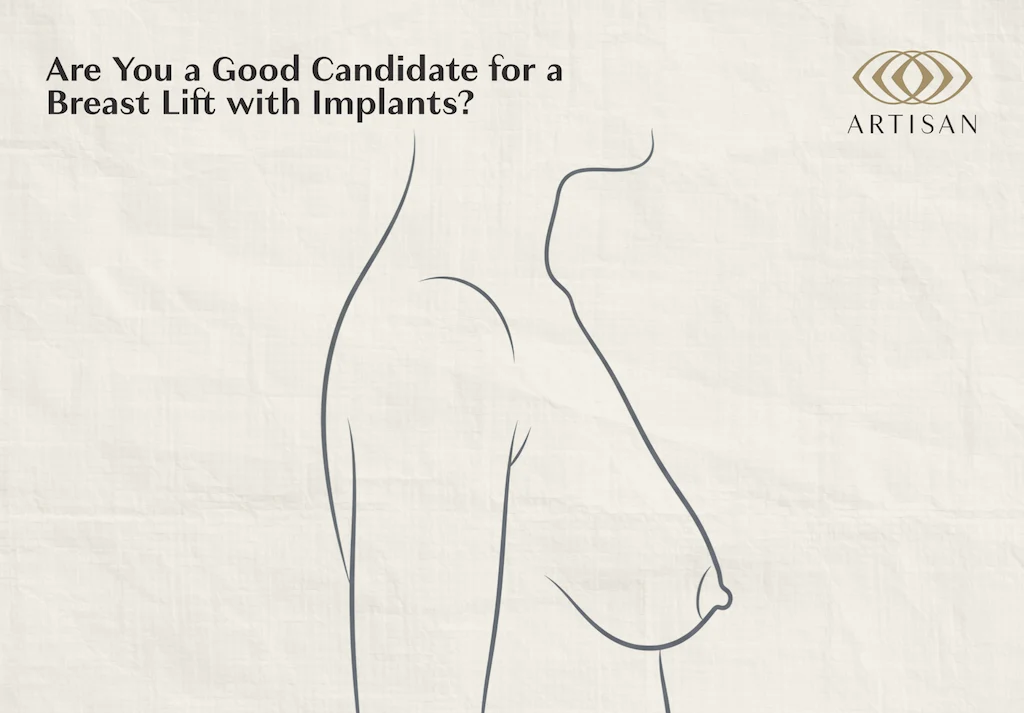
Candidacy comes down to two measurements rather than to how you feel in a bra. Your surgeon looks at where your nipple sits relative to the crease beneath your breast, and at how much spring is left in your skin.
An implant on its own cannot lift anything. Volume is heavy, and dropping it into a stretched skin envelope tends to push the breast lower rather than higher. Some patients end up with a double bubble, where the implant settles into a new position and the breast tissue stays exactly where it was.
A lift on its own has the opposite limit. It reshapes what you already have and raises the nipple, but adds no volume, so a breast lift without implants leaves an empty upper pole roughly where it found it. You are likely a candidate for the combination if several of these describe you:
- Your nipple points at or below the crease under your breast.
- Your breasts feel emptier at the top than they used to.
- Your skin no longer springs back when you lift the breast and let go.
- Your weight has been steady for several months.
- You do not smoke, or you are willing to stop before surgery.
Not everyone should have both done in one sitting. When sagging is advanced or the skin has little elasticity left, some surgeons stage the operations, doing the lift first and adding the implant months later to protect blood flow to the nipple. At Artisan, that call gets made on your anatomy alone.
For carefully selected patients, doing both at once is a well-supported option, according to ASPS. If you are trying to work out which camp you fall into, that instinct to slow down is exactly right.
How do you choose the right implant for a lift and augmentation?
The lift sets the ceiling. Every implant decision after that is about staying underneath it.
Here’s the thing. A mastopexy tightens the skin envelope and rebuilds the breast’s internal support, while an implant does the opposite and expands it. A published review describes these as two opposing forces, and notes that larger implants raise the tension the healing tissue has to carry.
| Feature | Silicone gel | Saline |
|---|---|---|
| Feel | Closer to natural breast tissue | Firmer, more noticeable |
| Rippling | Less visible | More visible with thin tissue coverage |
| If it leaks | Gel holds its shape, imaging detects it | Deflates visibly, the body absorbs the saline |
| Incision | Slightly longer, filled before insertion | Shorter, filled after insertion |
The ceiling the lift sets
This is where the conversation gets uncomfortable, because you may want more volume than your skin can safely hold. Wanting more is not greedy. It is the most human thing about this decision, and a good surgeon will tell you plainly where the tradeoff sits.
Profile matters as much as volume. A lift already cones and projects the breast tissue on its own, so a high-profile implant stacked on top can read as sharp rather than natural.
Cubic centimeters versus cup size
Implants are measured in cubic centimeters, a unit of volume. Cup size is not standardized, and the same person wears different cups across bra brands, so “I want to be a C” is a moving target.
Your frame decides the rest. Chest width, breast base width, and how much natural tissue you have all determine which volume looks balanced. Every plan at Artisan is curated around your anatomy and your goals, never around a number carried in from someone else’s result.
Fat grafting, instead of or alongside an implant
Fat grafting uses your own tissue rather than a device. It requires smaller incisions and less recovery time, and it suits patients who want a subtle increase rather than a dramatic one.
There is a middle path too. A hybrid approach described in one study pairs a smaller, lighter implant with fat grafting to fill the upper pole, giving fullness without asking the skin to carry as much weight.
What does recovery look like week by week?
Recovery from a combined lift and augmentation is gradual, and it runs longer than either procedure on its own.
| Phase | Timeframe | What to expect |
|---|---|---|
| Right after surgery | Day 1 to 3 | Tightness and soreness peak, rest with short walks |
| Early healing | Week 1 to 2 | Soreness eases, most return to desk work, no lifting |
| Building back | Week 3 to 6 | Swelling settles, light activity, still no heavy lifting |
| Back to training | Week 6 to 8 | Strenuous exercise resumes once your surgeon clears you |
| Settling | Month 3 to 6 | Implants drop and soften into a natural position |
| Final shape | Around one year | Scars mature and the contour settles |
The firmness catches people off guard. Right after surgery the breasts sit high on the chest and feel tight, because swollen tissue and a tense chest muscle are pressing against the implant. That softening is what surgeons call drop and fluff, and it keeps its own schedule, often on one side before the other.
Week two is where a lot of people wobble. You are off the strong medication, you are bored of resting, and your breasts still look nothing like the result you agreed to. That stretch is the normal middle of this process, not a sign that something has gone wrong.
Melissa, a patient at our Northside office who had a lift with implants, described that stretch of healing:
“Dr Val listened to me and understood what I wanted to look like and got the job done. I had a breast lift with implants and a thigh lift with liposuction. It’s been 2 months since I had both procedures done and if you know anything about thigh lifts its takes months before everything is healed and all swelling is gone. Dr Val has been very attentive throughout this whole process and I couldn’t ask for a better physician.”
What should you expect from scarring and scar care?
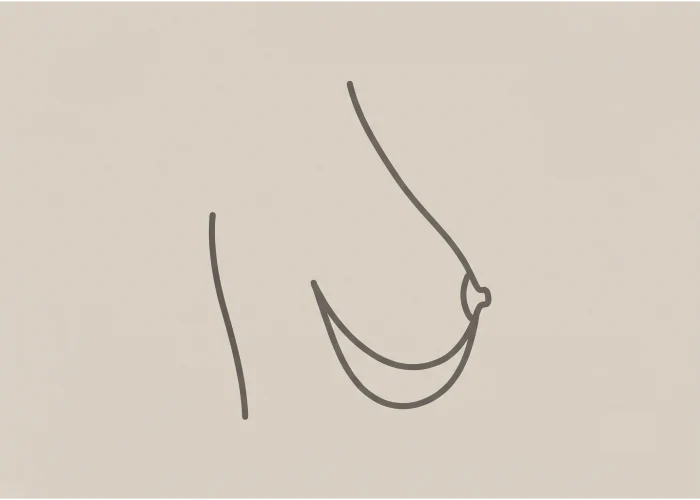
Every lift trades skin for shape, and that trade leaves a scar. Where the scar falls depends entirely on how much skin has to come out.
A small lift is usually done through an incision around the border of the areola. Moderate lifting adds a vertical line down to the breast crease, and significant sagging calls for an anchor pattern that runs along the crease as well.
A longer scar is not a worse outcome. It is often the only pattern that can release enough tissue to hold the shape you want.
Scar care is simple, and the timing matters more than the products:
- Wait for your surgeon’s clearance, usually around the three-week mark, before touching the scar at all.
- Medical-grade silicone gel or silicone sheeting, used twice daily, is the option with real evidence behind it.
- Keep the scar covered or out of the sun for the first year to avoid permanent darkening.
- Expect red and raised before flat and pale. That order is normal, not a warning.
Scars need a full year to finish maturing, and they look their angriest in the first six months. One breast almost always runs ahead of the other, and often the reason is nothing more mysterious than hand dominance.
What affects the cost of combining a lift and implants?
Cost is the question people ask last and think about first. There is no single number here, because a combined lift and augmentation is not a single line item.
| Cost component | What it covers |
|---|---|
| Surgeon’s fee | The operation itself and the surgical plan |
| Anesthesia fee | The anesthesiologist and your comfort during surgery |
| Facility fee | The accredited surgical center and its staff |
| Implants or fat grafting | The devices themselves, or harvesting and transferring fat |
| Aftercare | Medications, surgical garments, and pre-operative lab work |
Doing both procedures in one operation means paying the anesthesia and facility fees once rather than twice. That is the practical reason most patients who need both have them together.
You will not find a price in this article, and that is deliberate. The plan does not exist until a surgeon has examined you, so a number quoted before that is a guess wearing the costume of information. You leave your consultation with a cost breakdown built around the plan you actually chose.
Because this surgery is elective, insurance does not cover it. Our practice works with Alphaeon Credit, Cherry, and CareCredit, so the payment structure can bend to your budget rather than the other way around.
What happens at your consultation?
Your consultation is not only your surgeon evaluating you. It is equally your chance to evaluate them, their approach, their space, and whether they actually listen when you describe what you want.
As Atlanta’s first woman-led plastic surgery practice, Artisan brings a particular perspective to that conversation. Our co-founders built this practice around the way women actually experience their bodies, and the consultation is where that shows up most clearly.
Consultations happen in person, at our Northside and Johns Creek offices, and there is a reason for that. Trying implant sizers, assessing your skin quality, measuring nipple position against the crease, none of it survives a screen. You will talk through profiles and volumes the way an artist talks through a composition, balance first and detail second.
Yvette, a patient at our Northside office who came in with lifelong asymmetry, described how that first visit felt:
“Dr. Wang-Ashraf is the best!!! She performed a breast augmentation with a lift on me as I have suffered with severe breast asymmetry most of my teenage and adult life. She was very confident in me and she made me feel so comfortable. Now I feel like a new person!”
Cost comes up here too, openly and without pressure. You can explore financing options through Alphaeon Credit, Cherry, and CareCredit before you commit to anything.
Conclusion
Volume was the request. Position was the half that went unnamed, and now you know why the two so often travel together. A breast lift paired with an implant is one operation asked to do both jobs at once, and the whole craft of it lives in the balance between them.
Looking at real patients whose starting point resembles yours will teach you more than any size chart can. Photographs of past results are the honest place to begin, and an in-person exam fills in everything a photograph cannot show you.
Artisan Plastic Surgery was built in Atlanta on a simple idea: every patient deserves to be heard before anything gets measured. The Art of Personalized Beauty is not a tagline here, it is the order of operations. Call (404) 851-1998 whenever the questions start outnumbering the answers.
Frequently asked questions
Can I get a breast lift with implants if I have small breasts?
Yes, and small implant breast lift combinations are common. The lift restores position while a modest implant restores fullness at the top, which is often exactly what smaller breasts need. Your skin quality matters more than your starting size.
How do I perform the pencil test at home to check for sagging?
Place a pencil in the fold underneath your breast and let go. If the pencil stays put on its own, there is enough overhang that a surgeon would likely grade you as having some degree of sagging. It is a rough screen rather than a diagnosis, and it tells you nothing about skin quality.
Will my nipples lose sensation after a combined augmentation and lift?
Changes in nipple sensation are common in the first months, and for most patients the feeling returns as the nerves settle. A smaller number notice a lasting change in sensitivity, either increased or decreased. Your surgeon should walk you through how the incision pattern you need affects that risk.
Can I breastfeed after getting a breast lift with implants?
Many patients breastfeed afterward, though no surgeon can promise it. Techniques that keep the nipple attached to the underlying tissue preserve the milk ducts better than those that do not. If future breastfeeding matters to you, say so early, because it genuinely changes how the operation is planned.
How long after pregnancy or breastfeeding should I wait to have this surgery?
Give your body time to finish changing. Most surgeons want to see several months after you stop breastfeeding, so the breasts have settled at their new volume and your weight has stabilized. Operating before that means tailoring skin around a shape that is still moving.
Do I have to get silicone implants, or is saline an option?
Both are options, and both are approved. Silicone gel tends to feel closer to natural tissue and shows less rippling, which matters more for patients with thinner tissue coverage. Saline sits lower in cost and reveals a leak immediately, since the implant visibly deflates.
Do breast implants need to be replaced over time?
Implants are not considered lifetime devices, but there is no expiration date stamped on them either. They are replaced when something changes, a leak, a shift in position, or a change in what you want, rather than on a fixed schedule. Your surgeon monitors them at follow-up visits over the years.
Can a breast lift and implants correct asymmetric breasts?
This combination is one of the better tools for it. The lift repositions each nipple independently and removes different amounts of skin on each side. Implants of different volumes then even out the fullness, though exact symmetry is never the goal, since no one starts out symmetrical.
What are the risks of combining a breast lift and implants?
The vast majority of patients come through without any trouble. As with any surgery, there are potential risks, including bleeding, poor healing at the incision, a change in nipple sensation, and sagging that returns over time. Choosing a board-certified surgeon and following your aftercare instructions does more to lower those odds than anything else.
Will insurance cover any part of a combined breast lift and augmentation?
Almost never, because both procedures are considered cosmetic. Insurance occasionally contributes when a lift is part of reconstruction after breast cancer or corrects a significant congenital asymmetry. Your surgeon’s office can tell you quickly whether your situation is one of the rare exceptions.
*Disclaimer: This content is for educational purposes only and does not constitute medical advice. A consultation with a qualified board-certified surgeon is required to determine the best treatment plan for your individual needs and any questions you may have about a medical condition or procedure.