




A breast contains no muscle of its own. Skin, fat, and glandular tissue sit on top of the chest muscles, not inside them. That one fact decides most of what follows.
It has not slowed the marketing. Botulinum toxin was the most common non-surgical procedure in the world in 2024, with 7,887,955 treatments performed, according to ISAPS. When a drug becomes that familiar, new uses get invented for it faster than evidence can test them.
At Artisan Plastic Surgery in Atlanta, our team performs both the injectable treatments and the surgery, so we have no reason to steer you toward either one. This article covers what a breast Botox lift can and cannot do, whether sutures and threads hold breast tissue, and how the minimally invasive options measure up against a surgical lift.
Key takeaways
- Breast tissue holds no muscle. Relaxing the chest muscles underneath it with a neuromodulator changes posture and muscle tone, not the position of the breast.
- No botulinum toxin product is approved for breast lifting or breast enhancement anywhere in the United States, and no peer-reviewed study supports the claim.
- Absorbable threads create real tension at first, but the lift is mechanical and temporary. As the threads dissolve, the support they provided dissolves with them.
- Energy-based tightening and platelet-rich plasma act on skin quality. Neither removes skin, and neither moves the nipple, which is what sagging actually requires.
- The honest dividing line is severity. Non-surgical treatments suit mild laxity and skin texture, while a surgical lift addresses moderate to advanced structural sagging.
How does a breast Botox lift work, and does it actually lift anything?
The theory sounds plausible for about ten seconds. Botox® is injected into the pectoralis minor, a small muscle tucked beneath the larger chest muscle. Relaxing it is meant to let the muscles of the upper back pull the chest up and back, producing a subtly higher-looking breast.
The anatomy does not cooperate. Sagging, which surgeons call ptosis, is a stretched skin envelope and a nipple that has drifted below the crease under the breast. Breast tissue contains no muscle at all, as surgeons pointed out in a letter to the journal Plastic and Reconstructive Surgery.
There is also the matter of where the needle goes. The pectoralis minor sits completely beneath the thick pectoralis major, which makes it a difficult and imprecise target, reached by passing a needle through breast tissue toward the chest wall. The risks specific to deep chest injection include:
- Puncture of the lung, because the chest wall sits directly behind the target muscle
- Weakness in the shoulder or arm if the toxin reaches muscles it was not meant to reach
- Difficulty swallowing, shortness of breath, or muscle weakness if the toxin spreads to other parts of the body
- Unpredictable interference with future mammograms and breast cancer screening
- Asymmetry, since a muscle you cannot see is a muscle you cannot dose evenly
Then there is the paperwork nobody reads. The FDA-approved label for onabotulinumtoxinA covers intramuscular, intradetrusor, and intradermal uses, and breast lifting appears nowhere on it. Any change that does appear is temporary, and no clinical trial has ever established that this works.
None of this makes the drug a villain. At Artisan Beaute, our injectors use Botox, Dysport®, Daxxify®, and Xeomin® every day at our Buckhead and Westside locations. The one chest-adjacent use we offer is for excessive sweating, and it works because blocking a nerve signal to a sweat gland is something the drug genuinely does.
Can a suture breast lift hold breast tissue in place?
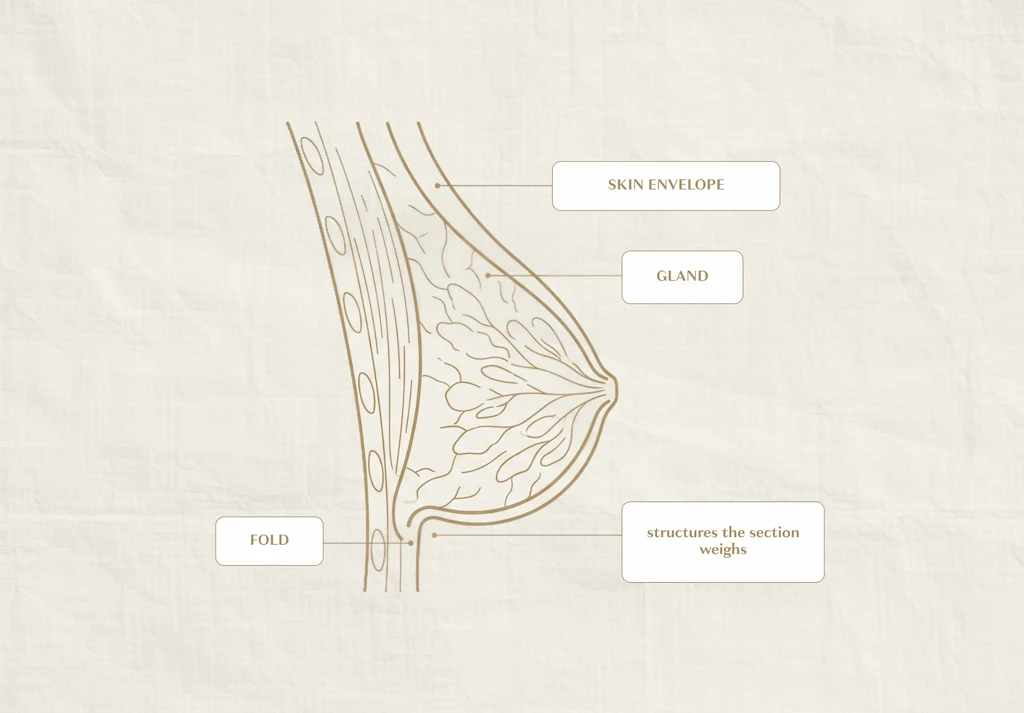
A suture breast lift, sometimes sold as a thread lift, places absorbable threads made of polydioxanone or poly-L-lactic acid under the skin. Barbs or small cones along each thread grip soft tissue, and the threads are anchored upward to firmer structures such as the deep chest muscle. Tension does the rest.
For a while, it works. A 2025 review in the Journal of Clinical Medicine found that thread suspension can produce a visible early lift in mild sagging. The threads also trigger new collagen as they break down, and there the catch arrives: the mechanical tension fades, and the lift fades with it.
Surgeons have watched this film before. Permanent barbed suspension threads were marketed for the face two decades ago and withdrawn after they broke, migrated, and lost their hold. Breast tissue is heavier than a cheek, gravity works on it every hour of every day, and a thread anchored to soft tissue eventually pulls through.
The side effects tend to be minor and self-limiting, which is genuinely reassuring: bruising, swelling, and tenderness that settle on their own. Less welcome are dimpling where a barb catches, visible or palpable threads, asymmetry, and the small possibility of infection along the thread’s path. Your surgeon should be candid with you about all of it before you commit, and a good one will be.
So the answer is a qualified one. Threads hold breast tissue the way a clothespin holds a curtain. It is real while it lasts, and it is not the same as taking in the fabric.
What other minimally invasive breast lift options are out there?
Quite a few, and they are not equivalent. The useful way to sort them is by what they physically change, because the marketing names rarely tell you.
| Option | What it actually does | Best suited for |
|---|---|---|
| Vampire breast lift (PRP) | Stimulates collagen in the skin | Skin texture and tone |
| Energy-based tightening | Heats deeper skin layers | Mild laxity only |
| Microcurrent and wearable devices | Briefly stimulates or swells muscle | Short-term, event-day effects |
| Liposuction, fat grafting, endoscopic access | Changes volume and contour | Shape, not nipple position |
| Surgical mastopexy | Removes skin, repositions the nipple | Moderate to advanced sagging |
Vampire breast lift
Platelet-rich plasma is spun from your own blood and injected to encourage collagen and cell growth. Because it is not surgery, Cleveland Clinic notes it cannot fully lift sagging breasts, reduce excess skin, or reposition the nipples. Many providers add hyaluronic acid filler in the same visit for immediate plumpness, and fat grafting is the longer-lasting way to add that volume.
What you get is better-looking skin on a breast that sits exactly where it sat before. For some patients that is enough, and there is nothing wrong with wanting it.
Energy-based skin tightening
Radiofrequency devices heat the deeper layers of skin to provoke new collagen. A small 2025 study of plasma-assisted radiofrequency reported an average lift of just over a centimeter in most participants at their six-month check. That is a measurable change, and a modest one.
The wider evidence base is thinner than the brochures suggest. A systematic review of non-ablative radiofrequency for skin laxity concluded that the large majority of published studies lacked control groups or blinding.
At Artisan Beaute we offer Morpheus8™, a non-surgical treatment pairing microneedling with radiofrequency to firm skin over a series of sessions. We describe it as a skin-quality treatment rather than a lift. If refreshing skin texture is what you are after, book a visit at Beaute Buckhead or Beaute Westside.
Microcurrent and wearable devices
The CACI bust treatment passes low-level electrical current through the pectoral muscles to make them contract. Any visible change in chest projection is brief, measured in days rather than weeks, and it does nothing for the breast tissue resting above the muscle.
External vacuum devices ask for something closer to a part-time job, often twelve hours of daily wear over months, in exchange for a modest change. Products sold as a “breast lifting device” or a wearable “laser bra” belong in the same conversation. Worth knowing: the laser bra is not a device at all, but a surgical technique that shapes an internal sling from the patient’s own tissue.
Liposuction, endoscopic access, and breast sculpting
A liposuction breast lift is a contour operation, not a lift. Removing fat can refine a heavy breast’s silhouette, and pairing liposuction with fat grafting alongside a formal lift is a recognized way to shape the upper breast.
An endoscopic breast lift is largely a marketing phrase. A true lift requires removing excess skin, and there is no way to remove skin through the keyhole incisions that endoscopic surgery depends on. Breast sculpting has the same problem: it alters volume and contour, while a lift specifically raises the nipple and areola into a higher position.
If any of this feels like a long list of near-misses, that is a reasonable reaction. Non-surgical treatments earn their place with early, mild concerns, and reading carefully before spending money on the wrong one is exactly the right instinct.
Sloane, a patient at our Northside office who chose a surgical lift after weighing her options, shared her experience:
“In April 2025 I had a breast lift and reduction with Dr. Wang-Ashraf. To say my life has changed because of her would be an understatement. The confidence, the happiness, the freedom and literal weight off my chest has been a blessing beyond measure.”
How do these alternatives compare to a surgical breast lift?
They answer a different question. Non-surgical options like radiofrequency tightening and platelet-rich plasma work well for early, mild concerns, while surgical procedures like mastopexy address more advanced structural changes. Framing it as surgery versus everything else misses the point, because the two are not competing for the same patient.
Severity is the dividing line. Surgeons grade sagging by where the nipple sits relative to the crease beneath the breast, and no non-invasive method corrects moderate or advanced grades. The reason is mechanical rather than technological: excess skin has to be removed, and no energy device or injection removes skin.
Nor do these treatments reposition the nipple and areola. A surgical lift moves that complex to a higher, more balanced position on the breast, which the published literature treats as the defining act of the operation. A treatment that leaves the nipple where it found it has not performed a lift, whatever it is called.
Where the comparison gets genuinely interesting is in the trade-offs a patient actually feels:
- Scars are the real cost of surgery, and at Artisan we say so plainly. They fade over time and usually sit inside a swimsuit top, but they are permanent.
- Recovery is longer. Most of our patients return to office work about a week after a lift, avoiding heavy lifting and straining.
- Results appear immediately and are structural, rather than accumulating across a series of appointments.
- Repeat treatments compound. A temporary result purchased again and again has a cost that a one-time operation does not.
- A lift can be combined with implants, a reduction, or fat grafting, which no non-surgical option can offer.
Every plan we build starts from your anatomy, your goals, and your tolerance for downtime, never from a menu. Deciding carefully between two honest options is not indecision. It is the whole point.
What happens when you bring these questions to a consultation?
You get measured, and you get to measure back. A consultation is not only a chance for your surgeon to evaluate your anatomy, skin quality, and health. It is equally your chance to evaluate their approach, their space, and whether they will tell you when a treatment you asked about will not work.
That assessment happens in person, at our Northside or Johns Creek office. Skin elasticity and nipple position are things a surgeon needs to see and feel rather than glimpse on a screen. Your surgeon will walk you through the options the way an artist discusses a composition, weighing balance and proportion, and then the two of you curate a plan.
As Atlanta’s first woman-led plastic surgery practice, Artisan brings a particular sensitivity to that conversation. Our three-pillar model means the surgical, aesthetic, and wellness options all sit on the same table in the same visit. The cost comes up, and it should.
We offer flexible financing through Alphaeon Credit, Cherry, and CareCredit, so the plan you choose is the one your anatomy calls for.
Melissa, a patient at our Northside office who came in with a clear picture of what she wanted, described being heard:
“Dr Val listened to me and understood what I wanted to look like and got the job done.”
Conclusion
We opened with the anatomy, so let us close there. A breast has no lifting muscle, which is why a neuromodulator cannot raise one and why a dissolving thread cannot hold one. A breast lift remains the only approach that removes skin and moves the nipple, and knowing that saves you from paying twice to learn it.
Looking at real patient photographs is the most useful next step, so browse our before-and-after gallery and find a starting point that resembles your own. What a photograph cannot show is the conversation, and that is where the plan is made.
Every patient who walks into Artisan Plastic Surgery in Atlanta deserves a straight answer, even when it is not the one the internet promised. That is what the art of personalized beauty means to us, and you can reach our team at (404) 851-1998 whenever you are ready to have the conversation.
Frequently asked questions
Can Botox actually lift sagging breasts?
No. Sagging is caused by stretched skin and a nipple that has descended, and a neuromodulator affects neither. Any change comes from relaxing a chest muscle and altering posture, which is a borrowed effect rather than a lift.
Are thread lifts safe for breast tissue?
They are generally well tolerated, with bruising and swelling that settle on their own. Dimpling, palpable threads, asymmetry, and infection along the thread’s path are the less common concerns. The larger issue is not safety but durability, since the tension the threads create does not stay.
Is there an FDA-approved nonsurgical breast lift?
No product carries approval for lifting the breast. Some devices used on the breast are cleared for other purposes, such as skin tightening, which is a different claim from lifting. Ask any provider to tell you exactly what a device is approved to do before you agree to it.
What is a vampire breast lift?
Platelet-rich plasma is drawn from your own blood, concentrated, and injected into the breast to stimulate collagen. It can improve the texture and tone of the skin. It does not change where the breast sits, and the name oversells what the treatment delivers.
How long do the results of a nonsurgical breast lift last?
Every non-surgical option produces a temporary result, and maintaining it means returning for repeat treatments. Neuromodulators fade as the drug wears off, threads take their tension with them as they dissolve, and energy-based tightening depends on collagen you keep losing with age. Surgical results are structural and persist for an extended period.
Do nonsurgical breast lifts leave scars?
Injections and energy treatments do not leave surgical scars, which is a genuine advantage. Threads can occasionally leave dimpling or a visible line where a barb has caught the skin. Surgery does leave permanent scars, though they fade and usually hide beneath a swimsuit top.
Can chest exercises mimic the effects of breast Botox?
In a sense, yes, and that is the most telling thing about breast Botox. Strengthening the pectoral muscles and improving posture can make the chest look firmer and more open. Neither exercise nor an injection lifts the breast tissue resting on top of those muscles.
Can I try a nonsurgical breast lift while breastfeeding?
Wait. Breast size, skin, and glandular tissue all change during and after breastfeeding, so any assessment made now will not describe the breast you eventually settle into. Our surgeons generally recommend a stable weight and a finished breastfeeding period before evaluating anything.
*Disclaimer: This content is for educational purposes only and does not constitute medical advice. A consultation with a qualified board-certified surgeon is required to determine the best treatment plan for your individual needs and any questions you may have about a medical condition or procedure.

