




Breast augmentation without implants uses your body’s own fat to add natural shape and volume. For women who would rather avoid silicone or saline, or who want a more modest, natural enhancement, fat transfer offers an appealing alternative.
Interest in these options reflects a broader shift happening right now. Worldwide, breast implant removals rose 4.7% in 2023, reaching 335,939 procedures, according to ISAPS. More and more women are asking whether their own tissue can do the job instead.
It’s a question we hear often. At Artisan Plastic Surgery in Atlanta, our co-founders have spent years helping patients carefully weigh natural-looking options against implants. This article walks you through what implant-free enhancement can realistically deliver, who tends to be a strong candidate, and what the recovery process looks like.
Key takeaways
- Implant-free breast enhancement uses your own tissue, most often through fat transfer, which moves fat from one area of your body to your breasts.
- These options typically deliver a modest increase, often around one cup size, with a soft, natural feel rather than a dramatic change in size.
- Good candidates have enough fat in donor areas like the abdomen or thighs, a stable weight, and realistic expectations. Significant sagging may also call for a lift.
- Your body reabsorbs some of the transferred fat in the first few months, so the breasts settle into their final shape over roughly three to six months.
- The single biggest safety factor is choosing a board-certified plastic surgeon who harvests, purifies, and places the fat with genuine skill and care.
What does it actually mean to enhance your breasts without implants?
Going implant-free means building shape from your own body rather than a manufactured device. The most common path is autologous fat transfer, a clinical term for moving fat from one area of your body to your breasts, with nothing foreign left behind.
So why are more women drawn to this idea? For some, it comes down to peace of mind. Implants are well studied and safe for most people, but they do involve a device that may need attention over the years.
Others simply feel more comfortable using their own tissue. Here are a few reasons patients explore implant-free enhancement:
- They want a soft, natural feel that moves with their body.
- They prefer not to plan around possible device maintenance later.
- They like the bonus of slimming a donor area in the same surgery.
- They want a subtle change rather than a noticeable jump in size.
Here’s the honest part: going implant-free usually means a modest result, often about one cup size, not a dramatic increase. If you’re set on a much larger size, your surgeon will walk you through the trade-offs vs. surgical refinement. The plan should always match what you actually want.
What are your best implant-free options for enhancing breast size?

There’s more than one way to go implant-free, and the right path depends on your goals and anatomy. Most women weighing this choice are deciding between a handful of well-established approaches.
| Option | How it works | Best suited for |
|---|---|---|
| Fat transfer | Liposuction harvests your own fat, which is purified and injected into the breast | A modest, natural increase with a softer feel |
| Auto-augmentation lift | Reshapes and repositions your existing breast tissue during a lift | Sagging breasts with enough natural volume |
| Regenerative matrix | A donor-derived adipose filler injected for small-volume shaping | Subtle touch-ups or early exploration |
| Hybrid approach | Pairs fat transfer with a small implant | Wanting more size than fat alone can give |
Fat transfer is the most popular of these because it adds soft volume while contouring a donor area at the same time. An auto-augmentation lift takes a different approach, it uses tissue that would otherwise be removed during a lift to restore fullness up top, which works beautifully when sagging is the real concern.
A quick word on products that promise size from a bottle: topical creams, herbal supplements, and vacuum systems do not meaningfully increase breast size. Treatments like radiofrequency or platelet-rich plasma can refresh the skin, but they don’t add real volume. Our team at Artisan would rather give you a straight answer than point you toward a shortcut that won’t deliver.
Are you a good candidate for a natural breast augmentation?
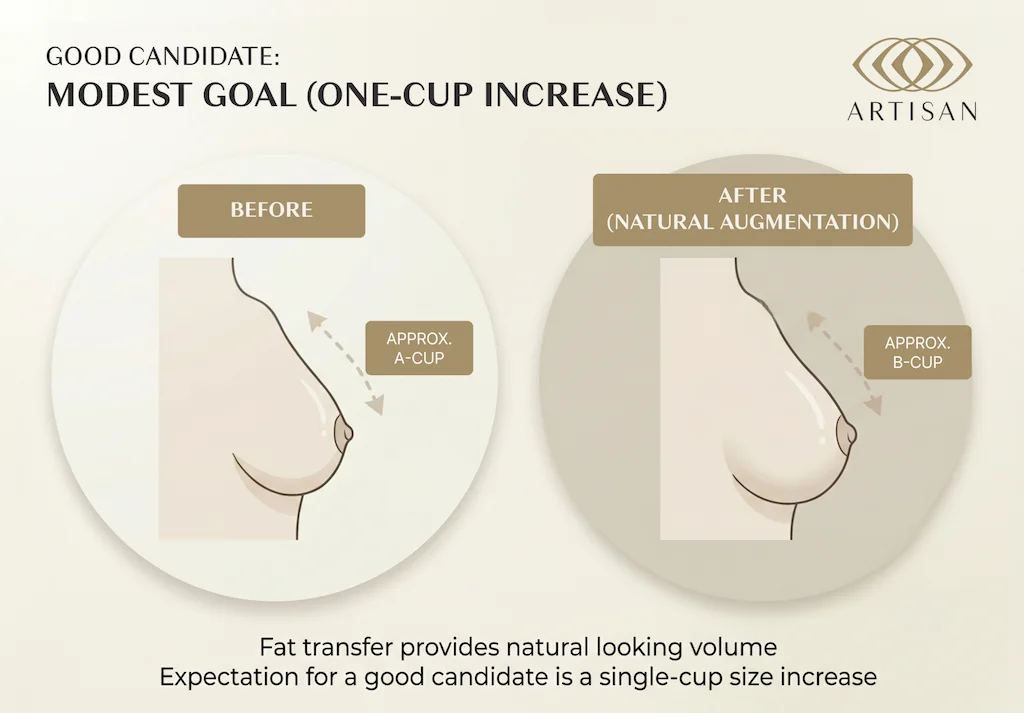
The best candidates share a few practical things in common, and many women fit the picture. Your surgeon will first look at whether you have enough fat to harvest, since the procedure borrows volume from one area to add it to another.
Because some transferred fat is naturally reabsorbed by the body, fat transfer breast augmentation requires an adequate supply of donor fat from areas such as the abdomen, hips, flanks, or thighs. The amount needed depends on your starting anatomy and desired increase in breast size. You may be a strong fit if:
- You have enough fat in common donor areas to harvest.
- Your weight has been stable and you plan to keep it that way.
- You feel good about a natural, modest increase rather than a large one.
- You understand that some sagging may need a lift alongside the fat transfer.
What if you carry very little extra fat? A lower body fat level isn’t an automatic disqualifier. Skilled surgeons can sometimes gather enough fat from several areas at once, though it does make you a more nuanced candidate.
Weight stability matters because transferred fat behaves just like the rest of the fat in your body. If you gain or lose a significant amount later, your results can shift with it. Every plan at Artisan is built around your individual anatomy and goals, never a one-size-fits-all template.
Amanda, a patient at our Northside office who valued natural results and an easy recovery, shared her experience:
“Highest level of expertise and care. The team go above and beyond for beautiful, natural results with an emphasis on wellbeing. They take time to listen to your concerns. The recovery process is very easy with their knowledgeable team to support you.”
Not sure where you fall? A hands-on assessment is the clearest next step, so reach out to our team for a candid conversation about what’s realistic for you.
How does a fat transfer breast augmentation work, step by step?
A fat transfer breast augmentation is really three smaller procedures rolled into one surgery. Understanding the process takes a lot of the mystery out of it. Most procedures use general anesthesia, so you’re completely comfortable throughout, and the whole thing typically takes a few hours from start to finish.
Harvesting the fat
Your surgeon begins with gentle liposuction Atlanta, using a thin tube to draw fat from a donor area you’ve chosen together. This step doubles as a contouring bonus, the donor area gets slimmer as the fat comes out.
Purifying it
The harvested fat can’t go straight back in. It’s cleaned and concentrated to separate healthy fat cells from fluid and other material. This step gives the surviving cells their best chance of thriving in their new home.
Placing it in the breast
Finally, your surgeon injects the purified fat in tiny droplets through small openings. Each bit is carefully layered so it can connect to a fresh blood supply. The fat is placed around the breast tissue rather than deep inside it, which keeps future imaging clearer.
What are the risks and safety considerations of going implant-free?
Let’s start with the reassuring truth: the vast majority of women come through fat transfer without any serious complications. That said, every surgery carries some risk, and you deserve the full picture.
The most predictable aspect of fat transfer is that your body will reabsorb some of what’s placed. Roughly 30 to 40% of the transferred fat naturally fades in the first few months. That’s exactly why surgeons plan for it from the start rather than treating it as a complication.
Occasionally, small pockets of fat don’t survive and form firm lumps or oil cysts, a finding called fat necrosis. This happens in a modest share of cases and is usually harmless. One related concern deserves a clear answer:
Fat transfer can create changes that show up on a mammogram, but leading guidance confirms it does not delay breast cancer detection. Simply let your radiologist know about your history so they can read your images with that context in mind. A few habits can also lower your odds of trouble:
- Choose a board-certified plastic surgeon with experience in fat grafting.
- Follow your aftercare instructions, especially regarding pressure on the breasts.
- Be upfront about your weight history and screening schedule.
- Ask how donor areas will be smoothed to minimize any unevenness.
The donor site has its own small considerations, since liposuction can occasionally leave mild unevenness as swelling settles. This is where an experienced hand makes all the difference. Our board-certified surgeons treat the harvest with the same care as the breast itself, because both areas shape your final result.
Mya, a patient at our Northside office who appreciated a surgeon who kept her fully informed, shared her experience:
“I recently had a breast reduction and tummy tuck and I couldn’t be happier with my results. My surgeon is not only an exceptionally skilled surgeon but also a genuinely kind and compassionate person. She went above and beyond to make sure I was comfortable and informed every step of the way.”
What does recovery look like, and when will you see your results?
Recovery from a fat transfer is usually gentler than people expect. There’s no implant to settle and no large incision. You’ll feel soreness in two places, the breasts and the donor area, and both ease steadily over the first couple of weeks.
| Phase | Timeframe | What to expect |
|---|---|---|
| First few days | Day 1 to 3 | Swelling and bruising in the breasts and donor sites; rest with short walks |
| Early recovery | Week 1 to 2 | Soreness eases; back to desk work for many; keep wearing your compression garment |
| Building back | Week 3 to 6 | Most swelling fades; ease toward normal activity, still no strenuous exercise |
| Settling in | Month 3 and beyond | Final shape and size become clear as the fat stabilizes |
Most people return to a desk job within five to seven days of surgery. Strenuous activity waits longer so the grafted fat can settle undisturbed. Many surgeons advise holding off on real workouts for four to six weeks.
One rule stands out during early healing: protect your breasts from sustained pressure. That means rethinking how you sleep and avoiding tight bras for a while. The transferred fat needs time to connect to a new blood supply, and pressure can interrupt that delicate process. Give it those first few weeks, and the payoff is fat that stays put. Your final shape settles over roughly three to six months, and our team checks in along the way so you always know what’s normal.
What should you expect at your consultation?
A consultation isn’t a sales pitch, and it isn’t a test you pass or fail. Think of it as a two-way conversation. Your surgeon assesses your anatomy and goals, while you get a real chance to decide whether this team feels like the right fit.
In person, your surgeon can do what a screen never could. A hands-on evaluation of your tissue, your donor areas, and your overall shape informs the entire plan. From there, you’ll talk through your options the way an artist discusses a composition, balancing proportion, softness, and what truly suits your frame. As Atlanta’s first woman-led plastic surgery practice, Artisan brings a perspective shaped by a deep understanding of how women experience their bodies.
Cost naturally comes up, and it varies with your technique, anatomy, and any areas you’d like contoured at the same time. To keep things manageable, we offer flexible financing through Alphaeon Credit, Cherry, and CareCredit, so the investment can be spread into payments that fit your budget. When you’re ready, schedule a consultation at our Northside or Johns Creek office, or call (404) 851-1998 to find a time that works.
Taylor, a patient at our Northside office whose decision came after years of putting herself last, shared her experience:
“My experience has been nothing short of life-changing. I’m 45 years old, and I had 4 children and nursed all 4 for a combined total of 9 1/2 years. I wanted a mommy makeover. I couldn’t be happier with the care and the results.”
So, is going implant-free right for you?
You came here weighing whether you could have more shape without an implant. Now you have an honest answer: often yes, in a natural and modest way, with the right candidacy and the right surgeon. If you’re still comparing routes, weigh the pros and cons of breast augmentation overall. A procedure to add volume and shape to your breasts built from your own tissue is a real option worth taking seriously.
One of the most grounding things you can do next is look at real outcomes. Browsing our before-and-after gallery helps set expectations, and a personal visit fills in the details that photos simply can’t capture.
Every patient of Atlanta’s board-certified plastic surgery team deserves to feel heard, respected, and confident in a choice this personal. Personalized care is a conversation, not a rushed decision. When you’re ready to explore what implant-free enhancement could look like for you, book your consultation or call (404) 851-1998, and we’ll meet you where you are.
Frequently asked questions
Is fat transfer breast augmentation permanent?
The fat that survives those first few months tends to stay with you long term, because it becomes living tissue with its own blood supply. That said, it behaves like any other fat in your body, so major weight changes can shift your results. Many women enjoy lasting fullness when their weight remains stable.
How many cup sizes can I gain with fat transfer?
Most patients gain about one cup size per session, since your body only accepts so much fat at once. If you’re hoping for a larger increase, a second session or a hybrid approach with a small implant may be worth discussing. Your surgeon will set a realistic target based on your tissue and available donor fat.
Is a fat transfer breast augmentation painful?
Most women describe the discomfort as soreness rather than sharp pain, and it’s often felt more in the donor area than in the breasts. Over-the-counter or prescribed medication usually handles it well in the early days, and the feeling eases noticeably within the first week or two.
Can I get a breast fat transfer if I have very little body fat?
It’s possible, but it takes more planning. A surgeon may need to harvest fat from several areas to gather enough volume, and your realistic increase may be smaller. This is exactly the kind of question a consultation is built to answer honestly.
Does a breast lift with auto-augmentation actually make my breasts larger?
An auto-augmentation lift reshapes and repositions the tissue you already have, so it restores fullness and a lifted look rather than adding new volume. It’s a strong option if sagging is your main concern and you have enough natural tissue. Pairing it with fat transfer can add a bit of size when that’s desired.
How does gaining or losing weight affect fat transferred to the breasts?
The transferred fat responds to weight changes just like fat anywhere else in your body. Gaining weight may cause the area to grow slightly, while losing weight may shrink it. Keeping a steady weight is the best way to protect your results.
Can fat transfer to the breast cause cancer?
Current evidence does not show that fat transfer causes breast cancer. It can create benign changes that appear on imaging, but leading guidance confirms it does not delay cancer detection. Always let your radiologist know you’ve had the procedure so your screenings stay accurate.
How much does a breast augmentation without implants cost?
Cost depends on your technique, the donor areas involved, and whether you combine procedures — so there’s no single price. We’re happy to walk you through a personalized estimate at your visit. Flexible financing through Alphaeon Credit, Cherry, and CareCredit can help spread the investment into manageable payments.
Can I breastfeed after a fat transfer or implant-free breast lift?
Many women can, since these procedures generally avoid disrupting the milk ducts and nerves that breastfeeding relies on. Much depends on the specific technique and your individual anatomy. If future breastfeeding matters to you, raise it early so your surgeon can plan accordingly.
How do I find out if I’m a good candidate?
The most reliable way is an in-person consultation, where our board-certified team can evaluate your tissue and donor areas. You’ll leave knowing your real options, whether that’s fat transfer, a lift, or a hybrid approach.
*Disclaimer: This content is for educational purposes only and does not constitute medical advice. A consultation with a qualified board-certified surgeon is required to determine the best treatment plan for your individual needs and any questions you may have about a medical condition or procedure.

