



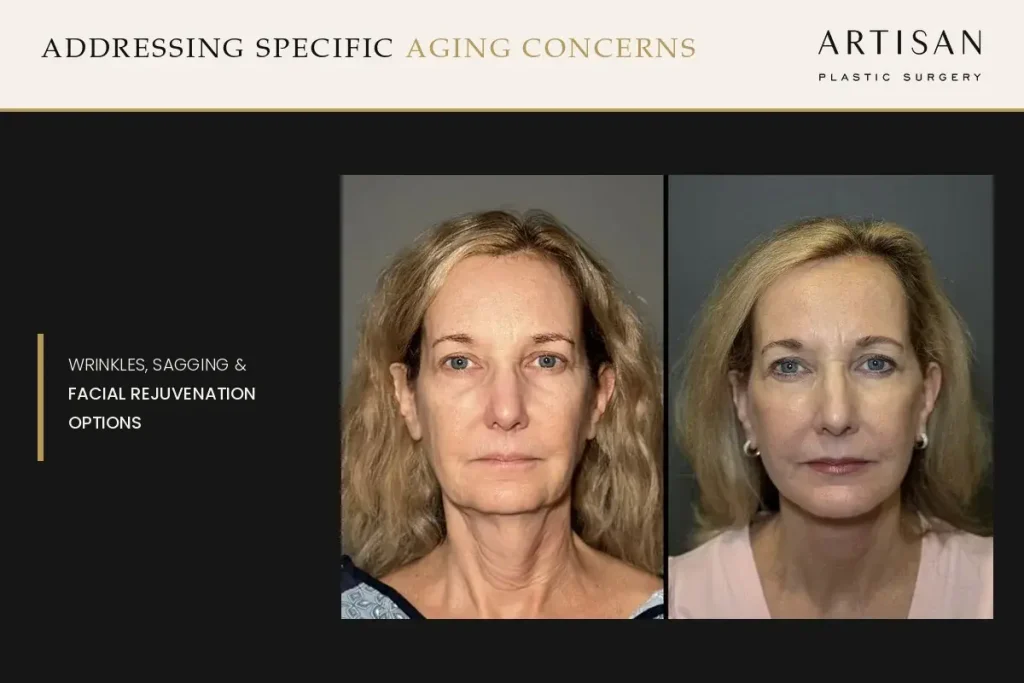
Wrinkles, sagging skin, and lost facial volume are three separate problems. They look related in the mirror, but they happen in different layers of the face, and no single treatment reaches all three. That is why the honest answer to “what should I do about my face?” starts with a question back.
The market reflects that split. Worldwide, botulinum toxin was the most-performed nonsurgical aesthetic treatment in 2024 at 7,887,955 procedures, with hyaluronic acid fillers second at 6,338,184, according to ISAPS. Those two treatments sit side by side on almost every menu, and they do completely different jobs.
At Artisan Plastic Surgery in Atlanta, our team has spent decades matching treatments to anatomy rather than to trends. This guide covers what is actually driving each change you see, which treatments address which concern, and how to weigh the nonsurgical and surgical paths against each other.
Key takeaways
- Wrinkles, volume loss, skin texture, and sagging come from different layers of the face. Naming which one bothers you most is the fastest way to narrow your options.
- Neuromodulators soften lines made by muscle movement, fillers and fat transfer replace lost volume, and resurfacing works on the skin’s surface. None of them lift tissue that has genuinely descended.
- Surgery is the answer for moderate-to-severe laxity, jowls, and neck banding. It does nothing for fine surface lines, sun spots, or uneven tone, which still need skin care afterward.
- Downtime is often the deciding factor. Injections generally cost you no time away, resurfacing asks for days to a couple of weeks, and a facelift is measured in weeks.
- Combining treatments usually outperforms picking one, because most faces are aging in more than one layer at once.
What is actually causing your wrinkles, sagging, and lost facial definition?
Four different things age a face, and they move at different speeds. Skin quality changes on the surface. Volume drains from the cheeks and temples, and the deeper support layer gradually loosens and drifts downward.
Start with the wrinkles themselves, because they split into two kinds. Dynamic lines appear when you move, across the forehead, between the brows, and at the outer corners of the eyes. Static lines stay visible when your face is completely at rest, which happens once repeated movement combines with thinner, less elastic skin.
Collagen is the reason that shift happens. Your skin begins losing it in your mid-20s, and the pace picks up around menopause. Less collagen means less firmness and less recoil, so creases that used to spring back start to stay.
| What you notice | What is driving it | Which category helps |
|---|---|---|
| Lines only when you frown or smile | Repeated muscle movement | Neuromodulators |
| Lines visible at rest | Thinner, less elastic skin | Resurfacing or fillers |
| Flat cheeks, hollow temples | Volume loss | Fillers or fat transfer |
| Rough texture, sun spots, redness | Sun damage and skin quality | Resurfacing |
| Jowls, softened jawline, neck bands | Descent of deeper tissue | Surgical lifting |
The last row is the one people most often misjudge. Gravity works on skin, on the retaining ligaments, and on the deeper support layer surgeons call the SMAS, so a jowl is not a skin problem sitting on the surface. It is tissue that has moved.
One more thing worth knowing: the face does not age in isolated zones. The brow, eyelids, cheeks, folds, jawline, and neck tend to shift together, which is why treating one area alone sometimes makes the untreated neighbor more obvious.
Which nonsurgical treatments work best for wrinkles and early facial aging?
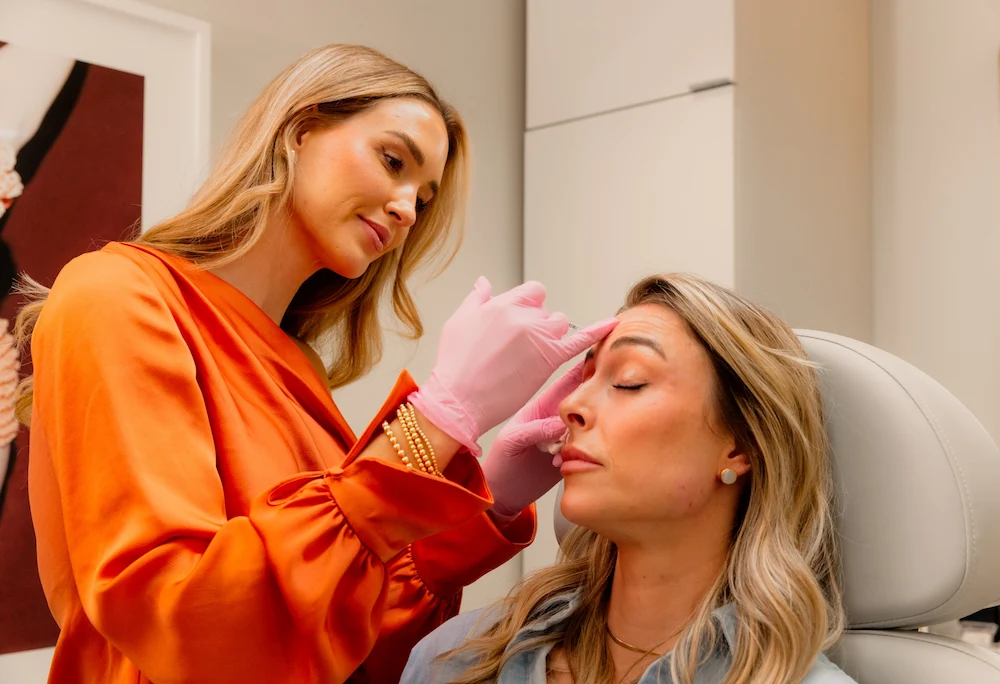
Nonsurgical treatments are strongest on the concerns that live in the skin and in the fat compartments, which means lines, texture, tone, and lost volume. They are weakest on tissue that has already descended. Getting that boundary right saves a lot of money and disappointment.
This section covers the nonsurgical options, plus one minimally invasive treatment that sits right on the border and is often miscategorised.
Artisan Beaute, the medical aesthetics side of our practice, handles injectables, lasers, and skin treatments at our Buckhead and Westside locations. Every plan is curated around your skin and your goals rather than pulled off a standard menu.
Neuromodulators for expression lines
Wrinkle-relaxing injections temporarily quiet the muscles that fold your skin, which softens forehead lines, the crease between the brows, and crow’s feet. A Cochrane review found botulinum toxin type A reduced the lines between the eyebrows more than placebo, with moderate-to-high certainty in the evidence.
Our injectors work with BOTOX®, Dysport®, Daxxify, and Xeomin, and appointments run about 30 minutes. Results build gradually over the first couple of weeks rather than appearing the same day. The effect is temporary and needs repeating, which is a genuine trade-off, not a hidden catch.
Fillers and fat transfer for lost volume
When the problem is a flattened cheek, a hollow temple, or a fold that stays put at rest, replacing volume works better than relaxing a muscle. Hyaluronic acid fillers use a gel form of a substance your body already makes to restore shape in a single visit.
Fat transfer is the other route, and it deserves a place in this conversation. Your surgeon takes fat from elsewhere on your body and places it where the face has hollowed. Not every cell survives the move, so results settle over the following months and can look slightly full at first.
Biostimulators such as Sculptra® and Radiesse® sit between the two. Rather than filling directly, they prompt your own collagen and elastin to rebuild, so the change arrives gradually over a couple of months.
Resurfacing for texture and tone
Sun spots, roughness, redness, and fine crepey lines are surface problems, and no amount of filler fixes them. Resurfacing works by removing or heating sun-worn layers so healthier skin replaces them.
Our aestheticians offer Halo™ laser and CO2 laser resurfacing, along with Morpheus8™ radiofrequency microneedling, SkinPen, and Sylfirm. Protocols vary widely across peels, lasers, and microneedling, so the device matters less than the person choosing the depth and setting for your skin.
Radiofrequency, the minimally invasive middle ground
FaceTite® is worth calling out because it is often filed in the wrong category. It works beneath the skin through a tiny opening, which makes it minimally invasive surgical rather than nonsurgical. It targets jowls, the jawline, the area under the chin, and nasolabial folds.
It suits mild to moderate looseness, not significant sagging. If you are curious whether your skin quality falls inside that window, book a visit at Beaute Buckhead or Beaute Westside and let our team assess it in person.
When does surgery correct sagging skin better than anything nonsurgical can?
Surgery earns its place when tissue has descended rather than thinned. Nonsurgical options like fillers and resurfacing work well for early, milder concerns, and minimally invasive radiofrequency extends that reach a little further. Surgical procedures like a facelift or neck lift address the more advanced structural changes none of those can correct.
At Artisan, our board-certified plastic surgeons take an artistic and highly personalized approach, because the goal of facial surgery is a result that is never overdone and always recognizably you.
Facelift and neck lift
A facelift is fundamentally a repositioning operation. It removes excess skin and lifts the deeper tissues of the face and neck, correcting moderate-to-severe laxity, sagging cheeks, jowls, and a blurred jawline. At our Northside location the procedure runs three to four hours.
A neck lift concentrates on loose neck skin, fullness under the chin, muscle banding, and jawline contour, and takes two to three hours. The two are frequently done in one session, since the lower face and neck rarely age separately.
Good candidates have noticeable excess skin on the face and neck, no medical conditions that could slow healing, a stable weight, and either do not smoke or are willing to stop beforehand.
Susan, a patient at our Northside office who had a facelift together with upper and lower eyelid surgery, shared their experience:
“I had a facelift with upper and lower eye surgery with Dr. Diane Alexander at Artisan, and I am so pleased with my experience so far. Dr. Alexander and her entire medical staff have been wonderful – attentive, caring, and professional every step of the way. The level of care and communication has been excellent.”
Eyelid surgery
Hooded upper lids and lower-lid bags are their own problem, sitting too high on the face for a facelift to reach. Eyelid surgery addresses excess skin and prominent fat pockets on the upper and lower lids in one to two hours.
It is also the single most-performed surgical aesthetic procedure in the world, with 2,115,360 eyelid procedures recorded in 2024. Patients often describe the result as looking rested rather than looking different, which is usually the point.
Limits of surgical lifting
Lifting deeper tissue does nothing for the skin’s surface. Fine wrinkles, crow’s feet, sun damage, and uneven pigmentation all persist after a facelift unless they are treated separately with resurfacing, medical skincare, and consistent sun protection.
That is not a flaw in the operation. It is a reminder that the face ages in layers, and a plan that treats only one layer leaves the others exactly where they were.
How do you compare surgical and nonsurgical facial rejuvenation side by side?
The comparison is less about which option is better and more about which problem you are solving. Both categories improve how patients rate their own appearance, but the size of the change differs, and so does what you give up to get it.
| What you are weighing | Nonsurgical and minimally invasive | Surgical |
|---|---|---|
| Best for | Lines, texture, volume, early laxity | Descended tissue, jowls, neck banding |
| Downtime | None to about two weeks | Light activity in 7 to 14 days |
| Anesthesia | Topical or local | General or sedation |
| Upkeep | Repeat sessions to sustain | One procedure, then skin care |
| What it cannot do | Lift tissue that has dropped | Improve surface tone or pigment |
Downtime is usually the honest deciding factor. Injections rarely cost you a day, resurfacing asks for a stretch of redness and peeling, and surgery is a real recovery with a real calendar attached.
Here is the part most comparison charts miss. Combining categories tends to beat choosing one, because most faces are aging in more than one layer at the same time. A 2026 ASPS-reported study of combined surgical and minimally invasive treatment found average improvements equivalent to about four years in skin age and seven years in wrinkles.
As Atlanta’s first woman-led plastic surgery practice, Artisan Plastic Surgery offers surgical and nonsurgical care under one roof. That means you can be evaluated for both in a single conversation, instead of being sent between providers who each see half the picture. Think of it as curating a composition rather than picking from a menu.
Researching this carefully before committing to anything is exactly the right instinct.
What should you expect during facial rejuvenation treatment and recovery?

Every plan starts with an in-person consultation, and it is worth reframing what that visit actually is. This is not only a chance for your surgeon to evaluate you. It is equally your chance to evaluate them, their space, and how they think.
Expect a review of your medical history, a hands-on examination of your skin, and an open conversation about your goals and the alternatives. Bring every prior treatment with you, including past fillers and energy-based devices. They change the anatomy, and that matters to surgical planning.
Eva, a patient at our Northside office who has kept up a nonsurgical plan over several years, described how the visits feel:
“She has such a natural eye and takes the time to really listen to what I want. The treatments are actually comfortable, and I leave looking refreshed and confident, not overdone. My goal is to keep myself youthful without looking obviously injected.”
Recovery then depends entirely on which layer you treated.
| Treatment type | Typical downtime | What to expect |
|---|---|---|
| Wrinkle-relaxing injections | None | Straight back to your day, results build over about two weeks |
| Fillers and microneedling | About 1 to 3 days | Swelling, small bruises, mild tenderness |
| Laser resurfacing | About 1 to 3 weeks | Redness and peeling, then steady improvement |
| Facelift or neck lift | Light activity in 7 to 14 days | Dressing at first, swelling easing over 2 to 3 weeks |
After facial surgery, most patients are comfortable in public again within about 10 to 14 days, though the refined final contour keeps settling for months. Exercise typically waits until weeks three to four, and only when healing is on track.
Consultations at Artisan happen in person, at Northside or Johns Creek for surgery and at Beaute Buckhead or Beaute Westside for injectables, lasers, and skin treatments. Cost depends on the technique, the facility, and whether treatments are combined. Flexible financing through Alphaeon Credit, Cherry, and CareCredit can spread it out.
When you are ready to map your own plan, schedule a consultation or call (404) 851-1998 and we will take it from there.
What risks should you weigh before choosing a facial rejuvenation treatment?
Most people move through facial rejuvenation without any real trouble, and the common after-effects are healing, not complications. Injections leave swelling, tenderness, small bruises, and occasional asymmetry that settles. Resurfacing brings redness and peeling. Surgery brings swelling and bruising that ease over the first few weeks.
The uncommon concerns are worth understanding once, clearly, and then setting down. A 2024 systematic review of 38 studies and 3,967 filler patients found reported reactions clustered at the injection sites, most often around the chin, lips, and cheeks. The rare exception is product entering a blood vessel, which one consensus review put at roughly one in 100,000 injections for vision-related events.
Surgical nerve concerns follow a similar pattern. A meta-analysis of 15,404 facelift patients found lasting motor or sensory changes in roughly five in 10,000 cases, with temporary changes far more common and self-resolving.
What actually lowers your risk is less dramatic than the risk itself:
- An injector or surgeon with formal training in facial anatomy, and a conservative, staged approach rather than large single sessions
- Full disclosure of medications, supplements, and every prior facial treatment
- Blood pressure that is well controlled going into surgery
- Stopping smoking well before an operation, since ASPS reports active smokers face a 12-fold increase in wound-healing problems
- An accredited facility and a surgeon whose board certification you have personally verified
Ask about procedure-specific experience, what recovery will realistically require of you, and how the practice handles a result that needs revisiting. A surgeon who answers those questions comfortably is telling you something useful.
None of this should scare you off. It should tell you what to look for, which is a very different feeling.
Conclusion
The question you started with was probably not whether to have a procedure. It was closer to which of these changes bothers you most, and what actually fixes it. A facelift answers that well, but only for the layer it was built to reach.
Seeing that difference is easier with something concrete in front of you. Browsing real patient photos that start from a face like yours tends to clarify more than any list of options, and a consultation fills in what a photograph cannot.
Every face is its own composition, and no two need the same plan. Artisan exists in Atlanta to help you bring yours back into balance while keeping everything that makes it yours, so call (404) 851-1998 whenever the timing feels right.
Frequently asked questions
What is the best face procedure for wrinkles on the forehead and around the eyes?
For lines that appear when you move, wrinkle-relaxing injections are the most directly targeted option, since they quiet the muscles doing the folding. If those lines are visible at rest or come with rough texture and sun spots, laser resurfacing is the better tool. Many patients end up using both, at different depths of the same problem.
Can wrinkle-relaxing injections treat lines around the eyes and forehead?
Yes. Botulinum toxin products are indicated for moderate-to-severe forehead lines, frown lines between the brows, and crow’s feet at the outer corners of the eyes. They work by temporarily reducing activity in the muscles responsible, so the skin above them creases less.
Are dermal fillers better for wrinkles or for lost facial volume?
Fillers are built for volume. They restore flattened cheeks, hollow temples, and static creases that stay visible at rest, rather than the dynamic lines created by expression. For volume that has drained more broadly, fat transfer is worth discussing alongside filler at your consultation.
Can laser resurfacing tighten sagging skin?
Not meaningfully. Resurfacing improves fine lines, texture, and pigmentation by removing or heating sun-worn layers and prompting new collagen. Genuine sagging comes from tissue that has descended, and that requires lifting.
What treatment works best for jowls and a loose jawline?
When jowling comes from real lower-face laxity, a lower facelift is the most effective answer, often paired with a neck lift when the neck has softened too. For earlier, milder looseness, radiofrequency treatments that work beneath the skin can be enough. The dividing line is how much tissue has actually moved.
Can a facelift remove fine lines and sun damage?
No, and this surprises people. A facelift lifts and repositions deeper tissue to improve the lower face, jawline, and neck, but it leaves the skin’s surface much as it found it. Fine wrinkles, sun spots, and uneven tone still need resurfacing, medical skincare, and sun protection.
What is the difference between a facelift and a neck lift?
A facelift rejuvenates the lower face, cheeks, and jawline. A neck lift focuses on loose neck skin, fullness beneath the chin, and muscle banding. Because those areas usually age together, the two operations are commonly performed in the same session.
Can you combine a facelift with fillers, eyelid surgery, or a brow lift?
Yes, when your anatomy and your health make it appropriate. Combining a facelift with eyelid surgery is common, and fillers or fat grafting can address residual volume loss that lifting alone does not restore. Our surgeons build a customized sequence rather than applying a standard package.
What are the risks of facial rejuvenation injections and surgery?
Injection risks include bruising, swelling, lumps, asymmetry, and rarely a vascular event. Surgical risks include bleeding beneath the skin, infection, scarring, and temporary changes in sensation, with lasting nerve changes being genuinely uncommon. Your surgeon should walk you through each one and how they are prevented.
How do you know whether your concerns need resurfacing, injections, or surgery?
Work backward from the cause. Movement-related lines point to neuromodulators, lost volume points to fillers or fat transfer, surface texture and pigment point to resurfacing, and descended tissue points to surgery. Most people fall into more than one bucket, which is why a hands-on assessment beats guessing from a photo.
How can you maintain facial rejuvenation results after treatment?
Daily broad-spectrum sun protection does more than anything else, and it matters especially in the months after resurfacing. A consistent medical skincare routine, stable weight, and not smoking all help preserve what you have gained. Our team builds a maintenance plan into your treatment plan rather than leaving you to figure it out afterward.
*Disclaimer: This content is for educational purposes only and does not constitute medical advice. A consultation with a qualified board-certified surgeon is required to determine the best treatment plan for your individual needs and any questions you may have about a medical condition or procedure.

